Call, Text or WhatsApp Us

Table of Contents
- Understanding Supercharger Pulley Size and Boost
- How to Measure Supercharger Pulley Diameter
- Calculating Pulley Ratio with a Supercharger Pulley Ratio Calculator
- Selecting Belt Length with a Supercharger Belt Length Calculator
- Target Boost and Pulley Selection for Your Engine
- Common Mistakes to Avoid When Choosing Pulley Size
- Validation and Installation After Pulley Selection
- Frequently Asked Questions
Last Updated: October 18, 2026
Understanding Supercharger Pulley Size and Boost
Choosing the right supercharger pulley size determines how much boost your engine receives and how hard your supercharger works. The pulley diameter controls blower speed relative to engine RPM: a smaller pulley spins faster, a larger one slower, and that single change shifts your entire performance curve.
The math is straightforward, but pick wrong and you either leave power on the table or push your engine beyond safe limits.
How Pulley Diameter Affects Blower Speed
Your engine’s crankshaft turns at a fixed RPM. The crank pulley connects via a belt to the supercharger pulley.
The relationship is direct and proportional: reduce the supercharger pulley diameter and blower speed increases, compressing more air into your cylinders and raising boost pressure.
For example, switching from a 3.5-inch supercharger pulley to a 3.2-inch pulley increases blower RPM by roughly 9%. That boost increase sounds small until you see it on the dyno.
Pulley Ratio and Engine-to-Supercharger Speed
Pulley ratio is the relationship between your crank pulley diameter and your supercharger pulley diameter:
Pulley Ratio = Crank Pulley Diameter ÷ Supercharger Pulley Diameter
A 4-inch crank pulley and 2-inch supercharger pulley give a 2.0:1 ratio, the blower spins twice as fast as the engine.
A higher ratio means more blower speed relative to engine speed. Most street applications run between 1.5:1 and 2.2:1, depending on supercharger type and power target.
The ratio does NOT directly predict boost, though. Boost depends on blower speed, supercharger displacement, engine displacement, and how much air your engine can actually use at that RPM.
How to Measure Supercharger Pulley Diameter
Measuring your current pulley diameter accurately is the first step in any pulley change.
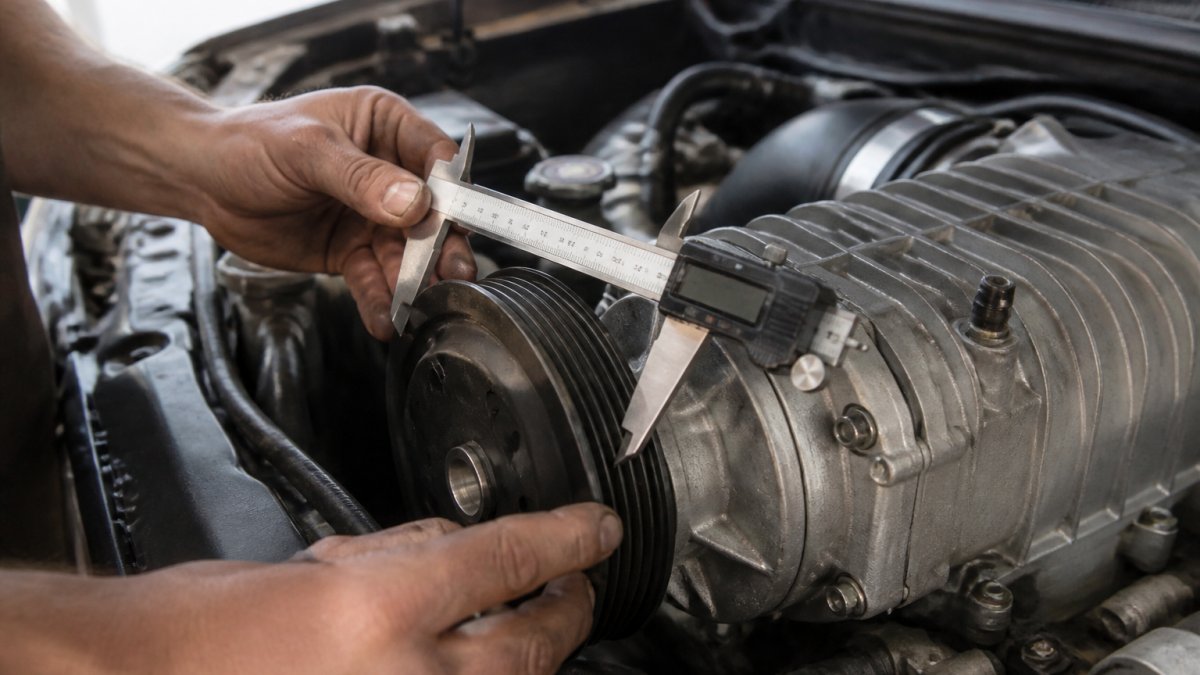
Measuring Effective Diameter vs. Outer Diameter
Two measurements matter: outer diameter and effective diameter.
Outer diameter is the total width from edge to edge. Most people measure this first, but the belt rides in the grooves, not on the outer edge.
Effective diameter is where the belt actually makes contact with the pulley. For ribbed pulleys (the standard on supercharger systems), effective diameter is smaller than outer diameter. The difference is typically 0.2 to 0.4 inches depending on the pulley design.
Blower speed calculations use effective diameter, not outer diameter, a common DIY mistake that leads to surprising boost levels.
Tools and Technique
You need two tools:
- A caliper (digital or dial type, at least 6 inches) or a ruler with fine gradations
- A way to access the pulley safely (jack, lift, or engine bay space)
Place your caliper across the pulley grooves where the belt rides and take multiple measurements around the pulley, since wear can create slight variations. Record the average.
Measure the crank pulley the same way. If you cannot access it easily, check your service manual or contact your vehicle manufacturer for your engine specs.
Calculating Pulley Ratio with a Supercharger Pulley Ratio Calculator
Once you have your measurements, the math is simple, but understanding what the ratio means for your engine separates a good pulley choice from a costly mistake.
The Ratio Formula and What It Means
Take your crank pulley diameter and divide it by your supercharger pulley diameter.
Example:
- Crank pulley: 4.0 inches
- Supercharger pulley: 2.5 inches
- Ratio: 4.0 ÷ 2.5 = 1.6:1
Your supercharger spins 1.6 times faster than your engine at any given RPM, at 5,000 engine RPM, the blower turns 8,000 RPM.
The ratio tells you relative speed only, not boost pressure. A 1.6:1 ratio in a small four-cylinder produces different boost than the same ratio in a large V8.
Online supercharger pulley ratio calculators are useful for ballpark estimates, but they ignore supercharger type, engine displacement, and air density.
Estimating Boost Changes from Pulley Changes
Blower speed increases roughly proportional to pulley diameter changes: a 10% smaller pulley raises blower speed about 10%. Boost pressure does NOT rise 10%, a 10% blower speed increase typically produces a 15-20% boost increase, depending on your engine.
The safest approach: make small changes. A 0.2-inch pulley reduction is a reasonable first step. Measure your boost before and after. Adjust from there based on actual data, not calculations.
Selecting Belt Length with a Supercharger Belt Length Calculator
Your belt connects the crank pulley to the supercharger pulley. Change one pulley, and you may need a different belt length.
Belt Sizing and Compatibility
Belt length is determined by the distance between pulley centers and the diameter of both pulleys. A supercharger belt length calculator takes your crank pulley diameter, supercharger pulley diameter, and center distance, then outputs the required belt length in seconds.
But here’s the catch: center distance is fixed on your engine. You cannot move the supercharger or crank pulley to adjust spacing. If your new pulley combination produces a belt length that does not match standard sizes, you have limited options:
- Use a slightly longer or shorter belt with adjusted tension (not ideal)
- Choose a different pulley size that produces a standard belt length
- Use a custom belt (expensive and slow)
Before you commit to a pulley size, calculate the required belt length. Check whether that length is available as a standard part. This step prevents buying a pulley only to discover no belt exists for your setup.
Belt Tension and Slip Prevention
Proper belt tension prevents slippage and premature wear. Most tensioners work automatically, but after a pulley change verify tension, a loose belt can slip 5-10%, destroying your calculated boost estimate.
Check tension by pressing on the belt midway between pulleys. It should deflect roughly 0.5 inches under moderate hand pressure. If it moves more, tighten the tensioner. If it barely moves, loosen it slightly.
Target Boost and Pulley Selection for Your Engine
Choosing a pulley size without a boost target is like driving without a destination.
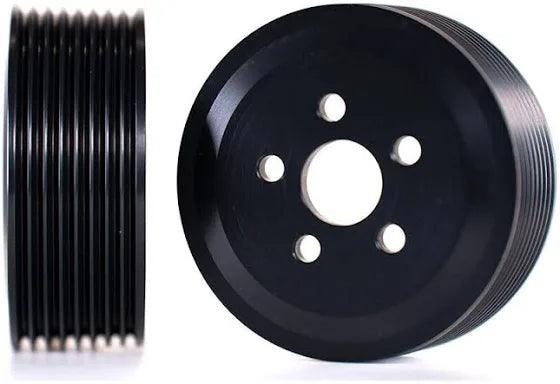
61 mm Pulley for VT Mazda Supercharger Kits →
Determining Your Target Boost Level
Start with your engine’s limits. Stock engines tolerate 6-8 PSI of boost safely. Built engines with higher compression and reinforced internals can handle 12-15 PSI or more.
Cooling also affects your limit. An intercooler reduces intake air temperature, allowing more boost safely. Without one, boost compresses air and raises temperature, increasing knock risk.
Write down your target boost. This becomes your pulley selection anchor.
Most street applications target 8-10 PSI of boost. This range delivers noticeable power gains (30-50 hp on many engines) without extreme tuning demands or reliability risk.
Supercharger Speed Limits and Manufacturer Specifications
Every supercharger has a maximum rated RPM. Exceeding them risks bearing failure, seal leakage, and internal damage.
Check your supercharger’s spec sheet. If it’s rated to 12,000 RPM maximum, you cannot spin it faster than that, ever.
Calculate your maximum blower RPM:
Maximum Blower RPM = (Engine Max RPM × Pulley Ratio) + 500 RPM safety margin
If your supercharger is rated to 12,000 RPM, this setup is at the edge. A smaller pulley pushes you over. A slightly larger pulley keeps you safely under.
Temperature, Fuel, and Engine Safety Consequences
Boost raises intake air temperature, and hot air is less dense, reducing the oxygen entering your cylinders and increasing knock risk.
Fuel octane rating determines knock resistance. Higher octane tolerates more boost without detonating. But octane is not free. The cost difference between 87 and 100-octane fuel adds up fast.
Choose a pulley size that matches your fuel choice, cooling system, and engine condition. A conservative pulley choice on a stock engine with 87-octane fuel is wiser than an aggressive one.
Common Mistakes to Avoid When Choosing Pulley Size
Most pulley selection errors stem from a few common misunderstandings.
Why Pulley Ratio Does Not Predict Boost Exactly
A 1.8:1 pulley ratio does NOT guarantee a specific boost level, only a specific blower speed relative to engine speed. What happens to that air once it enters your engine depends on:
- Your engine’s displacement
- Your cylinder head’s flow characteristics
- Your intake manifold design
- Your engine’s fuel and ignition tuning
- Ambient temperature and air density
Two builders with identical 1.8:1 ratios can see 8 PSI and 12 PSI respectively.
Use ratio calculators for estimates only. Rely on actual boost measurements after installation to validate your choice.
Overlooking Belt Drive Compatibility
A pulley size that produces a non-standard belt length is a trap: you commit to a pulley, then discover no belt exists or the only option is a custom belt costing three times the pulley price. Calculate belt length before you buy and verify the required length exists as a standard part.
Ignoring Positive-Displacement vs. Centrifugal Differences
Positive-displacement superchargers (like Roots-type blowers) deliver boost linearly with RPM. Double the blower RPM, and you roughly double the boost.
Centrifugal superchargers behave differently. Boost increases with the square of blower speed. Double the blower RPM, and boost increases dramatically more than linear.
This means a pulley change has a much larger effect on a centrifugal supercharger than on a positive-displacement unit.
Know which type you have. Adjust pulley size conservatively on centrifugal units.
Validation and Installation After Pulley Selection
Installing the pulley correctly and verifying the results is step two.
Pre-Installation Checks
Before you remove your old pulley:
- Measure your current boost with a boost gauge to establish a baseline
- Take photos of belt routing and tensioner position
- Verify your new pulley matches your supercharger’s bolt pattern
- Confirm your new belt length is in stock before you start disassembly
- Have your service manual or VT Superchargers installation guide ready
A rushed installation leads to belt misalignment, improper tension, or damaged components. Take your time.
Post-Installation Verification
After installation, your first drive should be a short test. Do not hit boost hard immediately.
Check for:
- Belt noise or squealing (indicates misalignment or low tension)
- Unusual supercharger noise (bearing damage or internal contact)
- Boost gauge reading at cruise and full throttle (verify your target)
- Engine knock or detonation (fuel or timing issue)
If everything looks good, take a longer drive and monitor boost under load. Your target should be within 1-2 PSI of your calculation.
Many builders install a boost gauge and data logger to track boost, air temperature, and knock activity over the first 100 miles.
VT Superchargers provides installation guides and support for all our kits.
Choosing the right supercharger pulley size requires understanding pulley ratio, blower speed, and boost pressure, and how they connect to your specific engine and goals. VT Superchargers offers precision-engineered pulley options like our 61 mm Pulley for VT Mazda Supercharger Kits and 63 mm Pulley for VT Mazda Supercharger Kits, both at $200.00, designed for precise fitment and reliable performance. Register with us today to explore our full range of bolt-on supercharger kits, financing options, and our 24-month warranty protection.
Frequently Asked Questions
How does pulley size affect supercharger boost?
A smaller supercharger pulley diameter increases blower speed, which compresses more air into the engine and raises boost pressure. A larger pulley reduces blower speed and boost. The relationship is proportional: if you reduce pulley diameter by 10%, blower speed and boost increase by approximately 10%. However, actual boost gain depends on engine load, fuel quality, and supercharger type. Positive-displacement superchargers respond more predictably to pulley changes than centrifugal designs.
How do you calculate supercharger pulley ratio?
Divide the crank pulley diameter by the supercharger pulley diameter. For example, an 8-inch crank pulley divided by a 3-inch blower pulley equals a 2.67:1 ratio. This ratio tells you how many times faster the supercharger spins than the engine. A higher ratio means more blower speed and boost. Use this calculation with a supercharger pulley ratio calculator to estimate boost changes before installation.
What is the correct belt length for a supercharger setup?
Belt length depends on the distance between crank and supercharger pulley centers and the pulley diameters. Most supercharger kits specify the correct belt size. Use a supercharger belt length calculator by entering your crank pulley diameter, blower pulley diameter, and center-to-center distance. Order the belt size recommended by your kit manufacturer. Incorrect belt length causes poor tension, belt slip, or premature wear.
How small can a supercharger pulley be?
Minimum pulley size depends on your supercharger’s maximum RPM specification. Most positive-displacement superchargers max out at 14,000-16,000 RPM. Pushing beyond this causes internal wear and reduced efficiency. Centrifugal superchargers typically handle higher speeds. Check your supercharger manufacturer’s specifications before selecting a pulley. Going too small risks overheating, fuel detonation, and engine damage.