Jeep Wrangler Supercharger Dyno Results: What the Numbers Really Show
Last Updated: November 5, 2026
Quick Summary
Jeep Wrangler supercharger dyno results vary because builds differ in measurement basis, boost, tires, and test conditions, not because the numbers are wrong. A stock 3.6L Pentastar makes roughly 200 to 210 wheel horsepower, and supercharged builds report figures like 345 whp at 10 psi or 376 whp on 37-inch tires.
- One Wayalife owner went from about 203 hp and 195 lb-ft stock to roughly 275 hp and 250 lb-ft supercharged.
- Wheel horsepower is measured at the tires and is always lower than crank horsepower.
- Compare kits across the 2,500 to 4,500 rpm mid-range, not just the peak number.
- A dyno sheet without correction standard, gear, or fuel listed cannot be reliably compared.
- The VT Superchargers 3.6L V6 kit for 2012+ Wranglers lists at $5,500.00.
Table of Contents
- Jeep Wrangler Supercharger Dyno Results: What the Numbers Actually Prove
- Jeep Wrangler 3.6 Supercharger Dyno Results: The Pentastar Baseline
- Jeep Wrangler Supercharger Horsepower Gains: Wheel vs. Crank Output
- Jeep Wrangler Supercharger Kit Comparison: What Changes the Dyno Curve
- Why Two Wrangler Dyno Pulls Never Match
- Reliability, Heat Soak, and Long-Term Ownership
- Cost and Value per Horsepower
- Choosing Your Wrangler Supercharger Kit at VT Superchargers
- Frequently Asked Questions
Jeep Wrangler Supercharger Dyno Results: What the Numbers Actually Prove
If you have spent any time reading Jeep Wrangler supercharger dyno results, you have probably noticed something frustrating: the numbers rarely agree. One build shows 345 wheel horsepower at 10 psi, another reports 376 with 37-inch tires, and a third claims a modest 70-horse gain. All three are real, and none of them are wrong. This guide from VT Superchargers breaks down what each figure actually represents, why test conditions matter more than the peak number, and how to read a dyno sheet without being misled.
The core problem is measurement basis. Some shops publish wheel output, others quote crank estimates, and many posts never say which. According to HG Performance's dyno testing notes, care is needed when testing an automatic vehicle, since transmission behavior can skew the pull. That single detail explains more variance between published Wrangler supercharger dyno results than most buyers realize.
Below, we explain what the numbers actually prove, what they hide, and how to compare builds fairly.
Jeep Wrangler 3.6 Supercharger Dyno Results: The Pentastar Baseline
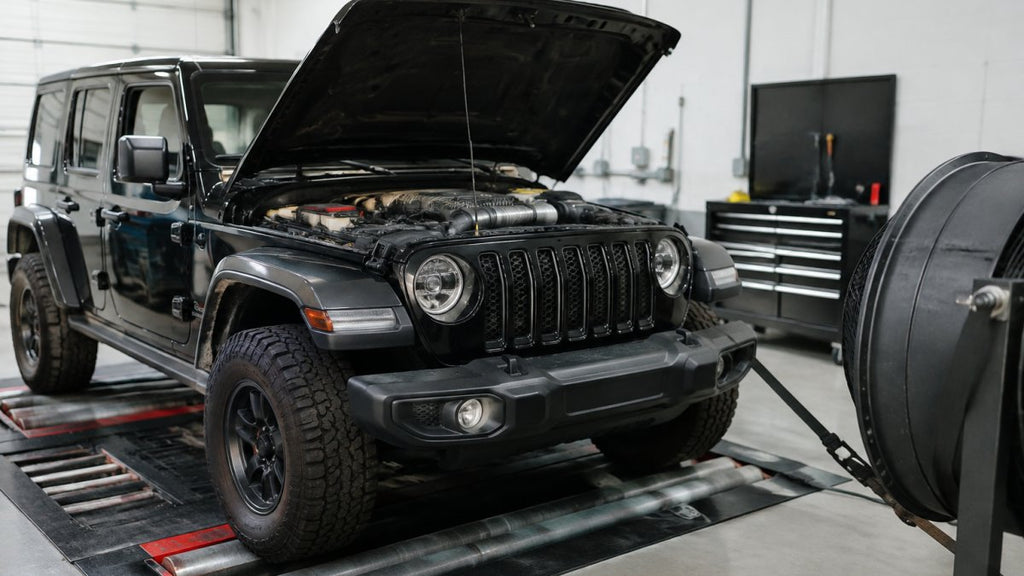
A stock 3.6L Pentastar V6 typically lays down roughly 200 to 210 horsepower at the wheels on a chassis dyno, well below the engine's rated crank figure. That gap is normal: driveline loss eats a percentage before the rollers ever see it.
One owner on the Wayalife forum reported approximately 203 hp and 195 lb-ft stock on a dyno, then roughly 275 hp and 250 lb-ft after installing a supercharger and its supplied tune. That is a clean before-and-after on the same vehicle, which makes it far more useful than cross-build comparisons.
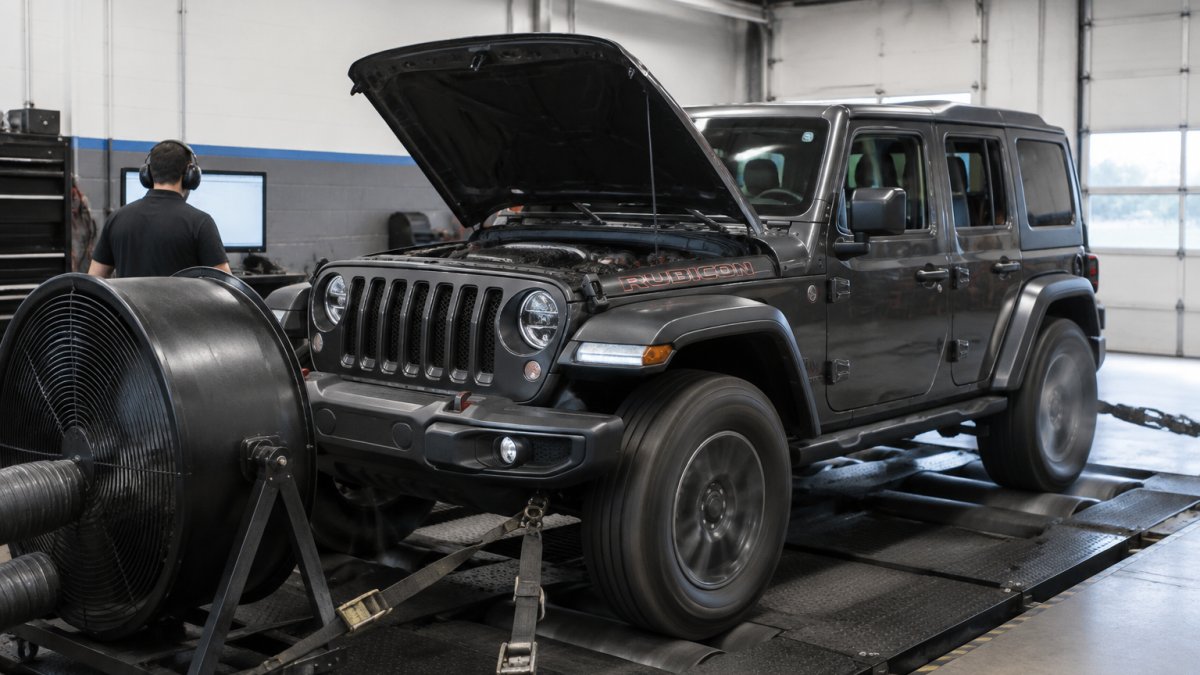
Stock 3.6L Pentastar Output on the Dyno
Baseline runs matter because they establish the starting point. Without one, a post-install figure tells you almost nothing. For broader context on how the Pentastar responds to bolt-on upgrades, see our guide on how to increase horsepower in a Jeep 3.6L Pentastar.
Post-Install Numbers and Boost Pressure
Boost pressure is the second variable. Bryant Brothers Racing reported 345 wheel horsepower and 330 lb-ft at 10 psi on a Dynojet 224xLC. RIPP Mods reported 376 wheel horsepower and 350 lb-ft on a supercharged Wrangler running 37-inch tires. These are separate builds, not a controlled comparison, and the tire size alone changes the effective load on the rollers.
Jeep Wrangler Supercharger Horsepower Gains: Wheel vs. Crank Output
Wheel horsepower is what the tires actually deliver to the ground. Crank horsepower is measured at the engine and is always higher because it excludes driveline loss. Mixing the two is the most common error in Jeep Wrangler supercharger horsepower gains discussions.
| Measurement Basis | What It Represents | Typical Use |
|---|---|---|
| Wheel horsepower | Power delivered at the tires | Most honest real-world figure |
| Crank horsepower | Power at the engine, excludes driveline loss | Manufacturer ratings |
| Wheel torque | Twist measured at the rollers | Towing and off-road pull |
| Boost pressure (psi) | Forced-air level from pulley and tune | Explains output differences |
Jeep Wrangler Supercharger Kit Comparison: What Changes the Dyno Curve
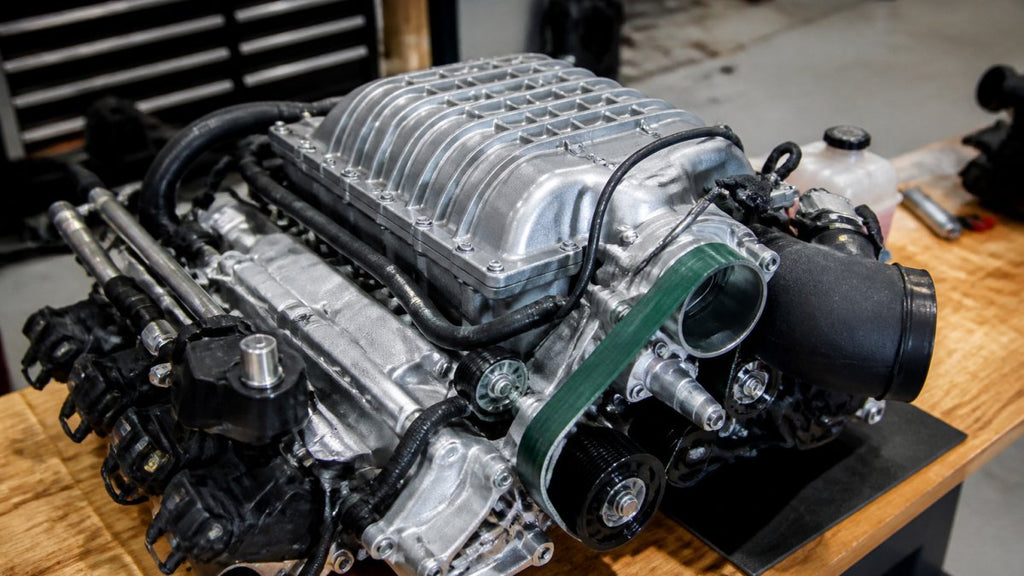
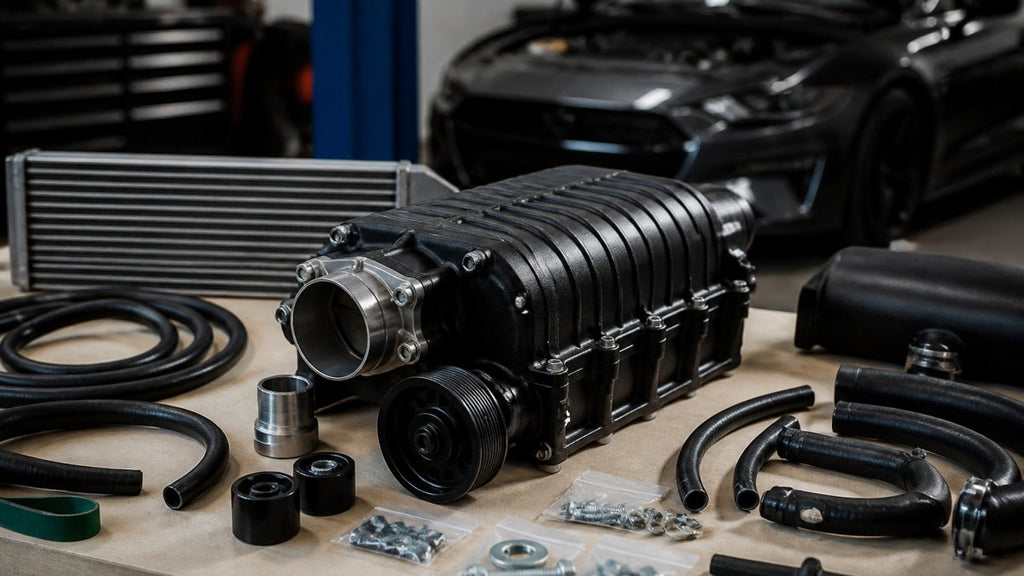
Kit design, not just boost level, shapes the curve. Two kits at the same psi can produce different peak numbers and very different mid-range behavior. A supercharger kit is a complete forced-induction system that includes the head unit, intake manifold, intercooling, drive belt, and hardware, and the quality of those components separates one dyno sheet from another.
The most useful way to compare kits is to look at three zones of the curve rather than one peak point: off-idle to about 2,500 rpm, the mid-range from roughly 2,500 to 4,500 rpm, and the top end above 4,500 rpm.
Intercooling, Pulley Size, and Tune
Intercooling controls intake air temperature, and heat is the enemy of consistent power. Our best intercooler guide for supercharged engines covers how charge cooling affects the dyno curve.
Pulley size sets the boost level directly. A smaller supercharger pulley spins the head unit faster and raises boost, which shifts the whole curve upward, but it also raises intake temperature and load on the belt and bearings. Our guide to choosing the right supercharger pulley size explains the trade-off between peak output and reliability.
The tune ties it together. Without a proper ECU calibration, the engine cannot safely use the extra air, fueling, timing, and torque management all have to be rescaled. ECU tuning is required on the Pentastar kit listings. When you compare two dyno sheets, check whether both runs used the kit's supplied calibration or a custom tune; a custom tune on a dyno day is not the same product as the boxed calibration a buyer receives.
A Practical Comparison Framework
When you line up published Wrangler supercharger dyno results, capture these fields for each build before comparing: engine (3.6L Pentastar, 3.0L diesel, 2.0L turbo, or 392), model year, dyno type (Dynojet vs. Mustang vs. other), correction standard (SAE J1349, STD, or uncorrected), gear used for the pull, fuel octane, tire size and weight, transmission, boost psi, pulley, intercooler type, and whether the figure is wheel or estimated crank. Builds that match on all of those are genuinely comparable; builds that differ on several are directional at best. A 345-whp pull on a Dynojet in cool air and a 376-whp pull on 37-inch tires are not a head-to-head, and treating them as one is the most common mistake in this space.
Watch out: a dyno sheet with no correction standard, gear, or fuel listed cannot be reliably compared to anything, ask for those details or discount the number.
Why Two Wrangler Dyno Pulls Never Match
No two dyno pulls are directly comparable unless the conditions match. Ambient temperature, humidity, elevation, cooling airflow, tire size, transmission type, and even strap tension all shift the result. HG Performance flags automatic-transmission behavior as a specific variable that complicates testing.
Jeep Wrangler 3.6L V6 Supercharger Kit (2012+) →
That is why a 345-whp build and a 376-whp build can both be accurate. Different vehicles, different setups, different days. The RIPP Mods product page and the Bryant Brothers Racing video describe separate builds, and treating them as a head-to-head would be a mistake.
If you want to understand how calibration changes the outcome, our article on tuning requirements after installing a supercharger walks through what a proper tune actually does.
Watch out: comparing a wheel figure from one shop against a crank figure from another will make a good kit look weak, or a weak one look strong. Always confirm the measurement basis first.
Reliability, Heat Soak, and Long-Term Ownership
Heat soak is the silent power thief. After repeated hard pulls, intake temperatures climb and the ECU pulls timing to protect the engine. That is why a single glory pull and a 30-minute trail session tell different stories. The mechanism is straightforward: the intercooler and heat exchanger absorb heat faster than airflow can reject it, intake air temperature rises, the calibration adds fuel and retards timing, and measured output falls, often well before any warning light appears.
The practical fixes are the same ones that protect the engine: adequate intercooler capacity and heat-exchanger airflow, a tune that manages timing and fueling conservatively at high intake temperatures, and supporting modifications that match the boost level rather than exceeding it.
Long-term reliability depends on three things: adequate intercooling, a correct tune, and supporting modifications that match the boost level. Beyond those, the ownership checklist is mundane but decisive, oil change intervals and oil quality, spark plug condition and gap, belt tension and wear, coolant condition in a water-to-air system, and periodic inspection of intake plumbing for leaks or loose clamps. A boost leak shows up on the dyno as a rich condition and lost top-end power, and it is one of the most common causes of a build that "suddenly feels down on power."
For overlanders and daily drivers, the questions that matter are different from the ones a drag-strip build asks. Does the setup hold power on a long climb at highway speed? Does it behave in stop-and-go traffic where airflow through the heat exchanger is poor? Does the calibration protect the engine when ambient temperatures are high? Those are the conditions that separate a reliable build from a peak-number build, and they are rarely captured in a single dyno pull.
VT Superchargers backs its kits with a 24-month warranty covering defects in materials and workmanship.
Watch out: a build that makes a strong single pull but loses power sharply on the second and third pull is telling you the cooling system, not the supercharger, is the limiting factor, address intercooling and airflow before adding boost.
Cost and Value per Horsepower
Value per horsepower is where the math gets honest. VT Superchargers' Jeep Wrangler 3.6L V6 Supercharger Kit (2012+) lists at $5,500.00 as a one-time purchase.
Choosing Your Wrangler Supercharger Kit at VT Superchargers
Match the kit to the vehicle and the goal. Our Jeep Wrangler 3.6L V6 Supercharger Kit (2012+) is the direct fit for 2012-and-up Wranglers, delivering up to 60% more horsepower and torque with a bolt-on, non-destructive install using OEM mounting points. The Jeep Pentastar 3.6L V6 Supercharger Kit adds 40% horsepower and 30% torque at 7 psi, with a mid-mounted water-to-air intercooler and front-mounted heat exchanger included. Gladiator and Grand Cherokee owners have dedicated kits as well.

Kits include a 24-month warranty, and global shipping is available. Confirm your engine code with our team before ordering.
Frequently Asked Questions
How much horsepower does a supercharger add to a Jeep Wrangler?
Reported gains vary by kit, engine, and tune. VT Superchargers lists up to 60% more horsepower and torque for its Wrangler kits. Treat every figure as setup-specific, and confirm whether it is measured at the wheels or the crank.
Are supercharger dyno results measured at the wheels or at the engine?
Wheel output reads lower than crank output because drivetrain losses take a cut. Ask which basis a number uses before comparing it to another build.
Do Jeep Wrangler supercharger dyno results vary by model year?
Yes. VT Superchargers lists separate kits for the 2012+ Wrangler 3.6L and the Pentastar ERB/EZH applications, so confirm your engine code before ordering.
What factors can change a Jeep Wrangler's supercharger dyno results?
Boost pressure, pulley size, intercooler capacity, fuel octane, ambient temperature, tire size, and the ECU calibration all move the curve. Run baseline and post-install pulls on the same dyno, in similar conditions, for a fair comparison.
The gap between a disappointing dyno sheet and a strong one usually comes down to measurement basis, cooling, and tune, not the kit itself. VT Superchargers builds bolt-on systems with OEM-style fitment, integrated intercooling, and a 24-month warranty so the number on the roller matches the power you feel on the trail. Get started with VT Superchargers and put a verified dyno sheet behind your build.

Related post
02
Nov
26
Oct
RECENT POSTS