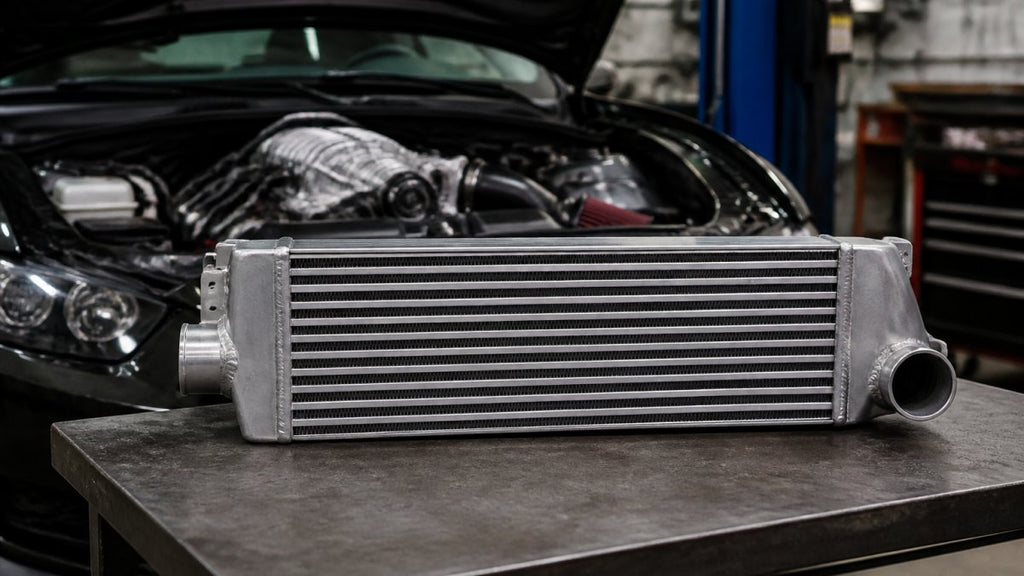
Best Intercooler for Supercharged Engines: 2026 Buyer's Guide
Table of Contents
- What an Intercooler Actually Does on a Supercharged Engine
- Air-to-Air vs. Air-to-Water Intercooler: Which Fits Your Build
- Intercooler Size for a Supercharged Engine: Sizing by Airflow and Boost
- Direct-Fit vs. Universal Intercooler: Fitment, Fabrication, and Cost
- Intercooler Heat Soak: Why Your Power Drops After the First Pull
- How to Evaluate Any Intercooler for Supercharged Engines
- Installation, Maintenance, and What to Check Before You Buy
- Conclusion: Matching the Intercooler to Your Supercharger Setup
- Frequently Asked Questions
Last Updated: October 6, 2026
What an Intercooler Actually Does on a Supercharged Engine
The best intercooler for supercharged engines is sized to your boost and airflow, matched to your driving conditions, and built to shed heat faster than your supercharger makes it.
A supercharger compresses intake air to force more oxygen into the cylinders, but that compression creates heat, and hot air is less dense. An intercooler, also called an aftercooler, is a heat exchanger between the supercharger and throttle body that pulls heat out of the charge air.
Intercooler vs Aftercooler: Same Job, Different Name
Intercooler and aftercooler describe the same component; the distinction is positional, not functional. An intercooler cools air between two compression stages, an aftercooler after the final stage. On a supercharged engine the cooler sits after the supercharger, so "aftercooler" is technically more precise, but the aftermarket uses the words interchangeably.
Air-to-Air vs. Air-to-Water Intercooler: Which Fits Your Build
Air-to-air and air-to-water intercoolers both remove heat from charge air, but through different mediums, which drives cost, complexity, and how consistent your power stays.
| System | How It Cools | Best For | Main Trade-off |
|---|---|---|---|
| Air-to-air | Ambient air passes through the core | Street cars, trucks, budget builds | Needs airflow and space |
| Air-to-water | Engine coolant or dedicated water circuit | Tight engine bays, consistent temps | More parts, more failure points |
Air-to-Air: Simpler Plumbing, More Room Needed
An air-to-air intercooler routes charge air through a finned core mounted where outside air flows across it, usually behind the front bumper or grille. No pump, reservoir, or fluid to maintain keeps it simple and reliable. The catch is packaging: you need large, unobstructed frontal area, and long charge piping adds pressure drop that costs boost.
Air-to-Water: Compact, Consistent, More Parts
An air-to-water system runs charge air through a compact liquid-cooled core, then sends that liquid to a separate heat exchanger mounted up front. Because liquid carries heat better than air, the core fits tight engine bays. The trade-off is complexity: a coolant circuit, pump, and reservoir, each of which can leak or fail.
Intercooler Size for a Supercharged Engine: Sizing by Airflow and Boost
Sizing an intercooler for a supercharged engine comes down to airflow and boost pressure, not guesswork. An oversized core adds weight and pressure drop; an undersized one heat-soaks and bleeds power. Match core size to how much air your supercharger moves at your target boost.
Start With Airflow, Not Horsepower
Horsepower is the goal, but airflow is what the intercooler cools. Estimate airflow from your power target with a common rule of thumb: roughly 1.5 to 1.6 cfm per crank horsepower for a gasoline engine.
Compare that number against a core's rated flow, most manufacturers publish a cfm rating or horsepower range. If your airflow sits near the top of a core's range, step up a size.
Convert Boost and Displacement Into Airflow
With engine displacement and boost, you can estimate airflow directly:
- Naturally aspirated baseline: cfm ≈ (displacement in cubic inches × RPM × volumetric efficiency) ÷ 3456. A 5.7L (346 ci) V8 at 6,000 rpm and 0.90 VE moves roughly 540 cfm.
- Add boost: multiply by the pressure ratio, (boost + 14.7) ÷ 14.7. At 8 psi the ratio is about 1.54, so the same engine moves roughly 830 cfm.
- Apply a supercharger efficiency factor: roots and twin-screw blowers add 5 to 15 percent more airflow than the pressure-ratio math predicts; centrifugal units track closer to the formula.
Size the core against that 830 cfm figure. A 600 cfm core is a restriction; a 1,200 cfm core is more than you need and costs pressure drop and weight.
Match Core Face Area and Internal Volume
Airflow tells you how much air moves; face area and internal volume tell you how well the core sheds heat:
- Face area: roughly 1 square inch of core face per 10 cfm. For 830 cfm, about 83 square inches, a core roughly 24 inches wide by 3.5 tall, or 18 by 4.5, depending on the bumper opening.
- Internal volume: 1.5 to 2.5 liters per 100 hp. A 500 hp build lands at 7.5 to 12.5 liters. Below that the core saturates; well above it charge air slows and pressure drop climbs.
These are starting points, not absolutes: a truck towing in 100°F ambient needs more face area than a street car doing short pulls in 70°F air.
Worked Example: 500 hp Supercharged V8
- Target power: 500 hp at the crank
- Estimated airflow: 500 × 1.55 ≈ 775 cfm
- Boost: 8 psi, pressure ratio ≈ 1.54
If a core's published pressure drop at 800 cfm is above about 2 psi, the boost you lose can offset the power the cooler air would have made.
Pro Tip
The most common sizing mistake is buying the biggest core that fits. A core that is too large for your airflow slows the charge air and adds pressure drop, which can cost more power than the extra cooling gains. Size to your boost and power target, not to the maximum dimensions your bumper allows.
When to Size Up
Step up one size from the calculated target if any of these apply:
- Sustained load, towing, track sessions, desert running, rather than short street pulls
- Ambient temperatures regularly above 95°F
- Air-to-air mounting with limited frontal airflow (behind a winch, bumper, or grille mesh)
Step down for a light, short-pull street build where response matters more than sustained cooling, or if packaging forces a smaller core and you'd rather keep pressure drop low than chase peak temperature drop.
Direct-Fit vs. Universal Intercooler: Fitment, Fabrication, and Cost
Direct-fit and universal intercoolers differ mainly in how much fabrication you sign up for, but the right choice also depends on your supercharger type, because roots, twin-screw, and centrifugal blowers place the throttle body and intake path in different spots.
Fitment by Supercharger Type
- Roots and twin-screw (positive displacement): These sit on top of the intake manifold, so charge air exits the blower and often travels forward to a front-mount core, then back to the throttle body. Direct-fit kits include the brackets, bypass valve provisions, and charge-pipe routing that clear the blower and hood; universal cores mean fabricating the entire path yourself.
- Centrifugal: The blower mounts off the accessory drive and pushes air forward through a dedicated charge pipe. With discharge already at the front of the engine bay, a front-mount air-to-air core is a natural fit and universal cores are more forgiving.
- OEM-style positive-displacement kits: The most packaging-sensitive. The intercooler often sits inside the intake manifold as an air-to-water brick, so a direct-fit replacement is the only realistic option unless you build a custom manifold.
What Direct-Fit Actually Buys You
A direct-fit unit is engineered for a specific vehicle and supercharger combination, with mounting points and charge piping that line up with factory locations. You pay for:
- Brackets that bolt to existing chassis and engine points, no drilling, no welding
- Charge pipes pre-bent to clear the blower, hood, and accessories
- Couplers, clamps, and hardware sized for the install
What Universal Actually Costs
A universal core is a generic size you adapt yourself. The part price is lower, but the total usually isn't:
- Core: lower upfront
- Charge piping: you buy or bend aluminum or stainless tube, often 2.5 to 3 inches in diameter
- Couplers and clamps: t-bolt clamps and silicone elbows add up quickly
A universal build can cost more than a direct-fit kit once piping, couplers, brackets, and labor are counted, and it takes longer, with more chances for a boost leak.
Compatibility Checks Before You Buy
- Supercharger clearance: confirm the core and piping clear the blower, bypass valve, and any pulley upgrades
- Throttle body: match the intercooler outlet to your throttle body diameter and bolt pattern
- Hood clearance: positive-displacement blowers eat hood space; measure before assuming a top-mount core fits
Which to Choose
- Direct fit: the safer bet for a weekend job without a fabrication shop, and the only realistic option for OEM-style positive-displacement kits with in-manifold coolers.
- Universal: makes sense with existing fabrication skills, when no off-the-shelf kit covers your build, or when a centrifugal setup gives you an easy front-mount path.
Intercooler Heat Soak: Why Your Power Drops After the First Pull
Heat soak is the buildup of heat in the intercooler and charge-air system until the cooler can no longer shed heat as fast as the engine produces it.
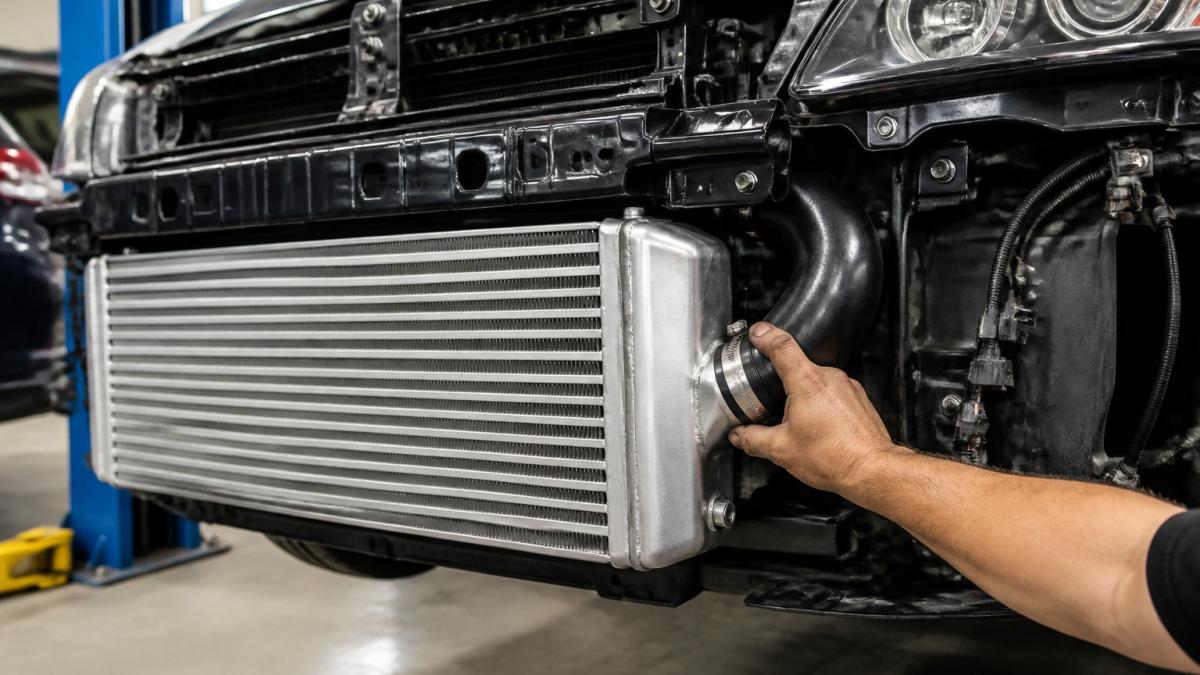
Air-to-air systems heat-soak more in stop-and-go traffic because they depend on vehicle speed to move air across the core. Air-to-water resists better in traffic but can still soak if the coolant circuit is undersized or the pump weak.
Watch Out
Ignoring heat soak does not just cost power. Repeated high-temperature operation pushes the engine toward detonation, and detonation can crack pistons or lift head gaskets. If your power fades after the first pull, treat it as a warning, not a quirk.
How to Evaluate Any Intercooler for Supercharged Engines
Evaluating an intercooler for supercharged engines means judging measurable criteria, not marketing claims. Core construction, pressure drop, and real-world temperature reduction tell you more than a polished product page.
Use this checklist before you buy:
- Core construction: Bar-and-plate cores generally handle boost and heat better than tube-and-fin for forced induction
- Pressure drop: Lower drop across the core preserves boost; ask for the figure at your target airflow
- Temperature reduction: Look for intake-air temperature drop measured at your boost level, not a peak number
Key Takeaway
The single most useful number when comparing intercoolers is pressure drop at your target airflow. A core that cools well but drops boost badly can leave you slower than a smaller, more efficient unit.
Installation, Maintenance, and What to Check Before You Buy
Installation difficulty tracks with whether you chose direct fit or universal. Direct-fit kits generally install with hand tools and basic mechanical skill; universal setups demand fabrication, welding, and custom piping. Before committing, confirm you have the tools, space, and time, or budget for a shop.
Maintenance is modest but not zero. Check before and after install:
- Inspect the core for bent fins and debris blocking airflow
- Confirm charge-pipe couplers are tight and leak-free
- For air-to-water systems, check coolant level, pump operation, and hose condition
Conclusion: Matching the Intercooler to Your Supercharger Setup
Choosing the best intercooler for supercharged engines is a matching exercise: airflow, boost, space, and how you drive decide the answer. Get the sizing and the air-to-air versus air-to-water call right, and your supercharger delivers the power it promised.
At VT Superchargers, we build bolt-on supercharger kits with OEM-style fitment for makes including Dodge, Ford, Jeep, Mazda, Nissan, Suzuki, and Toyota, so the forced-induction side of your build lines up with the rest of the system.
Frequently Asked Questions
Do supercharged engines need intercoolers?
Yes, if you want to keep power consistent. A supercharger compresses intake air, and compression raises its temperature. Hot charge air is less dense, which reduces the oxygen available for combustion and forces the ECU to pull timing to avoid detonation. An intercooler sits between the supercharger and the intake manifold and drops that intake-air temperature before it reaches the cylinders. Without one, a supercharged engine loses power on repeated pulls and runs closer to the edge of knock.
Is an air-to-air or air-to-water intercooler better for a supercharged engine?
It depends on your setup. Air-to-air uses ambient airflow through a front-mounted heat exchanger, has fewer parts, and costs less to maintain, which suits daily drivers and trucks with open front-end space. Air-to-water uses a coolant circuit and a separate heat exchanger, so it packages into tight engine bays and holds intake-air temperature steadier in stop-and-go or low-speed off-road use. The trade-off is more components, more weight, and a second cooling system to maintain.
How do I choose the right intercooler size for a supercharged engine?
Start with your target horsepower and boost pressure, then match core volume and airflow capacity to those numbers rather than to the biggest core that fits. An oversized core adds pressure drop and turbo-style lag on a belt-driven blower, while an undersized core heat-soaks within a few pulls. Also check the core's internal fin density and inlet/outlet diameter against your charge piping. If you are unsure, ask the manufacturer for airflow ratings at your boost level before ordering.
Can an intercooler reduce intake air temperatures on a supercharged engine?
It can, and that is its main job. Depending on core design, ambient conditions, and airflow through the exchanger, an intercooler typically pulls a meaningful amount of heat out of the charge air before it enters the manifold. The exact temperature reduction varies with boost pressure, outside air temperature, and vehicle speed, so treat any single number as condition-dependent. What matters for tuning is consistency: a core that recovers quickly after a pull keeps intake-air temperature stable instead of climbing.
Related post

RECENT POSTS