Tacoma Engine Maintenance for Performance
Last Updated: October 23, 2026
Quick Summary
Tacoma engine maintenance is the foundation of engine performance, requiring oil and filter changes every 10,000 miles, air filter replacement every 15,000-30,000 miles, and regular fluid checks to keep your engine running cooler, responding faster, and delivering consistent power.
- Replace oil and filter every 10,000 miles with 0W-16 full synthetic oil for 2026 Tacoma models
- Replace engine air filter every 15,000-30,000 miles, sooner in dusty environments
- Check engine oil level monthly and top off immediately if below minimum line
- Complete comprehensive inspection at 30,000 miles including brakes, tires, belts, and all fluid levels
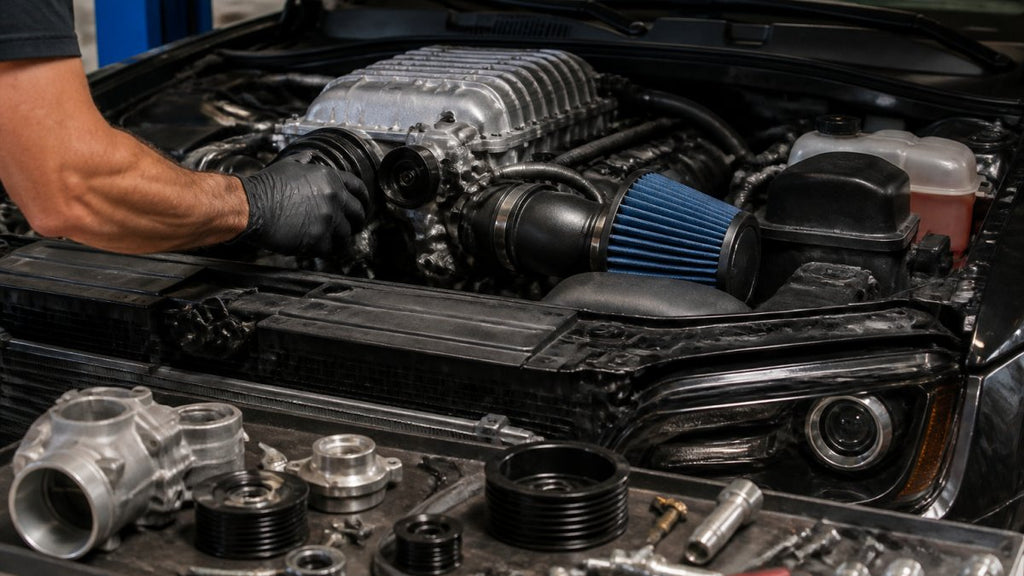
- Proper maintenance prepares your engine for performance upgrades like superchargers
Table of Contents
- Why Tacoma Engine Maintenance Directly Affects Performance
- Understanding Your Tacoma Maintenance Schedule
- Toyota Tacoma Oil Change Interval and Procedure
- Toyota Tacoma Engine Air Filter Replacement
- Fluid Checks and Coolant Maintenance
- Toyota Tacoma 30,000-Mile Service Essentials
- How Proper Maintenance Unlocks Engine Performance
- Common Maintenance Mistakes to Avoid
- Frequently Asked Questions
Why Tacoma Engine Maintenance Directly Affects Performance
Your Toyota Tacoma's engine performance depends on consistent tacoma engine maintenance, the foundation that determines whether your engine delivers its designed power or slowly loses responsiveness.
Skip maintenance and oil thickens, air filters clog, spark plugs foul, fuel economy drops, and throttle response turns sluggish.
But here's the part most guides miss: proper maintenance doesn't just keep your Tacoma running. According to Toyota's 2026 Warranty & Maintenance Guide, regular oil and filter changes are foundational to engine longevity and performance.
This matters even more if you're considering performance upgrades later: an engine starved of maintenance won't handle forced induction, while a properly maintained one is ready for real power gains.
Understanding Your Tacoma Maintenance Schedule
Your maintenance schedule is a roadmap engineered by Toyota to keep your engine at peak performance. Learn about supercharger-specific maintenance requirements to understand how upgrades affect your service intervals. Miss intervals and you're not just risking breakdowns, you're leaving performance on the table.
Mileage-Based Service Intervals
The 2026 Tacoma maintenance schedule breaks down into clear intervals. Herb Chambers Toyota of Boston's 2026 Tacoma maintenance summary documents the recommended schedule: oil and filter changes every 10,000 miles, with inspections and tire rotations at 5,000-mile intervals.
Here's what this means in practice:
- 5,000 miles: Engine oil level check, visual inspection of engine and inverter coolant, tire rotation
- 10,000 miles: Oil and filter replacement, fluid level inspections, air filter check
- 20,000 miles: Cabin air filter inspection, brake fluid assessment
Missing even one interval compounds problems: oil degrades fast, and filters trap contaminants that damage your engine if not removed on schedule.
Model Year and Engine Variations
Not all Tacomas are the same. Your maintenance needs depend on your engine.
The 2025 and 2026 Tacoma with the 3.5L V6 2GR-FKS engine requires 0W-16 full synthetic oil, per Toyota of Cleveland Heights' 2025 Tacoma maintenance guide.
Using the wrong oil viscosity is a silent killer, affecting engine temperature regulation, fuel economy, throttle response, and long-term wear.
Follow these mileage intervals to keep your Tacoma engine performing at its peak.
| Mileage Interval | Service | Key Details |
|---|---|---|
| 5,000 miles | Engine oil level check, tire rotation | Visual inspection of engine and inverter coolant |
| 10,000 miles | Oil and filter replacement | Fluid level inspections, air filter check |
| 20,000 miles | Cabin air filter inspection | Brake fluid assessment |
| 30,000 miles | Comprehensive inspection | Brake pads, rotors, transmission fluid check |
| 60,000 miles | Major service | Spark plugs, coolant flush, differential fluid |
Toyota Tacoma Oil Change Interval and Procedure
Oil is your engine's lifeblood: it protects moving parts, carries away heat, and keeps the engine clean. Neglect this one service and everything else fails faster.
Checking Oil Level Monthly
Monthly checks catch problems before they become expensive. With the engine cold and parked on level ground, pull the dipstick (usually a bright yellow or orange handle), wipe it clean, reinsert it fully, and read the level. It should sit between the minimum and maximum lines; if it's below minimum, add oil immediately. Low oil pressure triggers warning lights, ignore them and your engine seizes.
Oil Specification and Synthetic Requirements
Your 2026 Tacoma needs 0W-16 full synthetic oil, this isn't negotiable. Synthetic flows better cold, resists breakdown at high temperatures, lasts longer between changes, and protects better under boost (important if you're planning supercharger installation). Conventional oil thickens in cold weather and breaks down faster under heat. The "0W" means the oil flows at zero degrees Fahrenheit; the "16" is the viscosity at operating temperature.
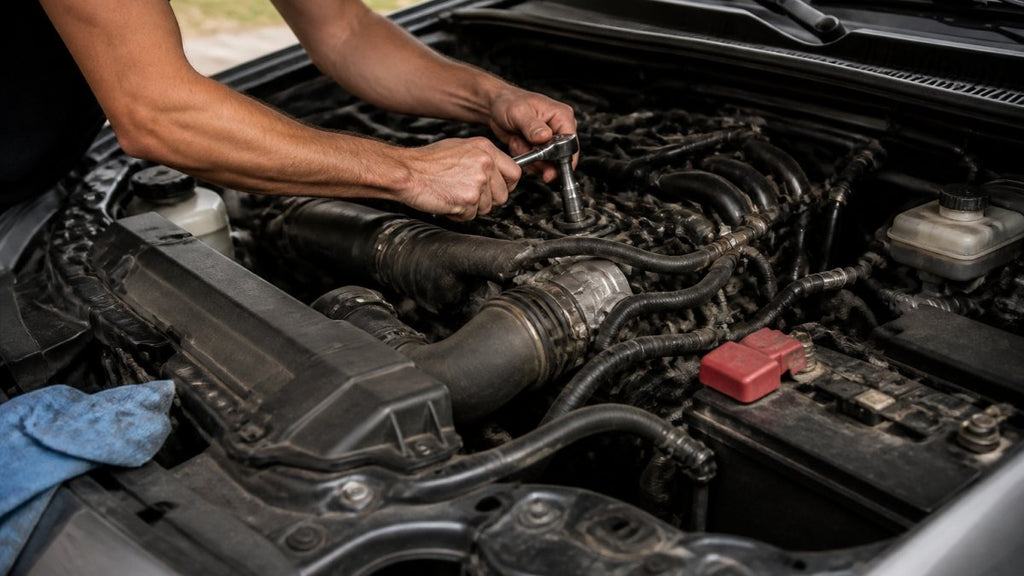
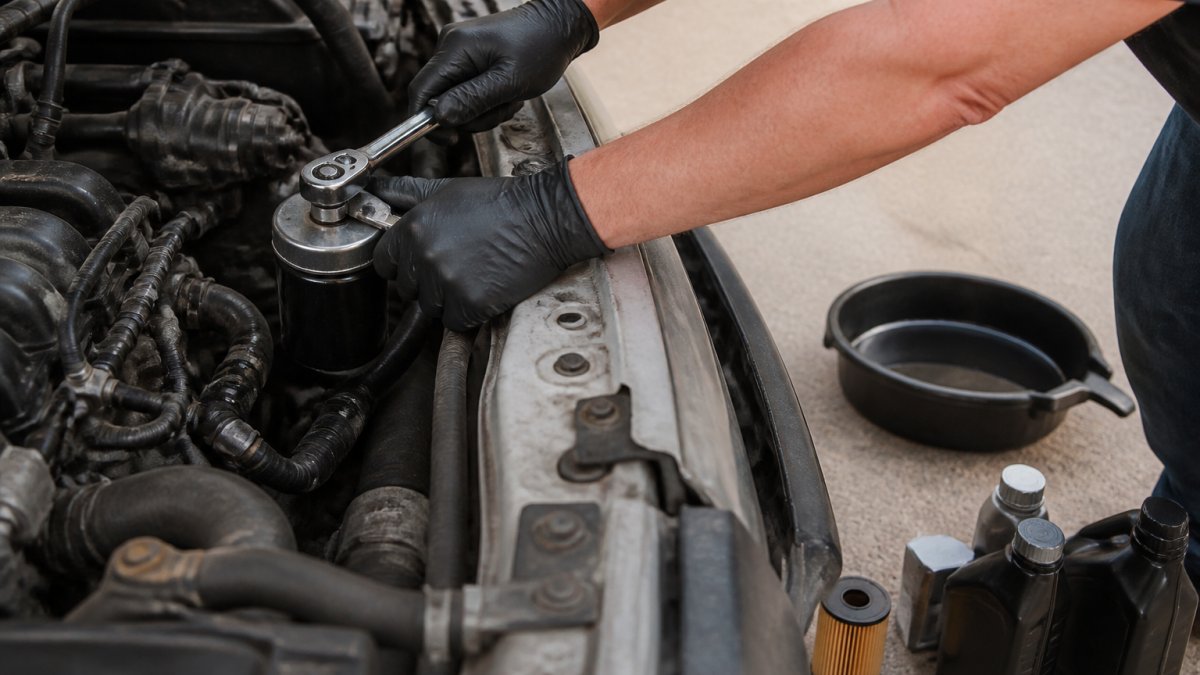
Step-by-Step Oil and Filter Replacement
This is a job you can do yourself in 30 minutes.
What you need:
- Socket wrench set
- Oil drain pan
- Oil filter wrench
The process:
-
Warm the engine. Run it for two minutes; warm oil drains faster and carries more contaminants.
-
Locate the drain plug. It's on the bottom of the engine pan. Position your drain pan underneath.
-
Remove the drain plug. Turn it counterclockwise with your socket wrench and let it drain into the pan for 3-5 minutes.
-
Locate the oil filter. It's usually on the side of the engine. Loosen it with your oil filter wrench, then turn counterclockwise by hand.
-
Remove the old filter. Expect oil to spill. Have rags ready.
-
Clean the filter mount. Wipe the rubber gasket surface with a clean rag.
-
Install the new filter. Apply a thin layer of fresh oil to the new filter's rubber gasket. Screw it on by hand until the gasket contacts the mount, then turn an additional three-quarter turn. Don't overtighten.
-
Reinstall the drain plug. Hand-tighten it first, then snug it with your wrench. Don't overtighten; you can strip the threads.
-
Add new oil. Check your owner's manual for the correct amount. Pour it in slowly, wait 30 seconds, then check the dipstick.
-
Start the engine. Run it for 30 seconds. The oil pressure light should go out. Check for leaks around the filter and drain plug.
-
Turn off the engine. Wait two minutes, then check the level again with the dipstick.
Pro Tip
Don't dispose of old oil in the trash. Take it to an auto parts store or recycling center. Most accept used oil for free.
Toyota Tacoma Engine Air Filter Replacement
A clogged air filter starves your engine of oxygen, reducing power and fuel economy. Replacing it is one of the easiest maintenance tasks you can do.
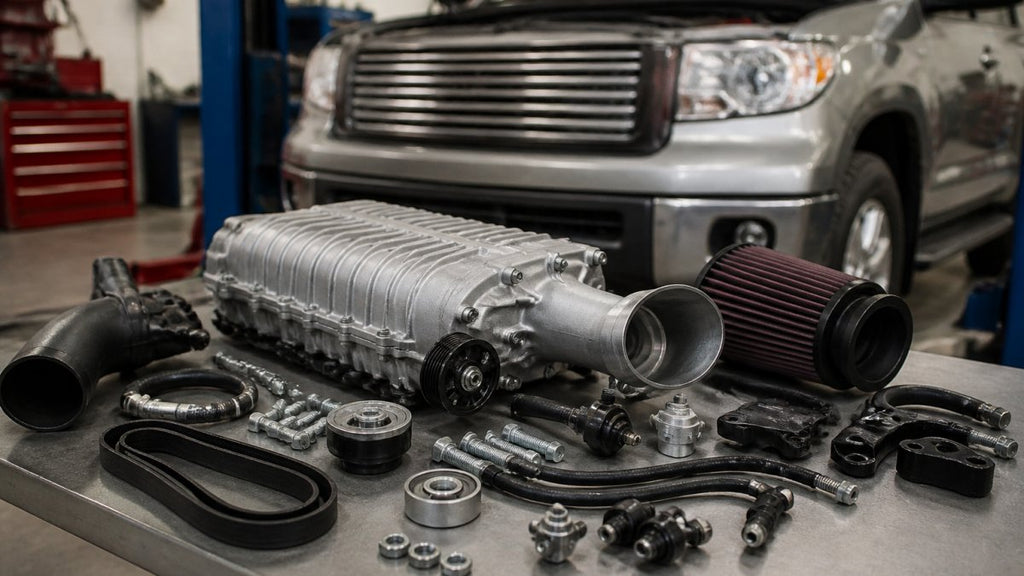
Toyota Tacoma 4.0L 1GR-FE Supercharger Kit →
When to Replace Your Engine Air Filter
Replace your engine air filter every 15,000-30,000 miles, sooner in dusty environments (off-road, desert, gravel roads). To check, remove the filter and hold it up to light, if you can't see light through it, replace it. A clogged filter causes loss of throttle response, reduced fuel economy, harder cold starts, and engine hesitation under acceleration.
DIY Replacement Process
This takes 10 minutes. No special tools required.
-
Locate the air filter box. It's usually on the side of the engine, a large plastic box with a hose running to the intake.
-
Remove the box cover. It's held by clips or bolts. Unclip or unbolt it.
-
Pull out the old filter. Note its orientation. The new one goes in the same way.
-
Inspect the box. Wipe out any dust or debris with a rag.
-
Install the new filter. Slide it in, matching the orientation of the old one.
-
Reinstall the cover. Secure all clips or bolts.
-
Start the engine. Listen for any unusual sounds. Everything should feel normal.
Fluid Checks and Coolant Maintenance
Your Tacoma runs on more than oil, transmission fluid, coolant, and brake fluid keep everything working. Neglecting these invites expensive repairs.
Engine Coolant Level and Inspection
Coolant prevents your engine from overheating and freezing. Check the level at every oil change: the reservoir (usually a translucent plastic container near the engine) should read between the minimum and maximum marks when cold. Never open the radiator cap when the engine is hot, pressurized coolant will spray and burn you. If low, top it off with the coolant type specified in your owner's manual; the wrong coolant can cause corrosion.
Transmission and Differential Fluid
These fluids are easy to forget because they don't need frequent changes, but they matter. Transmission fluid keeps gears shifting smoothly; differential fluid protects the rear-end gears. Both break down over time. Most Tacomas need transmission fluid service around 60,000 miles and differential fluid service every 50,000 miles if you tow or drive in severe conditions.
Toyota Tacoma 30,000-Mile Service Essentials
The 30,000-mile service is a comprehensive checkpoint where you catch problems before they become expensive.
Comprehensive Inspection Checklist
At 30,000 miles, your Tacoma needs a full inspection:
- Engine oil and filter (replace)
- Engine air filter (inspect, replace if needed)
- Cabin air filter (inspect, replace if needed)
This checklist takes a shop 1-2 hours. Catching problems at 30,000 miles is infinitely cheaper than ignoring them until 60,000.
Brake and Tire Inspection at This Interval
Your brakes and tires are safety items, don't skimp. Brake pads typically last 50,000-70,000 miles; at 30,000 miles, measure thickness and plan to replace them soon if below 3mm, since worn pads damage rotors. Tires need rotation every 5,000-7,000 miles to wear evenly. Check tread depth with a penny, if you can see the top of Lincoln's head, the tread is too shallow.
How Proper Maintenance Unlocks Engine Performance
This is where maintenance connects directly to what you feel when you drive.
Fuel Economy and Responsiveness
A well-maintained engine is efficient: fresh oil reduces internal friction, clean filters let air flow freely, and proper coolant temperature keeps the engine in its sweet spot. The result is immediate throttle response, smooth acceleration, and better fuel economy. Neglect maintenance and your engine works harder for the same power, fuel economy drops, and you feel hesitation.
Preparing Your Engine for Performance Upgrades
If you're considering a supercharger, maintenance is your foundation. Explore the Toyota Tacoma Supercharger Kit Guide to understand your upgrade options.
The VT Superchargers Toyota Tacoma 4.0 Supercharger Kit delivers 40-60% more horsepower and 30-50% more torque on the 1GR-FE engine.
Before you invest in a supercharger, invest in maintenance. Get your Tacoma to 100% first. Then upgrade.
Key Takeaway
Maintenance isn't a cost. It's an investment in performance. A properly maintained engine runs cooler, responds faster, and handles power upgrades without breaking.
Common Maintenance Mistakes to Avoid
Most owners make the same mistakes. Learn from them.
Using the wrong oil grade. Your 2026 Tacoma needs 0W-16 synthetic. Anything else is a compromise.
DIY jobs without the right tools. Some maintenance is easy, some requires specialty equipment.
Proper maintenance is the difference between a Tacoma that performs and one that just runs.
Maintenance isn't optional. It's the foundation everything else is built on.
Ready to take your Tacoma to the next level? How to Prepare Your Engine for Supercharger Installation walks you through the pre-upgrade checklist. Or explore the VT Racing Toyota Tacoma 4.0 Supercharger Kit to see what real performance looks like when your engine is dialed in.

Frequently Asked Questions
How often should I change the oil in my Toyota Tacoma?
Most 2026 Tacoma models require oil and filter changes every 10,000 miles or 12 months, whichever comes first. Check your owner's manual for your specific model year, as older Tacomas may have different intervals. Monthly oil level checks are also essential to catch leaks or burning oil early. Using the correct oil grade, typically 0W-16 full synthetic for newer models, ensures optimal engine protection and performance.
What maintenance helps a Toyota Tacoma engine last longer?
Consistent fluid maintenance is the foundation for engine longevity. Change your oil at factory-recommended intervals, inspect coolant and transmission fluid regularly, and replace air filters when they show dirt or restriction. Keeping your engine cool and clean prevents premature wear. Additionally, following the factory-recommended service schedule protects your warranty and maintains resale value. Neglecting these basics accelerates internal engine wear and reduces power output.
Which engine fluids should I check regularly in a Toyota Tacoma?
Check engine oil monthly, as the manufacturer specifies. Inspect engine coolant level at the 5,000-mile mark and visually at each oil change. Monitor transmission fluid condition and level according to your maintenance schedule. Brake fluid should be inspected annually for contamination or low level. Windshield washer fluid is easy to overlook but necessary for visibility. Differential fluid in 4WD models also requires periodic inspection, especially if you tow or drive off-road frequently.
What should I do at the 30,000-mile service for my Tacoma?
At 30,000 miles, perform a comprehensive vehicle inspection including brake pads, rotors, and brake fluid condition. Rotate tires and inspect them for wear or damage. Check all hoses, belts, and pulleys for cracks or looseness. Verify coolant level and condition, and inspect the cabin and engine air filters. If your Tacoma has higher mileage or severe-use conditions, consider transmission and differential fluid inspection. This milestone service catches wear patterns before they become costly repairs.

Related post

26
Oct
23
Oct



RECENT POSTS