Is an Eaton Supercharger for Your Ford Bronco Worth It?
Last Updated: October 29, 2026
Quick Summary
An Eaton supercharger for Ford Bronco off-road use is worth it mainly for low-speed trail behavior, since the roots-type M90 builds boost from idle for predictable crawling torque. However, it was never factory-fitted to a Bronco, so expect custom adapters, brackets, cooling and tuning, plus a multi-week build.
- The M90 suits smaller V6 engines better than a 5.0L V8, which runs out of airflow up top.
- Sixth-gen Broncos are already turbocharged, so stacking a supercharger is not practical for a daily driver.
- An intercooler or heat exchanger is essential; without one the ECU pulls timing and you lose power.
- Budget for a rebuild or at least a bearing and coupler inspection before installing a used M90.
- The adapter plate or custom intake manifold is the single biggest fabrication cost on a Bronco.
Table of Contents
- Eaton M90 Supercharger Ford Bronco: What Actually Fits
- Ford Bronco Supercharger Kit: Components and Installation Reality
- Horsepower, Torque, and Low-Speed Trail Behavior
- Ford Bronco Supercharger Reliability: Heat, Maintenance, and Longevity
- Eaton M90 Supercharger Cost: Full Installed Budget Breakdown
- Eaton M90 vs. Edelbrock-Style and ProCharger-Style Alternatives
- Register Your Bronco Build With VT Superchargers
- Frequently Asked Questions
Eaton M90 Supercharger Ford Bronco: What Actually Fits
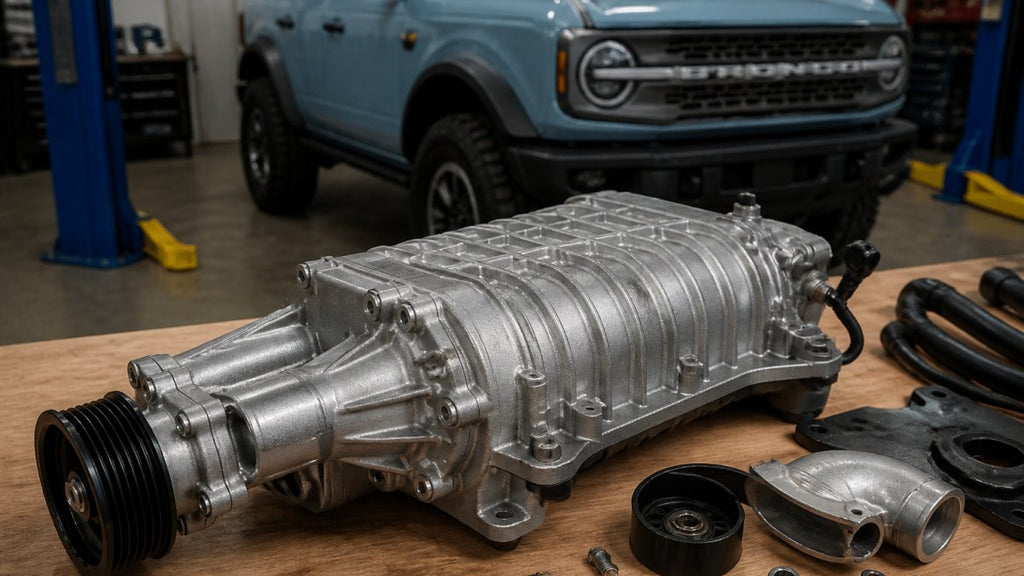
An Eaton supercharger for Ford Bronco off-road use is a roots-type, positive-displacement blower that builds boost from idle, which is exactly the behavior you want when you are crawling a ledge at low RPM. The Eaton M90 is the smaller of the common Eaton units, and that size is both its appeal and its limitation on a Bronco. Many off-road builders ask whether a used M90 is a smart buy for a trail rig. The honest answer depends far more on your engine bay and transmission than on the blower itself.
The M90 was never factory-fitted to a Bronco, so an M90 build is typically a swap that relies on adapters, brackets, and tuning decisions. That changes the math on cost, fitment, and reliability.
Engine and Transmission Compatibility by Bronco Generation
Fitment is the first filter, and it eliminates more builds than budget does. The M90's displacement suits smaller V6 engines far better than a 5.0L V8. Blowing a large-displacement engine with a small positive-displacement blower tends to run out of airflow up top, so you get a strong midrange and a flat top end.
| Bronco Generation | Common Engine | M90 Fitment Reality | Transmission Note |
|---|---|---|---|
| Early Bronco (classic) | 302 V8 | Custom fabrication required | Manual swaps common |
| Fifth-gen | 4.0L V6 | Adapter-plate builds exist | Automatic needs tuning |
| Sixth-gen | 2.7L EcoBoost | Poor fit, already boosted | Not a practical target |
| Sixth-gen | 2.3L EcoBoost | Poor fit, already boosted | Not a practical target |
The sixth-generation Bronco ships turbocharged, so adding a supercharger means stacking forced induction. That is a different project entirely, and not one we would recommend for a daily driver.
Fabrication and Supporting Parts You Cannot Skip
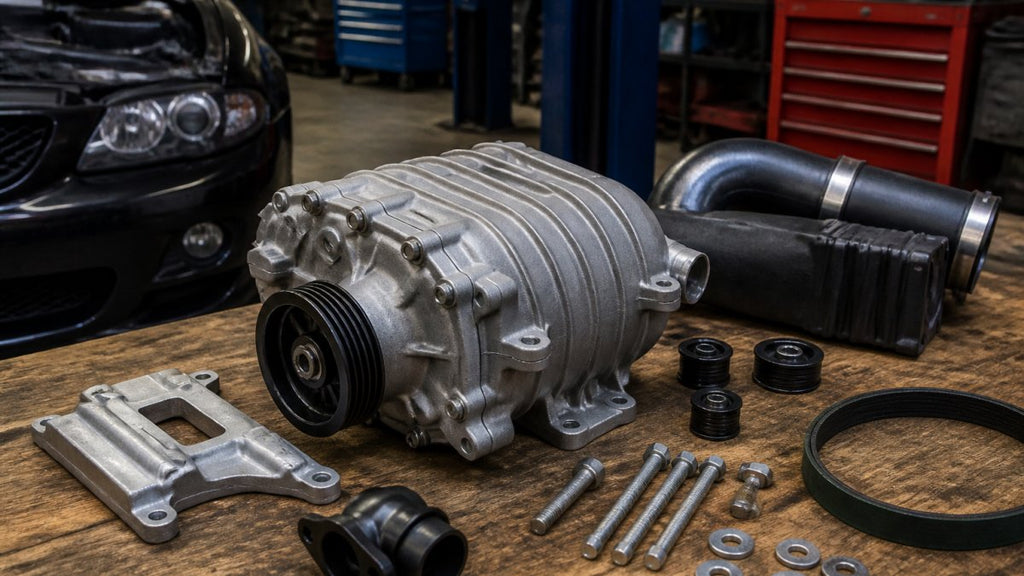
A common mistake is budgeting for the blower and nothing else, since a swap of this kind usually requires supporting components beyond the unit itself.
None of that is optional. The blower is the cheap part.
Ford Bronco Supercharger Kit: Components and Installation Reality
A Ford Bronco supercharger kit is only as good as its completeness.
Installation time varies with fabrication. A custom M90 swap on a Bronco can be a multi-week build that often ends at a fabrication shop, and buying a used unit with unknown bearing wear and no rebuild history is a common way these projects stall.
ECU, Injectors, and Fuel System Requirements
The stock ECU can often be tuned to run low boost, but it cannot compensate for a fuel system that runs out of capacity, so fuel system capacity and tuning should be planned before full-throttle use.
Horsepower, Torque, and Low-Speed Trail Behavior
Low-speed response is where the Eaton M90 earns its place on a trail rig. Positive-displacement blowers deliver boost almost immediately off idle, so throttle response feels linear and predictable on technical terrain. That is the opposite of a centrifugal blower, which builds boost with RPM and feels soft until you are deep into the throttle.
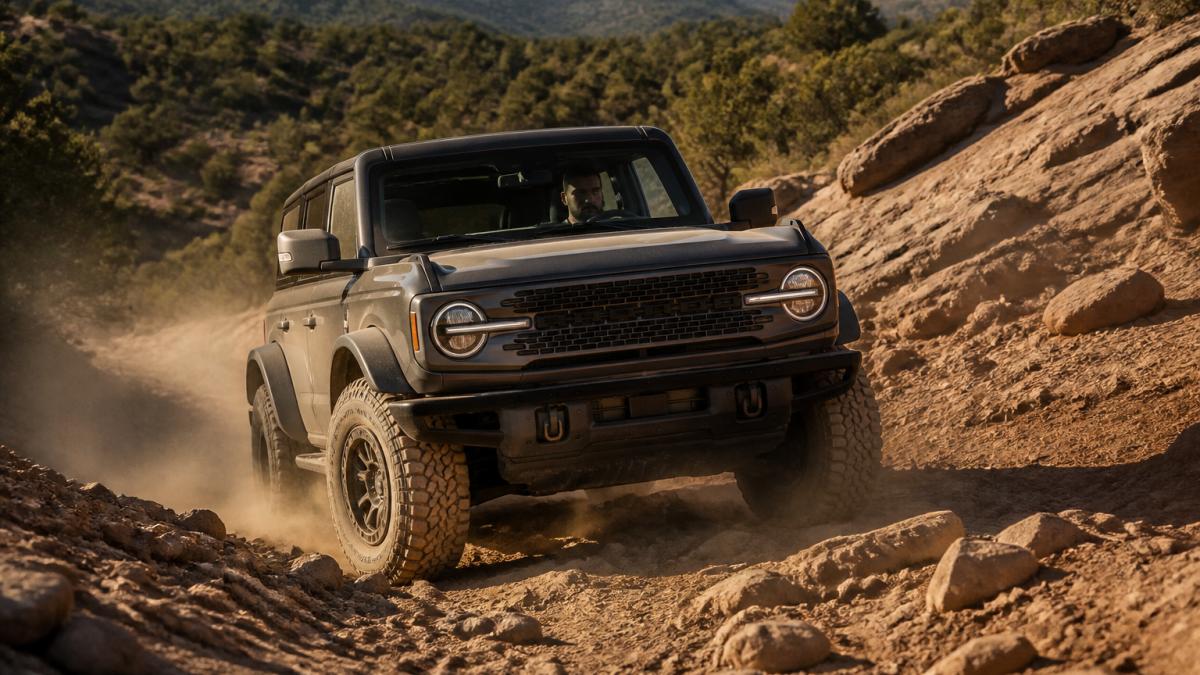
For rock crawling and steep climbs, that instant torque helps you modulate speed without stabbing the throttle. For buyers weighing blower types, our guide to the best supercharger for off-road torque compares twin-screw and centrifugal designs on low-end delivery.
Ford Bronco Supercharger Reliability: Heat, Maintenance, and Longevity
Ford Bronco supercharger reliability comes down to heat management and maintenance discipline, and on a trail rig those two things are tested harder than on a street truck. Positive-displacement blowers generate intake heat under sustained load, and a Bronco crawling a long climb at low speed with limited airflow through the grille is a worst-case scenario for charge temperatures. An intercooler or heat exchanger is what keeps that in check; without one, the ECU pulls timing, you lose the power you paid for, and sustained heat accelerates wear.
What actually fails first
Heat and wear on the supporting system are a general concern for forced-induction builds. Under sustained low-speed trail use, heat soak can become more likely than on open-highway driving, so cooling capacity is worth planning around worst-case use.
Maintenance intervals that matter
Routine maintenance generally involves inspecting belts and couplers, checking blower oil at the manufacturer's interval where applicable, and watching for bearing noise or boost loss.
Longevity expectations
Longevity of any forced-induction setup generally depends on keeping charge temperatures in check, running a conservative tune, and staying within what the fuel system and cooling can support. How forced induction affects long-term wear is covered in our breakdown of supercharger impact on truck engine longevity.
Key Takeaway
On a Bronco, reliability is a cooling and tuning problem more than a blower problem. Budget for the intercooler and the tune before you budget for more boost.
Eaton M90 Supercharger Cost: Full Installed Budget Breakdown
Eaton M90 supercharger cost depends heavily on the supporting parts a Bronco build requires, not just the blower itself. Here is a general overview of what a full installed budget can include, so you can plan the whole project.
Used M90 unit and inspection
The price of a used Eaton M90 varies with condition, mileage, and whether its components are serviceable. Budget for a rebuild or at minimum a bearing and coupler inspection before install, a unit with unknown history is the most common reason these projects stall mid-build.
Adapter plate or custom intake manifold
This is the single biggest fabrication cost on a Bronco. Adapter plates and custom intake manifolds can vary considerably in cost depending on design, machining, and test-fitting requirements.
Pulley, belt, and bracket fabrication
Costs for a pulley and belt setup and any custom brackets depend on complexity and whether factory accessory drive points can be reused.
Intercooler or heat exchanger
A water-to-air intercooler or heat exchanger setup adds cost for the core, pump, lines, and reservoir, and cooling capacity matters for sustained climbs.
Fuel system: injectors, pump, and tuning
Larger injectors, a higher-capacity fuel pump, and a proper tune add to the total build cost, and fuel system capacity and tuning are important for engine protection.
Labor
If you are not doing the work, labor for a custom M90 swap on a Bronco can be substantial, and fabrication-heavy swaps are typically shop projects.
Realistic total installed range
The total cost of an M90 swap on a Bronco varies widely with the amount of off-the-shelf versus custom parts, tuning, and labor required.
Watch Out
Budgeting from the used-unit price alone may leave out supporting parts such as the adapter, intercooler, fuel system, and tune.
Pricing depends on vehicle and configuration, so check the VT Superchargers website for current prices or a quote. For a fuller picture of what installation runs, see our guide to supercharger installation cost.
Eaton M90 vs. Edelbrock-Style and ProCharger-Style Alternatives
Twin-screw and centrifugal designs are common alternatives to the M90, each with different power-delivery characteristics.
| Option | Power Delivery | Fitment Effort | Best For |
|---|---|---|---|
| Eaton M90 | Instant low-end boost | High, custom | Budget trail builds |
| Edelbrock-style twin-screw | Strong throughout | Low, kit-based | Bolt-on builds |
| ProCharger-style centrifugal | Builds with RPM | Moderate | Street and strip |
For a deeper look, our comparison of supercharger alternatives for off-road builds and our breakdown of Edelbrock supercharger alternatives cover fitment and drivability trade-offs.
Register Your Bronco Build With VT Superchargers
Deciding on an Eaton supercharger for Ford Bronco off-road duty means weighing fabrication against fitment, and used savings against tuning costs. VT Superchargers offers bolt-on supercharger kits for a range of makes, including Ford, with a 24-month warranty and financing available. Upgrading your drivetrain to handle this newfound power often requires reinforcing the chassis with off-road axle kits to ensure the Bronco remains reliable on the trail.
Get started with VT Superchargers and register your build so our team can confirm fitment for your Bronco before you commit.
Frequently Asked Questions
Can you install an Eaton M90 supercharger on a Ford Bronco?
Yes, but fitment depends on your Bronco's engine and generation. The M90 is a positive-displacement unit that works best on V6 and V8 applications with adequate hood clearance and accessory drive space. Kit contents vary, so confirm with the seller which mounting, intake, pulley, and tuning components are included. Custom fabrication may be needed for older generations or modified engine bays. Check vehicle specifications and confirm compatibility before buying a used unit, since intake and throttle body layouts vary significantly across model years.
How does an Eaton supercharger affect a Bronco's low-speed off-road performance?
Twin-screw and roots-style Eaton designs deliver boost early in the RPM range, which improves throttle response and low-speed torque for rock crawling and technical terrain. That added low-end grunt helps turn larger tires without constant downshifting. The trade-off is heat buildup during extended slow-speed work, so monitor engine and intake temperatures on long trail days. Pairing the supercharger with proper gearing and cooling upgrades keeps power delivery predictable when you need precise throttle control on obstacles.
Is an Eaton M90 supercharger reliable for off-road use?
Reliability of any supercharger depends on maintenance and operating conditions. Ford Bronco supercharger reliability depends more on the supporting system than the blower itself: correct fueling, conservative boost levels, adequate cooling, and a proper tune. Off-road use adds heat and vibration, so inspect belts, pulleys, and fluid intervals more often. VT Superchargers offers a 24-month warranty; confirm the coverage terms, including any labor coverage, before you install.
What does an Eaton M90 supercharger cost for a Bronco build?
Eaton M90 supercharger cost varies widely depending on whether you buy a used unit or a complete new kit. A used blower alone is only part of the budget; you also need a mounting kit, fuel injectors, tuning, and possibly a upgraded fuel pump and heat exchanger. Pricing depends on the kit configuration and your Bronco's current setup, so check the VT Superchargers website for current prices or a quote.

Related post
26
Oct
23
Oct


RECENT POSTS