Signs of Supercharger Belt Slip After a Pulley Upgrade
Table of Contents
- Why a Pulley Upgrade Makes Belt Slip More Likely
- Supercharger Belt Slip Symptoms You Can Hear and Feel
- Step-by-Step Diagnostic Procedure for Confirming Slip
- Supercharger Belt Tension and Alignment Checks
- Supercharger Belt Length After a Pulley Upgrade
- How to Stop Supercharger Belt Slip for Good
- Symptom-to-Cause Chart and When to Replace Parts
- Conclusion
- Frequently Asked Questions
Last Updated: October 12, 2026
Why a Pulley Upgrade Makes Belt Slip More Likely
A smaller supercharger pulley spins the blower faster, loading the belt harder. That single change explains most cases of supercharger belt slip after a pulley upgrade: the belt must turn a faster, harder-to-drive pulley with the same contact patch, so something has to give, usually traction.
Three things change at once after a pulley swap:
- The pulley spins faster, so the belt sees higher surface speed
- The load on the belt climbs with boost
- The same belt length now has to wrap a smaller pulley, which can reduce belt wrap
According to SAE International technical papers on belt drive systems, belt capacity depends on speed, tension, and wrap. Change one and the others shift. This is almost always fixable.
Supercharger Belt Slip Symptoms You Can Hear and Feel
Supercharger belt slip symptoms show up in what you hear and what you feel, usually the sound first, then the power loss.
Boost Loss and Power Delivery Changes Under Load
The clearest sign is boost that builds, then falls off, the gauge climbs, then drops a few pounds as the belt loses grip.
These symptoms show up under load, not at idle. A hard pull in third gear or a wide-open throttle run exposes slip that a gentle drive hides.
Watch for:
- Boost that peaks, then bleeds off
- Power loss that comes and goes
- Intermittent slip on hot days or long pulls
Supercharger Pitch, Squeal, and Belt Dust
A high-pitched squeal is the classic giveaway, often on cold start or during a hard pull, and the supercharger pitch can sound strained rather than smooth. Black belt dust around the pulley is rubber being ground away, and shiny or glazed belt ribs mean the surface has hardened and lost grip.
Watch Out
Glazing is a one-way street. Once the ribs turn shiny and hard, cleaning rarely brings the grip back. Keep running a glazed belt and it will keep slipping no matter how tight you set tension.
Step-by-Step Diagnostic Procedure for Confirming Slip
Confirming slip means proving the belt is losing grip, not guessing. Follow these steps in order.
- Cold-start the engine and listen for a squeal
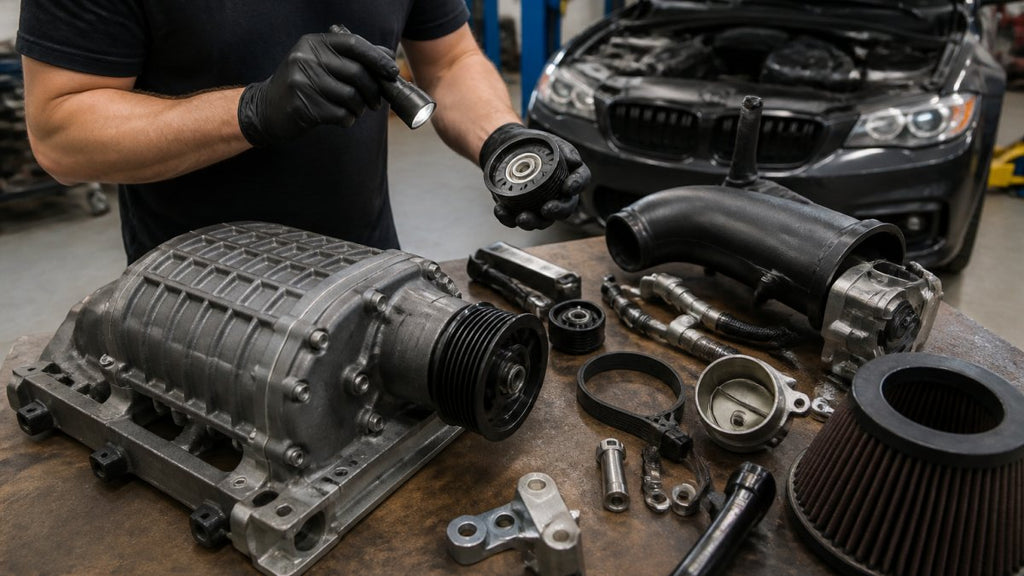
- Inspect the belt ribs for shine, cracks, and glazing
- Check for rubber dust around the pulley and tensioner
- Watch the boost gauge during a controlled pull
- Log boost and engine RPM data on a wide-open throttle run
- Check belt tension and tensioner movement
- Check pulley alignment with a straightedge
Confirming Slip With Logged Boost and RPM Data
A datalog settles the argument. Log boost pressure against engine RPM on a wide-open throttle pull: a healthy setup rises smoothly and holds, while a slipping setup spikes then drops even as RPM climbs.
That gap between expected and actual boost is your proof. If boost falls while RPM rises, the belt is losing grip under load.
Safety Precautions During Belt Inspection
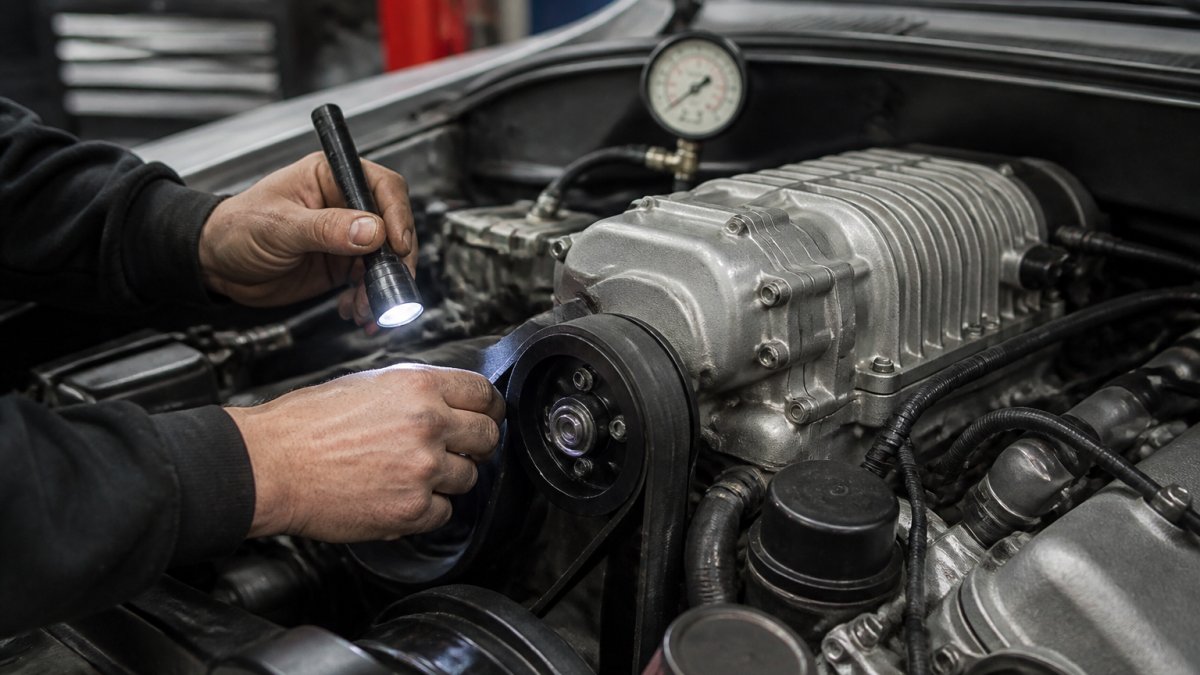
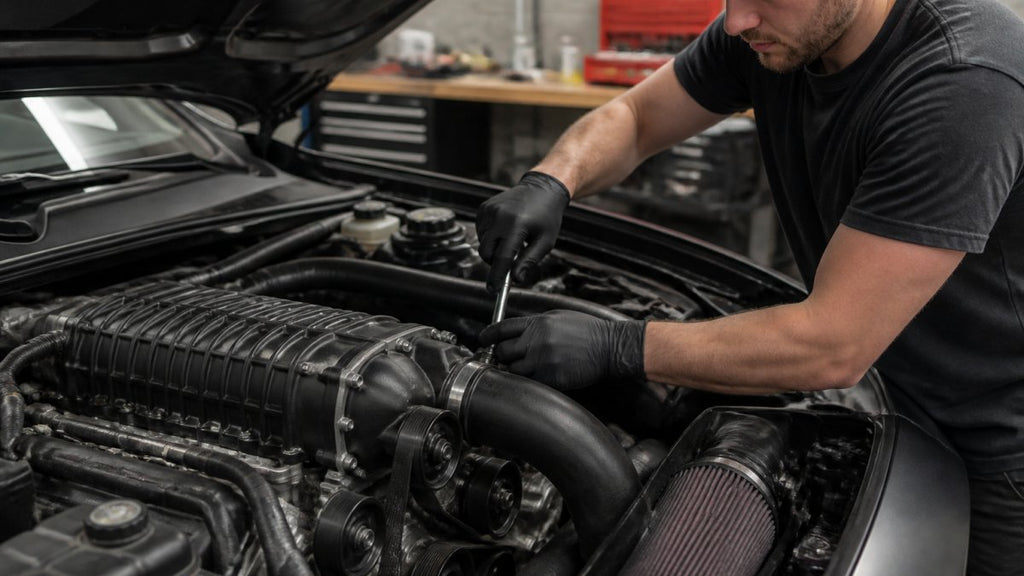
Never inspect a running belt with your hands, loose clothing, or dangling jewelry. Before any hands-on check, shut the engine off and let it cool, belts and pulleys get hot enough to burn. Use a flashlight and a mirror rather than reaching in.
Pro Tip
Use a mechanic's stethoscope or a length of hose to pinpoint the squeal. It separates belt noise from a bad idler bearing, which sounds similar but needs a different fix.
Supercharger Belt Tension and Alignment Checks
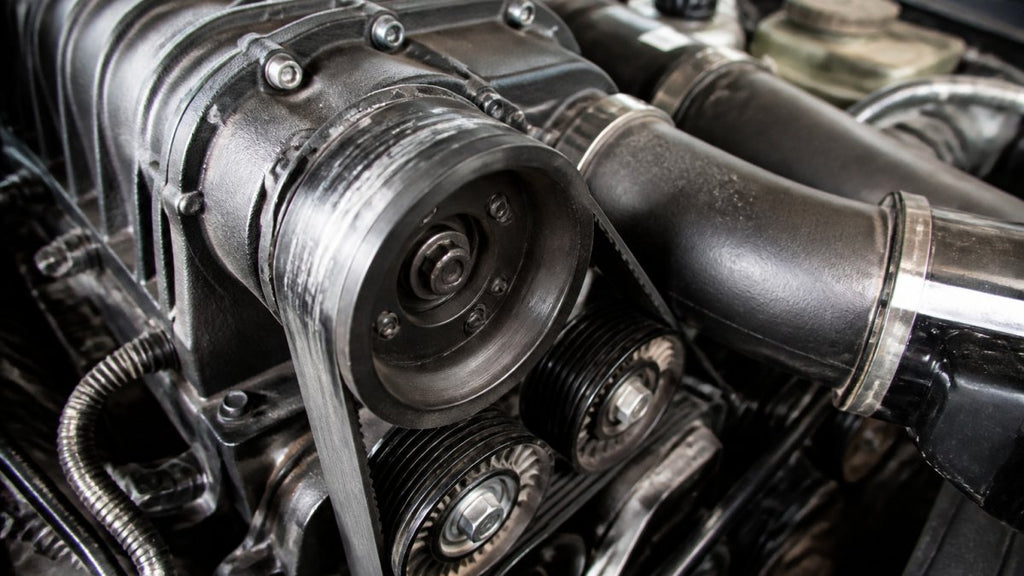
Supercharger belt tension and alignment are the two most common root causes, and both are easy to check. Read the tensioner's position, watch how it moves, and trace how the belt sits on every pulley in the drive.
Reading the Tensioner Correctly
With the engine off and the belt cold, look at where the tensioner arm sits in its travel. Most spring-loaded automatic tensioners have a cast-in indicator or stamped range. Three positions matter:
- Mid-range: normal. The tensioner has room to take up stretch and load.
- Near the end of travel (maxed out): the belt is too long for the pulley combination, or the spring has weakened. This is the single most common cause of slip after a pulley swap.
- Bottomed out against the stop: the tensioner cannot apply any more force. The belt will slip under load no matter what you do.
A tensioner that sits mid-range at rest but swings to the stop during a hard pull is a different problem: the spring rate is too soft for the higher boost load. That is a tensioner upgrade, not a belt change.
Checking Tensioner Health, Not Just Position
Position alone does not tell you the tensioner is doing its job. With the engine off, rock the tensioner pulley: any wobble, grinding, or side-to-side play means the bearing is failing, which mimics belt squeal and can let the belt walk off under load. Spin it by hand, it should turn smoothly with light drag and no grit; one that spins freely has lost its grease and is on the way out.
Alignment: The Straightedge Test and What It Misses
Lay a straightedge across the faces of two pulleys that share the belt, typically the crank and supercharger pulley, or the supercharger and tensioner. The belt should sit flat and centered on both; if the straightedge rocks or shows a gap, the pulleys are not coplanar.
A straightedge catches gross misalignment. It misses two things that matter after a pulley upgrade:
- Angular misalignment, one pulley tilted relative to the other. The belt tracks to one edge and wears a chamfer into the ribs. Check by sighting down the belt run from the side; the belt should run parallel to the pulley faces, not angled across them.
- Belt wrap angle, how much of the supercharger pulley circumference the belt actually contacts. A smaller pulley reduces wrap, and reduced wrap reduces the torque the belt can transmit before slipping. Most practitioners find that below roughly 120 degrees of wrap on the driven pulley, slip becomes hard to eliminate with tension alone.
Wear Patterns That Point to the Cause
Read the belt itself. The wear pattern tells you which problem you have:
- Even shine across all ribs: glazing from slip. Replace the belt.
- One edge shiny, the other dull: misalignment or a tracking problem. Fix alignment before replacing the belt, or the new belt will wear the same way.
- Chunks missing from ribs or a frayed edge: the belt has been running against a flange or a misaligned pulley. Inspect the pulley flanges for damage.
Root-Cause Decision Logic
Do not treat every slip the same. Work through this order:
- Is the tensioner mid-range at rest? If not, fix belt length first.
- Does the tensioner hold position under load? If it swings to the stop, the spring is too soft.
- Does the belt track flat and centered? If not, fix alignment before anything else.
- Is the belt glazed, cracked, or shedding dust? Replace it.
- Is wrap angle adequate for the new pulley size? If not, add an idler or a larger tensioner pulley to increase contact.
Only after all five check out should you consider that the pulley ratio itself is asking more of the belt drive than it can deliver.
Pro Tip
Photograph the tensioner position and belt tracking before you change anything. After the fix, take the same photo from the same angle. Side-by-side comparison catches small changes that are easy to miss in person.
Watch Out
Never reach toward a belt or pulley with the engine running to check tension or tracking. Use a flashlight and a mirror, or shut the engine off and let it cool first. Belts and pulleys reach temperatures that cause serious burns, and a running belt can pull in loose clothing or jewelry in an instant.
Supercharger Belt Length After a Pulley Upgrade
A smaller supercharger pulley changes the geometry of the entire drive: the belt path gets shorter, the tensioner takes up more slack, and the belt wraps a tighter radius. Getting the length right is a measurement, not a guess.
Why the Stock Belt Usually Does Not Work
When you drop from a stock pulley to a smaller one, the belt run around the supercharger pulley shortens and the automatic tensioner extends to take up slack.
The rule of thumb most shops use: if the tensioner moves more than about a quarter of its total travel from its pre-swap position, you need a different belt length.
How to Determine the Correct Belt Length
You have two reliable methods. Use both if you can.
Method 1: String wrap. Route non-stretch string or thin rope around the entire belt path, crank, supercharger pulley, idlers, tensioner, with the tensioner held at mid-travel.
Method 2: Manufacturer fitment. Most pulley manufacturers publish the recommended belt length or part number for their pulley with the stock accessory drive.
Reading the Tensioner After the Swap
Once the new belt is on, check the tensioner position again with the engine off:
- Mid-range: correct. The tensioner has room to compensate for stretch and load.
- Near the stop: the belt is too long. Go down one size.
- Cannot install without forcing: the belt is too short. Go up one size.
A belt one size off will still run, but it will either slip (too long) or overload the tensioner and accessory bearings (too short). Both shorten belt life and can mimic other problems.
Rib Count, Width, and Construction
Length is only one dimension. After a pulley upgrade, confirm:
- Rib count matches the pulleys. A 6-rib belt on an 8-rib pulley will slip no matter how tight it is. Count the grooves on the supercharger pulley and match.
- Width is correct for the pulley face. A belt narrower than the pulley will walk and wear unevenly.
- Construction suits the load. Standard EPDM belts work for mild upgrades. For high-boost setups, a belt with aramid or carbon cord reinforcement resists stretch better and holds grip longer under repeated hard pulls.
When to Change the Belt vs. Change the Drive
If belt length, rib count, and construction are matched and the tensioner still maxes out under load, the drive itself is the limit. Options:
- Add an idler pulley to increase wrap on the supercharger pulley.
- Switch to a larger tensioner pulley to take up more slack without running out of travel.
- Step up to an overdrive crank pulley instead of a smaller supercharger pulley, same ratio change, but the belt sees a larger radius on both ends and keeps more wrap.
Key Takeaway
Pulley ratio and belt length work as a pair. Change the pulley without matching the belt and you build in slip from day one. Measure the tensioner travel before and after, and let the numbers pick the belt, not the other way around.
Pro Tip
Keep the old belt as a spare in the trunk. If a new belt fails on the road, a slightly-too-long stock belt will at least get you home at low boost, and it costs nothing to store.
How to Stop Supercharger Belt Slip for Good
How to stop supercharger belt slip comes down to fixing the root cause, not just adding tension, over-tightening loads the bearings and can still slip.
Work through the real causes:
- Match belt length to the new pulley and tensioner range
- Replace a glazed or worn belt with a fresh one
- Fix pulley alignment so the belt tracks flat
If slip keeps coming back after all of that, the setup may be asking more of the belt drive than it can deliver, the point where a stronger belt system or professional help makes sense.
Symptom-to-Cause Chart and When to Replace Parts
Use this chart to match what you see and hear to the likely cause.
| Symptom | Likely Cause | Fix |
|---|---|---|
| Boost drops under load | Belt slip from low tension | Reset tension, check tensioner travel |
| High-pitched squeal | Glazed belt or misalignment | Replace belt, align pulleys |
| Black belt dust | Belt wear from slip | Replace belt, check tracking |
| Shiny belt ribs | Glazing | Replace belt, clean pulley surface |
| Tensioner maxed out | Wrong belt length | Fit correct belt length |
| Belt rides to one edge | Pulley misalignment | Align pulleys, check tracking |
Replace the belt if it is glazed, cracked, or shedding dust. Replace the tensioner if it wobbles or will not hold tension. If slip continues after new parts and correct setup, get a professional to check pulley ratio and belt wrap.
Conclusion
Belt slip after a pulley upgrade is common, but you do not have to live with it.
At VT Superchargers, our bolt-on kits are built for a precise, OEM-style fitment across Dodge, Ford, Jeep, Mazda, Nissan, Suzuki, and Toyota.
Get started with VT Superchargers and keep your boost where it belongs.
Frequently Asked Questions
How can I tell if my supercharger belt is slipping?
Look for a combination of symptoms: boost pressure that drops or fluctuates at wide-open throttle, a high-pitched squeal or a change in supercharger pitch under acceleration, and black rubber dust around the pulley. A glazed, shiny belt surface and visible tensioner movement are also strong indicators. Confirming slip with logged boost and RPM data removes the guesswork.
What happens if a belt slips off its pulley?
A belt that walks off the pulley can lose all drive to the supercharger, causing an immediate power loss and possible engine damage if fragments enter the intake path. Belt tracking issues usually trace back to pulley alignment, worn tensioners, or the wrong belt length after a pulley upgrade. Stop driving and inspect the belt routing and alignment before restarting.
Can a smaller supercharger pulley cause belt slip?
Yes. A smaller upper pulley increases the pulley ratio and spins the supercharger faster, which raises the load on the belt and reduces belt wrap around the pulley. That extra demand makes any pre-existing tension or alignment weakness show up as slip. Upgrading to a shorter belt and checking tensioner travel are the first steps to restore belt grip.
How do you fix supercharger belt slip after a pulley upgrade?
Start by verifying belt length and routing for the new pulley ratio, then check tensioner movement and pulley alignment. Replace a glazed or worn belt, clean pulley surfaces, and confirm the tensioner holds steady under load. If slip persists, log boost and RPM data to pinpoint the root cause before adding more tension, which can damage bearings.
Related post
09
Oct
RECENT POSTS