Best Supporting Mods for Forced Induction Builds
Table of Contents
- Why Supporting Mods Decide Whether Your Forced Induction Build Makes Power or Makes Problems
- Fuel System Upgrades for Forced Induction: Injectors, Pumps, and Octane
- Intercooler Upgrade for Boost: Controlling Charge-Air Temperature
- Engine Tuning for Forced Induction: ECU Calibration and Data Logging
- Clutch and Transmission Upgrades for Boost: Drivetrain Capacity
- Airflow, Exhaust, and Engine Internals: The Supporting Mods That Protect Reliability
- A Staged Upgrade Plan Tied to Your Power Goal, Budget, and Build Order
- Conclusion: Match Every Supporting Mod to the Boost You Actually Plan to Run
- Frequently Asked Questions
Last Updated: October 13, 2026
Why Supporting Mods Decide Whether Your Forced Induction Build Makes Power or Makes Problems
A forced induction build is only as strong as the parts around the power adder. At VT Superchargers, we've watched too many owners chase peak horsepower while ignoring the supporting mods that decide whether that power survives the first hard pull.
The best supporting mods for forced induction solve one problem: more air in means more fuel in, cooler charge air, and a drivetrain that can take the torque. Miss any of those and the build fights itself.
This guide walks through each system in the order that matters, from fuel delivery to engine internals, and shows how to stage the work against a real power goal. The U.S. Department of Energy's fuel economy guidance is a useful reference for how added load and drivetrain changes affect real-world performance.
Key Takeaway
Every supporting mod exists to serve one of three jobs: feed the engine more fuel, keep the intake charge cool, or hold the torque together. If a part doesn't do one of those, it's decoration.
Fuel System Upgrades for Forced Induction: Injectors, Pumps, and Octane
Fuel delivery is the first system to address because it caps your safe power ceiling. Forced induction adds air density, so the engine needs a proportional increase in fuel volume and pressure. Run out of fuel under boost and you get a dangerously lean condition, how most boosted engines fail.
Sizing Injectors and Fuel Pumps to Your Power Goal
Injectors are rated by flow, and the correct size depends on your target wheel horsepower and fuel type. Higher boost and rpm demand more flow, and E85 demands roughly 30% more volume than gasoline for the same power.
A common mistake is buying injectors for the power you have today rather than the power you plan to run. Upgrading once, with headroom, costs less than doing the job twice.
Fuel pumps work the same way.
Fuel Type and Octane: 91 Octane, E85, and What Your Tune Can Support
Octane is the fuel's resistance to knock, and knock is the enemy of every boosted engine.
E85 changes the math. Its higher effective octane lets a tuner run more timing and boost, but it demands more fuel volume, more frequent oil changes, and a fuel system built for it, more power potential, more maintenance.
What your calibration can support is the deciding factor. A tune written for 91 octane should never be run on lower-grade fuel, and a flex-fuel setup needs the sensor and calibration to adjust automatically.
Watch Out
Running lower-octane fuel in a build calibrated for 91 or E85 causes detonation that can crack pistons and bend rods in a single pull. If you can't consistently source the fuel your tune needs, have the calibration built for what you can actually buy.
Intercooler Upgrade for Boost: Controlling Charge-Air Temperature
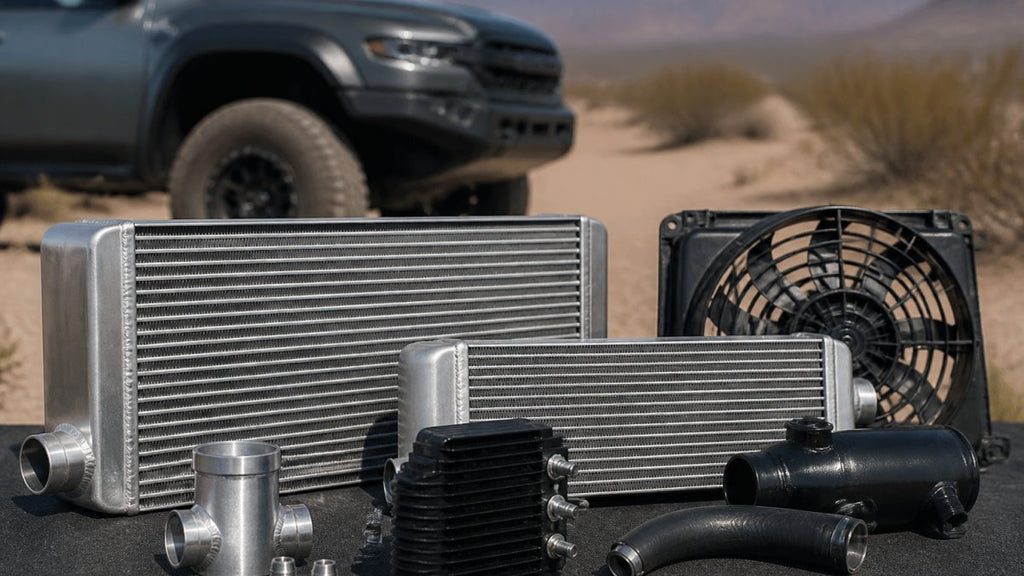
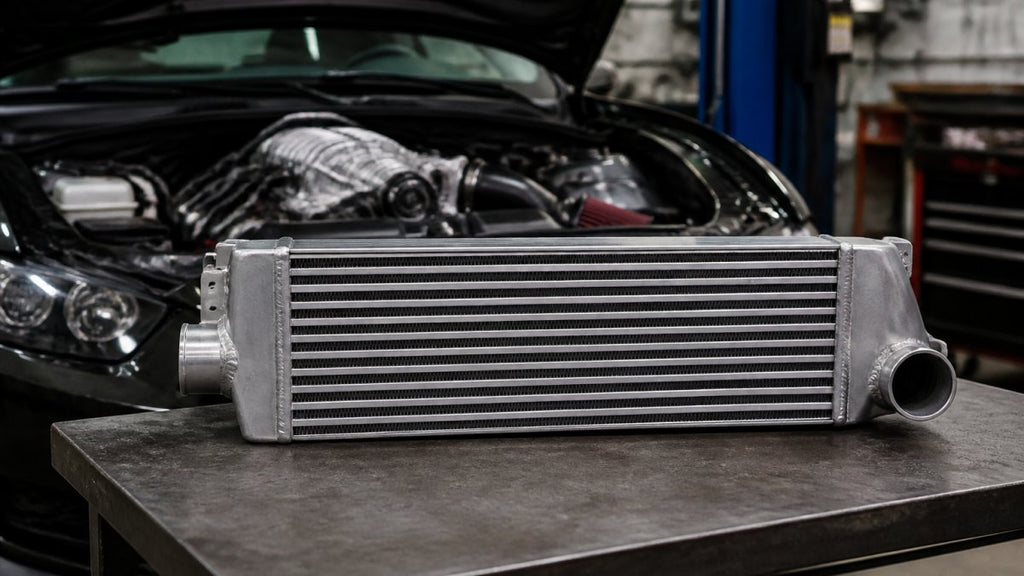
An intercooler upgrade for boost is the single most effective way to protect power on a forced induction build.
Charge-air temperature is the number to watch. Air-to-air intercoolers use ambient airflow and suit most street and off-road builds, while air-to-water units hold temperature more consistently in stop-and-go traffic and short bursts.
Bigger isn't automatically better. An oversized core can add pressure drop and lag, so match the intercooler to your boost level and airflow rather than buying the largest unit available.
Engine Tuning for Forced Induction: ECU Calibration and Data Logging
Engine tuning for forced induction is where every hardware choice gets validated or exposed. The ECU calibration controls fuel delivery, ignition timing, boost targets, and safety limits, and it decides whether your supporting mods work together or fight each other.
What a Proper Calibration Changes Beyond Peak Horsepower
A good calibration does far more than raise a peak number. It reshapes torque delivery, sharpens throttle response, and sets the safety margins that protect the engine when conditions change.
- Fuel mapping: matches injector flow to boost so air-fuel ratios stay safe across the rev range
- Timing control: advances spark only as far as the fuel and charge temperature allow
- Boost control: manages how quickly and how far boost builds, protecting the drivetrain
Data logging confirms the tune is actually safe. Log boost, air-fuel ratio, charge-air temperature, and knock over repeated pulls. If anything drifts, the calibration needs attention before you add more power.
Pro Tip
Log before you upgrade, not just after. A baseline log of your current tune shows the tuner exactly where the stock calibration is already working hard, which tells you which supporting mod to address first.
Clutch and Transmission Upgrades for Boost: Drivetrain Capacity
Clutch and transmission upgrades for boost protect the parts that turn engine torque into motion. Adding power without addressing drivetrain capacity is how owners end up with a slipping clutch or broken gearbox within weeks of a successful dyno day.
The drivetrain has to handle torque, not just horsepower. A late-spooling turbo and a positive-displacement supercharger that makes boost off idle can produce the same peak horsepower while loading the driveline very differently.
Manual Transmissions: Clutch Capacity and Clamp Load
For manual trucks, an upgraded clutch with higher clamp load and a friction material suited to the torque is the first step. Clamp load is the force the pressure plate applies to the disc, determining how much torque the clutch can transmit before it slips.
Friction material matters too. Organic discs are smooth and street-friendly but fade under repeated hard launches. Ceramic and sintered-metallic discs hold more torque but engage abruptly and can chatter in traffic.
Automatics: Valve Body Tuning, Converters, and Coolers
Automatics need a valve body tune or rebuild to hold added torque and shift cleanly under boost. A valve body calibration raises line pressure and shortens shift times so the clutches grab harder and slip less.
Transmission fluid temperature is the silent killer here. Added torque and a looser converter generate more heat, which shortens automatic transmission life. An auxiliary transmission cooler is cheap insurance and belongs alongside the valve body tune.
Driveshaft, Axles, and Differential
Beyond the transmission, consider the driveshaft, axles, and differential, especially on off-road builds running larger tires that multiply stress downstream. A larger tire acts like a longer lever arm, so the same engine torque produces more twisting force at the axle.
Match drivetrain capacity to your torque goal with margin, and address it before torque climbs past what the factory parts hold, not after something breaks.
Watch Out
A slipping clutch or a transmission that flares between shifts under boost is a warning sign, not a nuisance. Continued driving overheats the friction surfaces and turns a rebuild into a replacement. If you feel slip, back out of the throttle and fix the capacity gap before adding more power.
Airflow, Exhaust, and Engine Internals: The Supporting Mods That Protect Reliability
Airflow, exhaust, and engine internals decide whether your forced induction build stays reliable as power climbs. Each part either helps the engine breathe and survive, or becomes the bottleneck that limits everything else. The trick is knowing which parts to install in which order, and how to tell when one is holding the rest back.
Intake, Headers, and Cat-Back Exhaust Flow
A cold air intake feeds the compressor with cooler, less restricted air.
Headers and a cat-back exhaust handle what leaves the engine. Forced induction pushes more exhaust volume, and a restrictive factory exhaust creates backpressure that costs power and raises temperatures.
A common pattern is to measure backpressure before and after an exhaust change. If backpressure drops and boost stays the same, you found a restriction.
Forged Pistons, Connecting Rods, and Head Studs for High Horsepower
Engine internals become the limiting factor at high horsepower.
Forged pistons differ from cast in how they are made: forging aligns the metal grain and removes porosity, so the piston resists cracking under detonation.
This is the most expensive stage, so it should follow, not lead, the build. Address fuel, cooling, tuning, and drivetrain first, then build the bottom end when your power goal genuinely requires it.
Installation and Tuning Sequence: What Goes On Before the Calibration
Order of installation matters as much as the parts themselves. A common pattern is to install fuel-system hardware, intercooling, and any intake or exhaust changes first, then load a baseline calibration and log it before adding boost.
If you install internals or a larger turbo before the fuel system and intercooler are sorted, the first dyno pull can expose a fuel or heat problem on a fresh, expensive engine.
Monitoring and Safety Limits: Knock, Air-Fuel Ratio, and Temperature
Reliability is not just about parts, it is about watching the numbers that tell you when a part is about to fail. Four channels matter most on a boosted build:
- Knock: knock sensors or a standalone knock monitor catch detonation before it cracks a piston. A sudden spike in knock counts under boost means back out of the throttle.
- Air-fuel ratio: a wideband oxygen sensor shows whether the engine is running lean under load. Lean conditions under boost are the most common cause of melted pistons.
- Charge-air temperature: rising intake temps after the intercooler mean the intercooler is heat-soaked or undersized for the boost level.
A common pattern is to log all four channels on every hard pull for the first few weeks after a build, then periodically after that. If any channel drifts, the calibration or a supporting part needs attention before more power is added.
Pro Tip
Install a wideband air-fuel gauge and a boost gauge before you install the power adder, not after. Seeing the baseline behavior of the stock engine makes it obvious when something changes under boost.
A Staged Upgrade Plan Tied to Your Power Goal, Budget, and Build Order
A staged upgrade plan keeps a forced induction build reliable and affordable by matching each mod to a power goal.
| Stage | Focus | Key Mods | Best For |
|---|---|---|---|
| 1 | Safe baseline | Calibration, data logging, intake | Stock or mild boost |
| 2 | Fuel and cooling | Injectors, fuel pump, intercooler | Moderate boost goals |
| 3 | Drivetrain | Clutch, transmission tune, axles | Added torque |
| 4 | Internals | Forged pistons, rods, head studs | High horsepower builds |
Start with a calibration and logging baseline so you know what your current setup can safely take.
This order also handles real-world drivability. Owners running oversized tires often find that fixing fueling and tuning improves low-end torque and reduces gear hunting before any internal work is needed.
Conclusion: Match Every Supporting Mod to the Boost You Actually Plan to Run
The parts around your power adder decide whether the build makes power or makes problems, and the right sequence is fuel, cooling, tuning, drivetrain, then internals. Skipping a stage to save money usually costs more later.
At VT Superchargers, our bolt-on supercharger kits are engineered for OEM-style fitment across Dodge, Ford, Jeep, Mazda, Nissan, Suzuki, and Toyota, with financing available and a 24-month warranty for peace of mind.
Frequently Asked Questions
What supporting mods do you need for a forced induction build?
At minimum, plan for fuel system upgrades (injectors and pump), an intercooler upgrade to control charge-air temperature, a proper ECU calibration, and a clutch or transmission that can handle the added torque. Beyond that, intake, headers, and cat-back exhaust flow help the engine breathe. If you are chasing high horsepower, forged pistons, connecting rods, and head studs become necessary to keep the engine together. Build order matters: fuel and tuning first, then drivetrain, then internals.
Do you need to upgrade fuel injectors for a supercharger?
In most cases, yes. Factory injectors are sized for naturally aspirated airflow and run out of duty cycle once boost raises horsepower. Upgrading injectors and the fuel pump gives the ECU headroom to add fuel safely under boost. If you skip this step, the engine runs lean at wide-open throttle, which risks detonation and engine damage. Size injectors to your wheel horsepower target and the fuel type you plan to run, whether that is 91 octane or E85.
How important is tuning after installing a supercharger?
Tuning is not optional. A forced induction build needs a calibration that accounts for boost, charge-air temperature, fuel delivery, and ignition timing. A stock ECU calibration cannot safely manage the added airflow, so engine tuning for forced induction is what ties every supporting mod together. Data logging during the tune lets the calibrator verify air-fuel ratios, knock, and boost response. Skipping a proper tune is one of the fastest ways to turn a reliable build into a broken one.
What supporting mods should you install before increasing boost?
Before raising boost, confirm the fuel system can supply enough volume, the intercooler can keep charge-air temperature in check, and the ECU calibration is written for the higher pressure. Also verify the clutch and drivetrain can handle the torque, and that cooling and oil systems are up to the extra heat. Increasing boost without these supporting mods first pushes the engine past its safety limits and shortens reliability, especially on daily drivers and tow rigs.
Related post
09
Oct
RECENT POSTS