Custom Tuning for Supercharged Trucks Explained (2026)
Table of Contents
- What Custom Tuning for Supercharged Trucks Actually Changes
- Custom Tune vs Preloaded Tune: Which Fits Your Build?
- Supercharger Air-Fuel Ratio Tuning: Getting the Mixture Right
- Truck Performance Tuning Risks: Knock, Heat, and Drivability
- Hardware That Must Match Your Custom Tune
- Legal and Emissions Compliance for Tuned Trucks
- Post-Tune Maintenance Schedule and Warranty Coverage
- Frequently Asked Questions
Last Updated: September 27, 2026
What Custom Tuning for Supercharged Trucks Actually Changes
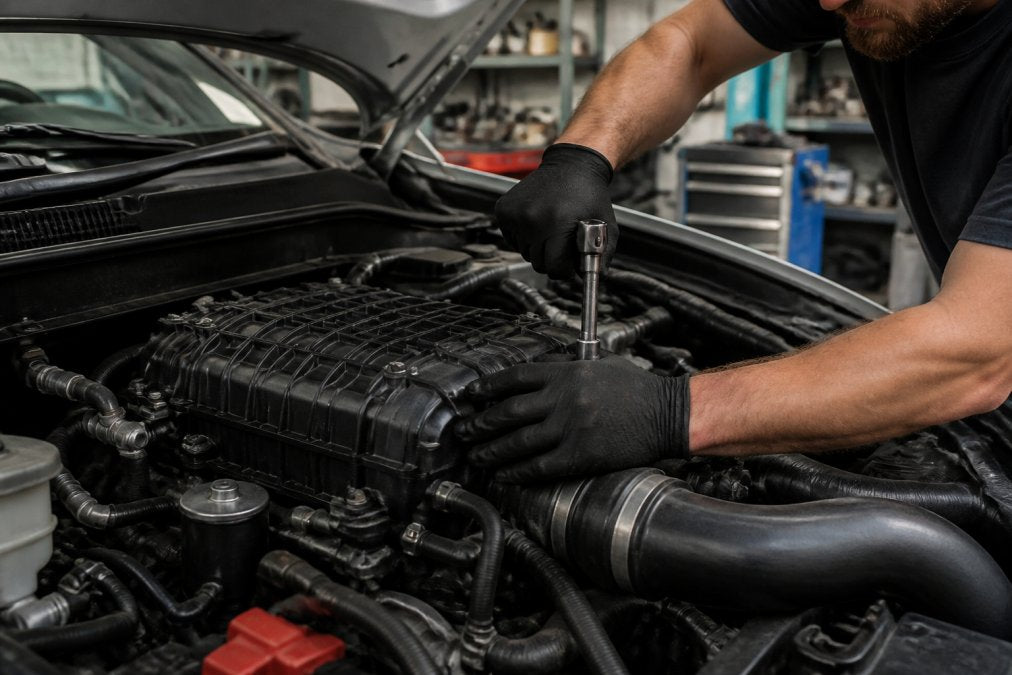
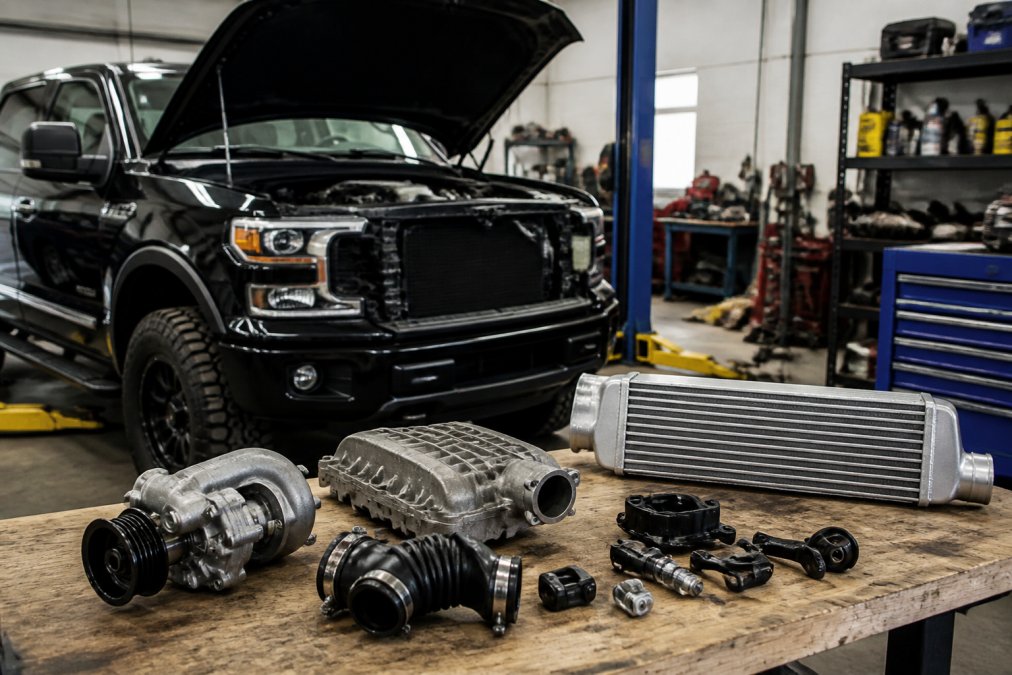
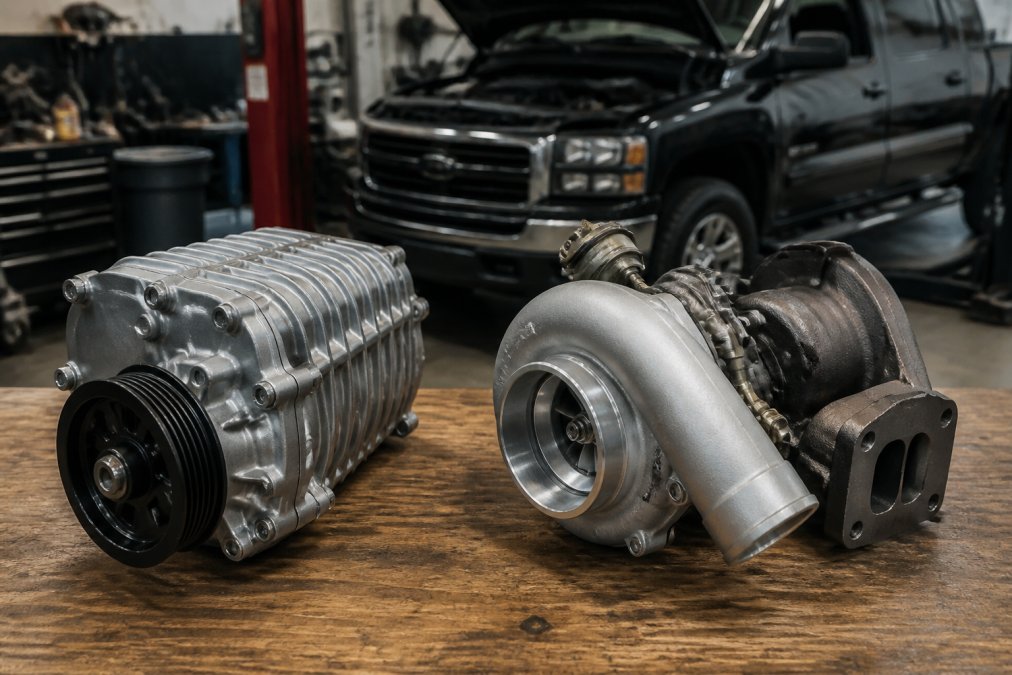
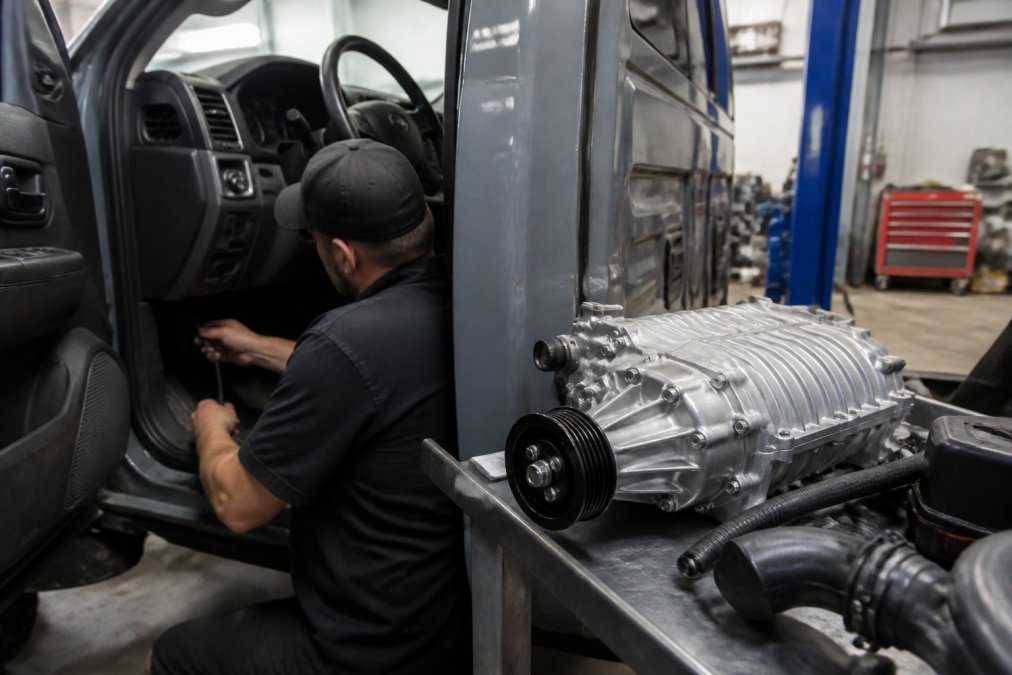
Custom tuning for supercharged trucks explained in plain terms comes down to one thing: rewriting the calibration inside your powertrain control module so the engine, transmission, and boost system work as a matched set. A supercharger forces more air into the cylinders, and the factory calibration was never written for that. At VT Superchargers, we see this constantly with bolt-on kits.
Why a Supercharger Alone Won't Run Right Without a Tune
Forced induction changes the physics of combustion, and the stock calibration cannot see it coming. Manifold absolute pressure climbs past what the factory fuel tables expect, and the engine leans out under load. Knock retard kicks in, pulling timing to protect itself, and you lose the power you just paid for.
Watch Out
Never run a supercharger kit on the stock calibration beyond a gentle idle check. Detonation under boost can crack pistons in minutes, and no warranty covers a lean-out you caused by skipping the tune.
Custom Tune vs Preloaded Tune: Which Fits Your Build?
A preloaded tune is a canned calibration written for a generic version of your engine. A custom tune is built for your specific truck, your fuel, your elevation, and your hardware. Preloaded files work fine on stock or near-stock builds. Once you add a supercharger, larger injectors, or a different pulley, a canned file leaves performance on the table and can be genuinely unsafe.
Pros and Cons at a Glance
| Factor | Preloaded Tune | Custom Tune |
|---|---|---|
| Cost | Lower upfront | Higher, includes dyno or remote logging time |
| Fit for stock trucks | Good | Overkill |
| Fit for supercharged builds | Risky | Required |
| Fuel and elevation flexibility | Fixed | Adjusted per data log |
| Revision support | Rare | Standard |
Preloaded tunes win on price and convenience. Custom tunes win on everything that matters once boost enters the picture. If you are running forced induction, the question is not whether to tune, it is who writes the file.
Supercharger Air-Fuel Ratio Tuning: Getting the Mixture Right
Supercharger air-fuel ratio tuning is where engines live or die. Under boost, the correct air-fuel ratio is richer than at idle, typically in the low 11s to low 12s on pump gas, because extra fuel cools the charge and suppresses detonation. A naturally aspirated engine can run leaner safely. A boosted one cannot.
Why Forced Induction Demands Richer Mixtures
Compressing air raises intake air temperature, and hot air invites knock. Extra fuel absorbs that heat as it vaporizes. Tuners also watch fuel injector duty cycle: if injectors run past roughly 85% duty cycle at peak boost, you need larger ones before chasing more power.
Truck Performance Tuning Risks: Knock, Heat, and Drivability
The three real risks in truck performance tuning are detonation, heat soak, and ruined drivability. What separates a safe boosted calibration from a grenade is knowing the specific thresholds your tuner is watching, and most generic tuning guides never give you numbers. Here are the supercharger-specific safety parameters that matter.
Knock Retard: The Number That Tells You to Back Off
Knock retard is the ECU's reaction to detonation, it pulls timing to stop the knock, and every degree it pulls is power you paid for. On a supercharged truck, a clean pull should show zero to roughly 2 degrees of knock retard at wide-open throttle. Anything sustained above about 3-4 degrees under boost means the calibration is too aggressive for your fuel, your intake air temperature, or your boost level.
Boost Pressure and the Safety Margin
Boost pressure is not a target you chase blindly. Every supercharger kit has a designed boost level, a pulley ratio and impeller speed that the fuel system, intercooler, and internals were sized for. Running above that level without supporting hardware pushes manifold absolute pressure past what the fuel tables and injectors can feed, and the engine leans out. A common pattern is a truck owner swapping to a smaller pulley for "a few more psi" without upgrading injectors or the fuel pump, then wondering why the tune keeps pulling timing.
Intake Air Temperature and Heat Soak
Compressing air heats it. A supercharger with a healthy intercooler and heat exchanger typically keeps intake air temperature within roughly 30-50 degrees Fahrenheit of ambient under a hard pull. When that gap widens, sitting in traffic, towing uphill, or after repeated pulls, the ECU pulls timing to protect itself, and you feel the power fall off. That is heat soak, and it is normal to a point.
Drivability: The Risk Nobody Logs
Drivability problems do not show up as a number on a dyno. They show up as harsh shifts, surging at part throttle, or a rev limiter that cuts in at the wrong moment. These usually trace back to torque management and transmission calibration, not the engine fuel map. On a lifted truck with oversized tires, the factory shift logic fights the new power curve, and a tuner who only touches the engine map leaves you with a truck that makes power and drives badly.
Toyota Tundra 5.7L 3UR-FE Supercharger →
How Data Logging Catches Problems Early
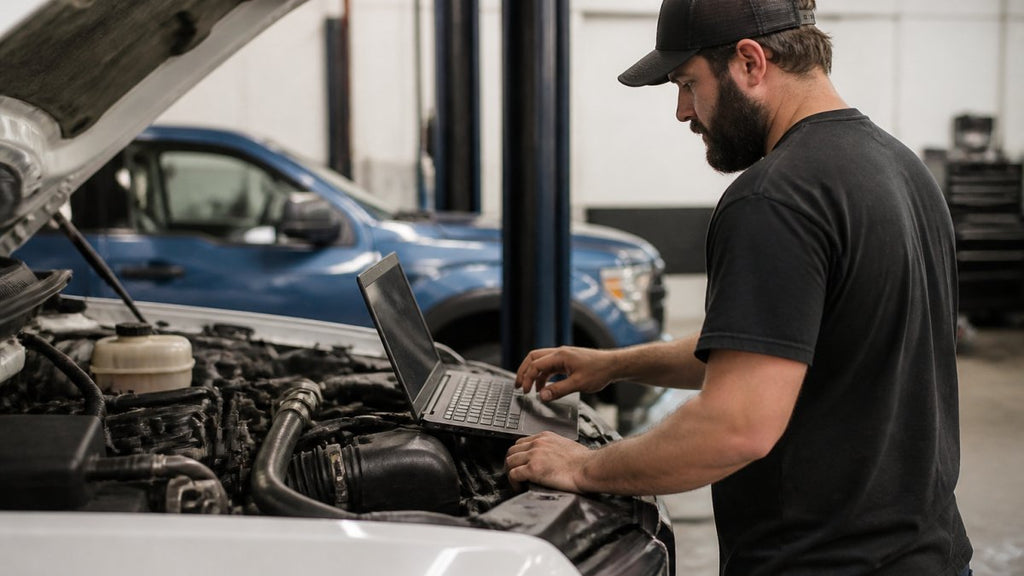
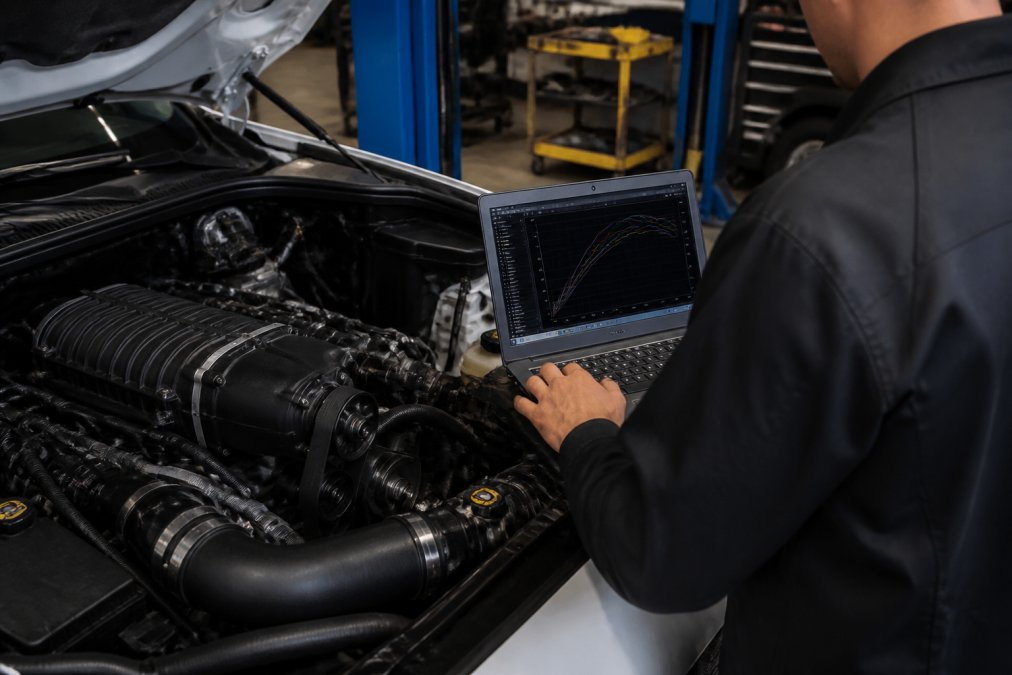
Data logging is the single most valuable habit a boosted-truck owner can build. A log captures boost pressure, air-fuel ratio, timing advance, knock retard, intake air temperature, and wastegate duty cycle over a real drive. Send that file to your tuner and they can revise the calibration before damage occurs.
- Log a third-gear pull from low RPM to redline
- Log a steady highway cruise to check closed-loop fueling
- Log a towing or loaded run if you haul
- Check diagnostic trouble codes after every revision
Pro Tip
Log the same stretch of road at the same ambient temperature each time. Comparing logs taken in different conditions is how people chase phantom problems for weeks.
Watch Out
If a log shows sustained knock retard above roughly 3-4 degrees or intake air temperature climbing well past ambient under load, stop the pull. Do not keep your foot in it hoping the ECU sorts it out, the ECU is already pulling timing to save the engine, and it has a limit.
Hardware That Must Match Your Custom Tune
Hardware compatibility decides how much a tune can safely deliver. A calibration is only as good as the parts feeding it. Mismatched hardware forces the tuner to pull timing and fuel to stay safe, which erases your performance gains. Here is what each part does and why it has to match the boost level you are running.
- Fuel injectors: sized for your target horsepower at a safe duty cycle. Injectors running past roughly 85% duty cycle at peak boost have no headroom left, and a tuner who sees that will cap your power rather than risk a lean-out. Upgrading injectors is usually the first hardware step before chasing more boost.
- Fuel pump and fuel system: injectors are only as good as the fuel feeding them. A stock pump that cannot hold pressure under boost will starve the injectors no matter how large they are. Most boosted builds need a higher-flow pump or a boost-a-pump before the injectors become the limit.
- Mass airflow sensor: must not max out its voltage range under boost. When a MAF sensor pegs, the ECU loses its primary load signal and the tune goes blind. Some builds move to a larger MAF housing or a speed-density (MAP-based) calibration to avoid this.
- Spark plugs: one heat range colder, with a reduced gap for forced induction. A colder plug pulls heat out of the combustion chamber and resists pre-ignition; a reduced gap keeps the spark strong under boost pressure, which tries to blow the flame out.
- Octane requirements: most boosted applications need 91+ octane premium fuel. Running lower octane on a boosted calibration is one of the fastest ways to induce knock retard and detonation.
- Intercooler and heat exchanger: keep intake air temperature in check. This is the hardware that decides whether your tune can stay aggressive on a hot day or has to pull timing to survive.
Why the Parts Have to Match Each Other, Not Just the Tune
The trap is upgrading one part in isolation. Bigger injectors on a stock pump starve. A smaller pulley for more boost on stock injectors leans out. A colder plug on a calibration that never sees boost does nothing. A tuner's job is to write a file that keeps every part inside its safe operating window at the same time, which is why a data log that shows duty cycle, MAF voltage, and intake air temperature together is worth more than any single number.
Key Takeaway
Match the hardware to the boost level first, then let the tuner write the calibration around it. A tune cannot make up for a fuel system that was never sized for forced induction.
Legal and Emissions Compliance for Tuned Trucks
Emissions compliance is the part most tuning guides skip entirely, and it is the part that can cost you at inspection. Under the federal Clean Air Act, tampering with emissions control equipment on a street-driven vehicle is prohibited, and the EPA has steadily increased enforcement against defeat devices and delete tunes. Many states run their own inspection programs that check readiness monitors, and a tune that disables an oxygen sensor or catalyst monitor will fail.
Post-Tune Maintenance Schedule and Warranty Coverage
Post-tune maintenance is what separates a boosted truck that lasts from one that eats itself. Boost accelerates wear on oil, plugs, and the cooling system, so your intervals tighten.
| Interval | Action |
|---|---|
| Every 3,000-5,000 miles | Oil and filter change, full synthetic |
| Every 15,000-30,000 miles | Spark plug inspection or replacement |
| Every oil change | Check coolant level and intercooler pump operation |
| Every 6 months | Review data logs for knock retard trends |
| Annually | Inspect belts, idler pulleys, and boost plumbing |
Key Takeaway
The tune protects the hardware. Skip it and you are gambling with an engine that cost more than the kit. Budget for the tune as part of the build, not an optional add-on.
Frequently Asked Questions
How much horsepower does a custom tune add to a supercharged truck?
It depends on the supercharger kit and engine. For example, the VT Superchargers kit for the Toyota Tundra 5.7L 3UR-FE delivers 40-60% more horsepower over stock and 30-50% more torque at 7 psi of boost. The Tacoma 3.5L V6 2GR-FKS kit adds 100 horsepower and 90 lb-ft of torque over stock. The tune itself doesn't create power, but it unlocks the safe, reliable output your supercharger hardware is capable of.
Do I absolutely need a custom tune after installing a supercharger?
Yes. Every VT Superchargers kit listing states that ECU/engine tuning is required for safe and optimal performance. Without a tune, the factory calibration cannot manage the extra airflow, leading to dangerous lean conditions, knock, and potential engine damage. The tune adjusts fuel delivery, ignition timing, and boost control to match the supercharger's output, protecting your engine while maximizing the performance gains you paid for.
What is the difference between a canned tune and a custom tune?
A canned (preloaded) tune is a generic calibration made for a specific vehicle and modification set, while a custom tune is built for your exact truck using data logs. Custom tuning accounts for your supercharger, octane, elevation, and hardware. For supercharged applications, custom tuning is strongly recommended because it tailors air-fuel ratios and timing to your setup, reducing risk and improving drivability.
Is it legal to use custom tuning on a street-driven truck?
Legality depends on emissions compliance. Federal law prohibits tampering with emissions control devices, and many states require vehicles to pass OBD-II readiness checks. A custom tune that disables or alters emissions controls may fail inspection. For street-driven trucks, choose a tune that retains emissions compliance and check your state's inspection rules. Off-road-only builds have different requirements, but always verify local regulations before tuning.
Boost without calibration is just heat and risk. The trucks that run reliably for years are the ones where the tune, the hardware, and the maintenance schedule were planned together from day one. VT Superchargers builds bolt-on kits with OEM-style fitment for a wide range of makes, backs them with a 24-month warranty, and offers financing so you can spread the cost of doing it right. Register with VT Superchargers and get the fitment guidance and tuning support your build actually needs.
Related post

RECENT POSTS