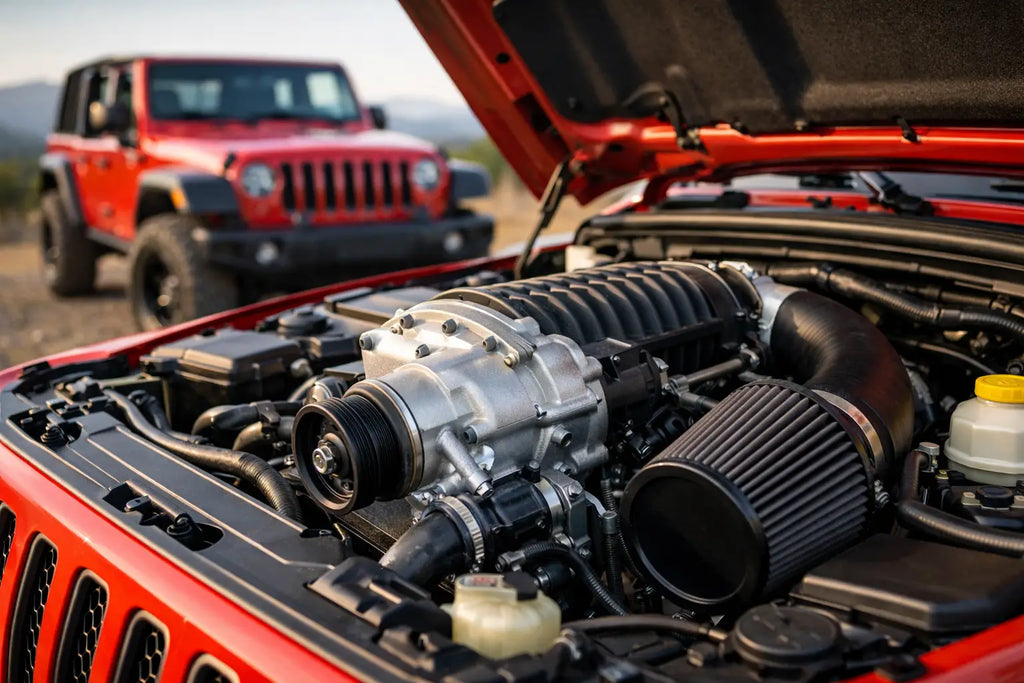
Jeep Wrangler Supercharger Benefits You Feel
Put 35s or 37s on a Wrangler, add steel bumpers, a winch, sliders, recovery gear, and a roof rack, then point it toward a mountain pass. Suddenly, that Jeep that felt fine on the dealer lot is hunting gears, losing speed on grades, and asking for more pedal than it should. That is where Jeep Wrangler supercharger benefits become real. This is not about chasing a dyno number for bragging rights. It is about getting your Wrangler to pull like a Jeep should after you have built it into the rig you actually wanted.
We see this all the time. A customer has a JK or JL that looks right, works right off-road, and has every upgrade he wanted. Then he drives it loaded for a weekend trip and realizes the factory engine is working overtime just to keep up with traffic. The biggest change from a properly matched supercharger kit is not a number on paper. It is the way the Jeep responds when you roll into the throttle.
The Jeep Wrangler Supercharger Benefits Start With Torque
Horsepower gets the headlines. Torque is what Wrangler owners feel in the seat, especially with larger tires and added weight. A centrifugal supercharger builds power in a smooth, predictable way as engine speed rises. You hit the gas to merge, climb a grade, or pass a slower vehicle, and the Jeep stops feeling like it needs a running start.
One of the biggest complaints we hear from 3.6L Pentastar Wrangler owners is weak midrange pull. Around town, the Jeep is manageable. On the highway, with 35-inch tires, it can feel flat when the transmission drops a gear and you need it to move now. More usable torque changes that. The throttle feels more connected, and the Jeep carries speed instead of bleeding it away every time the road turns uphill.
That matters even more on a loaded JL Unlimited or four-door JK. Add four people, coolers, camping gear, a fridge, tools, and a spare fuel can. You are asking a lot from a naturally aspirated V6 that was calibrated around a much lighter, stock-tire vehicle. After installing hundreds of kits, the first comment we usually get is simple: “It finally drives like it should.”
Bigger Tires Do Not Have to Make Your Wrangler Feel Slow
Big tires are part of the deal with Wranglers. A mild 33-inch setup may be easy to live with. Step into 35s, 37s, heavier beadlock-style wheels, and aggressive mud-terrain tires, and the rotational weight adds up fast. Even with a regear, the Jeep can still feel lazy when it needs to accelerate under load.
A regear and a supercharger do different jobs. Gears help put the engine back in a friendlier operating range. A supercharger adds the muscle that is missing when the vehicle is heavier, taller, and pushing more tire down the road. For some owners, gears are the first move. For others, especially those who spend plenty of time on the highway, towing, or driving at elevation, added power is what fixes the day-to-day frustration.
Most owners tell us they do not want their Wrangler to become temperamental. They want to leave a stoplight without matting the pedal. They want to pull onto the interstate without planning the merge a half-mile ahead. They want the transmission to stop constantly searching for the right gear. That is the practical payoff.
Passing and Hill Climbing Feel Different
A stock Wrangler can pass. It just tends to make you work for it. On a two-lane road, you often wait for a long opening because acceleration with oversized tires and a loaded cabin is not exactly urgent. With properly tuned boost, the Jeep builds speed with far less drama.
Hill climbing is where owners really notice it. Whether you are crossing the Rockies, heading into the Appalachians, or pulling a trailer through desert heat, altitude and grades expose weak factory power fast. Naturally aspirated engines lose power as elevation climbs. Forced induction helps bring back the response that disappears when the air gets thin.
That does not mean you should expect a Wrangler to tow like a heavy-duty pickup. Wheelbase, brakes, cooling, trailer weight, and factory tow ratings still matter. But within the Jeep's limits, more torque means less throttle, fewer downshifts, and a more relaxed pull on long grades.
Better Drivability Beats a Wild Power Curve
The right kit should not make a Wrangler feel like a race car with license plates. It should make it feel like the factory forgot to finish the job. Clean fitment, a proven calibration, and predictable power delivery matter more than a huge peak number that only shows up at wide-open throttle.
That is why vehicle-specific application details matter. A 2007-2011 JK with the 3.8L V6 is not the same animal as a 2012-2018 JK with the 3.6L Pentastar. A JL, a JLU, and a Gladiator can have different fitment, cooling, electronics, and tuning requirements depending on model year and engine. Do not buy based on a generic claim that a kit fits “Wranglers.” Verify the exact year, engine, transmission, and supporting modifications before ordering anything.
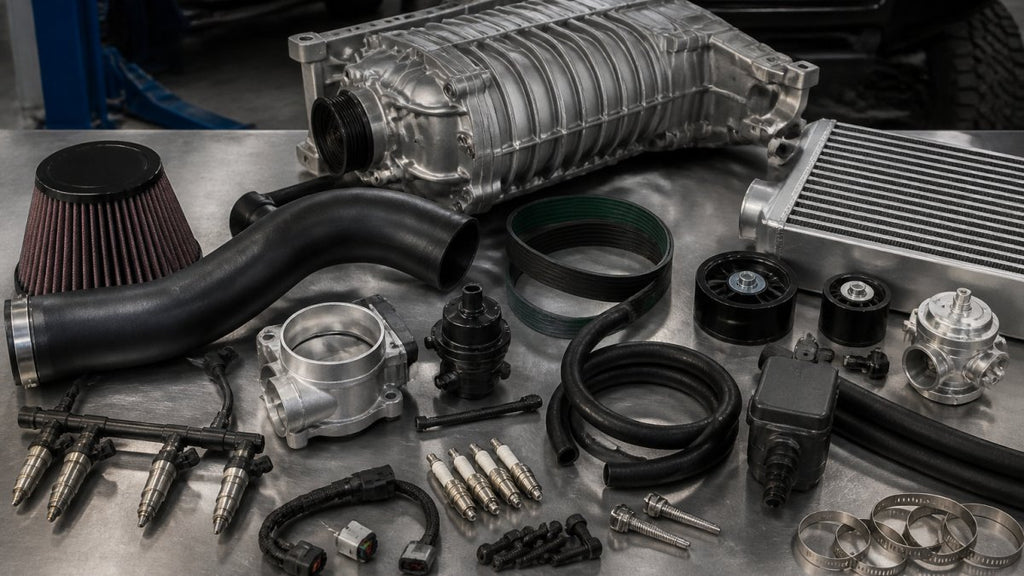
At VT Superchargers, that fitment-first mindset is the whole point. A bolt-on kit should install cleanly, preserve serviceability, and work with a tune designed for the vehicle it is going on. If the calibration is wrong, the Jeep can run poorly, shift badly, or create reliability problems that have nothing to do with boost itself.
A proper tune manages fuel, ignition timing, throttle behavior, and transmission behavior where applicable. It is what turns added airflow into smooth, repeatable power. You should be able to cold start the Jeep, drive through traffic, crawl into a parking spot, and head out on a road trip without feeling like you own a science project.
Off-Roading Gets Easier, Not Just Faster
No, a supercharger does not replace low range, lockers, good tires, or smart throttle control. On technical trails, finesse still wins. But added power can make a Wrangler more useful in loose sand, deep snow, soft dirt roads, and long climbs where momentum matters.
The key is controllability. You do not want a jumpy pedal that makes the Jeep hard to place over rocks. You want clean response when you ask for it. In higher-speed desert terrain or sandy climbs, that extra torque can keep the Jeep moving without burying the throttle and hoping the engine catches up.
Overland owners feel the benefit in a different way. Their rigs are heavy. Drawer systems, rooftop tents, skid plates, water, fuel, armor, and camping equipment can turn a Wrangler Unlimited into a rolling tool shed. The added power makes the drive to the trail less tiring, especially when the vehicle is loaded for several days.
Reliability Comes Down to the Whole Package
There is no honest conversation about supercharging without talking about responsibility. More power puts more demand on the engine, drivetrain, cooling system, fuel system, and tires. The best way to enjoy boosted power long term is not to stack random parts and chase the highest possible boost level.
Start with a healthy Wrangler. Handle maintenance first: fresh fluids, good plugs, no unresolved check-engine lights, no cooling issues, and no questionable transmission behavior. Use the fuel the calibration requires. Keep up with oil changes. Pay attention to belts, clamps, and scheduled inspections just like you would with any performance part.
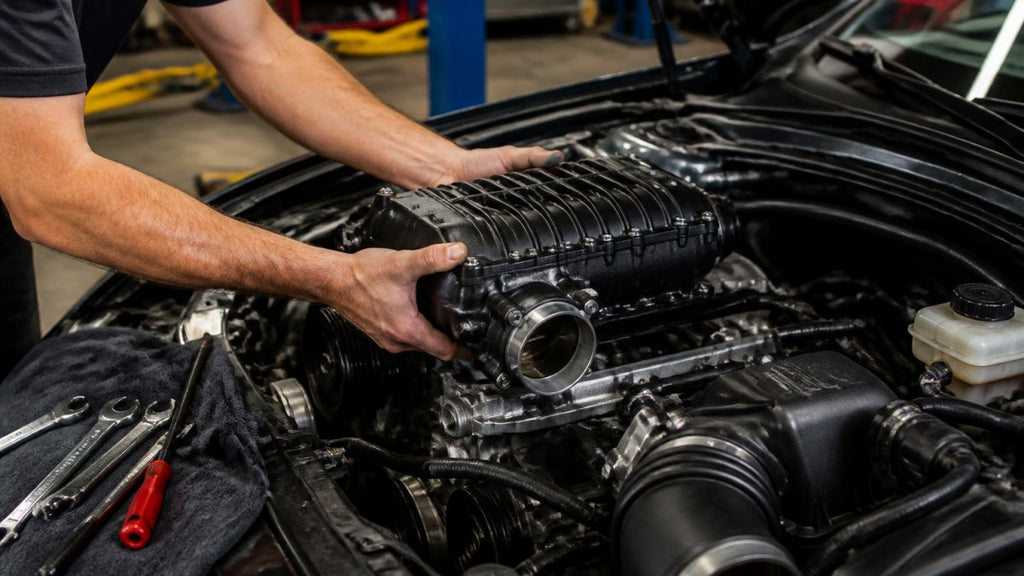
Installation matters, too. A kit can be engineered well and still cause headaches if hoses are routed poorly, fasteners are missed, wiring is sloppy, or the tune is not loaded correctly. We see this all the time with bargain installs. If you are not doing the work yourself and following the instructions closely, use an installer who understands forced induction and knows Wranglers.
Also be honest about your goal. If you spend every weekend bouncing a 37-inch Jeep off the rev limiter in deep mud, parts will wear faster than they would on a street-driven rig. If you want stronger daily acceleration, better mountain manners, and confident towing within factory limits, a conservative, properly supported setup is built for that kind of ownership.
Is a Supercharger Worth It for Your Wrangler?
It depends on how you use the Jeep. A mostly stock two-door that sees local errands and easy trails may not need it. But if your Wrangler has become heavier, taller, and slower with every modification, the value is easy to feel. The more often you deal with altitude, loaded cargo, highway passing, steep grades, or 35s and 37s, the stronger the case gets.
One of the biggest benefits is that you get to keep the Jeep you already built. You do not have to trade it for a different vehicle just because the power no longer matches the setup. Bolt on the right system, tune it correctly, maintain it, and your Wrangler can feel strong on Monday morning, headed to camp on Friday, and climbing toward the trailhead on Saturday. That is the kind of power upgrade worth doing.
Related post
09
Oct
RECENT POSTS