Supercharger vs Turbocharger for Off-Roading: 2026 Guide
Table of Contents
- How Superchargers Work vs How Turbochargers Work
- Supercharger vs Turbocharger: Performance Comparison Table
- Turbo Lag in Off-Road Driving: Why Throttle Response Matters
- Supercharger Low-End Torque Benefits for Rock Crawling
- Forced Induction Reliability for 4x4 Vehicles
- Installation Complexity and Space Requirements
- Cost, Warranty, and Long-Term Maintenance Considerations
- Which System Should You Choose for Your Off-Road Build?
Last Updated: August 6, 2026
How Superchargers Work vs How Turbochargers Work
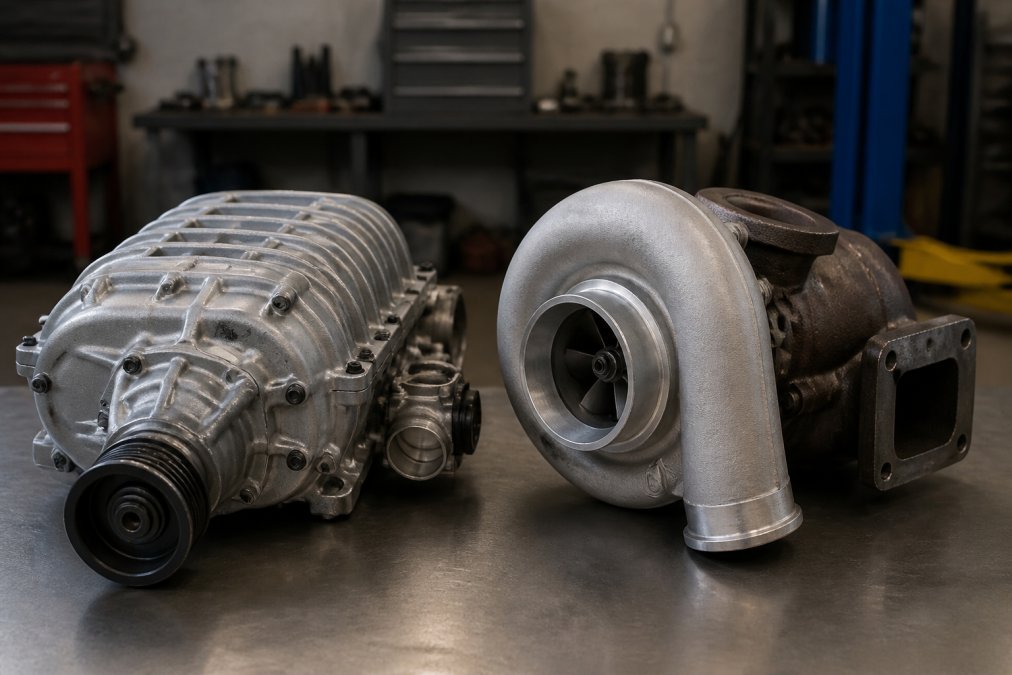
Both superchargers and turbochargers deliver forced induction by compressing air before it enters the engine, increasing power output. But they work fundamentally differently, and for off-road driving, that difference matters tremendously.
The Supercharger: Belt-Driven Forced Induction
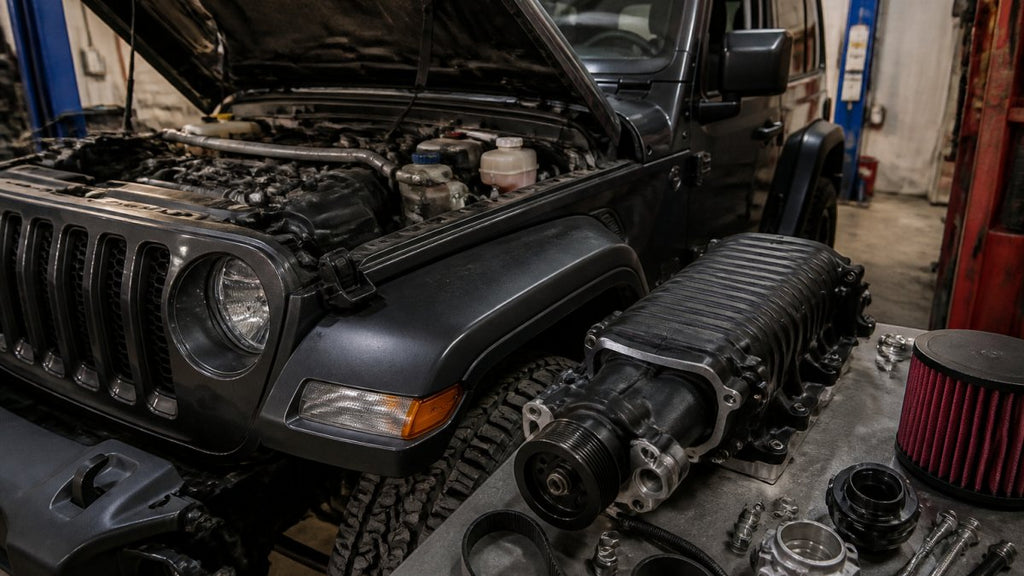
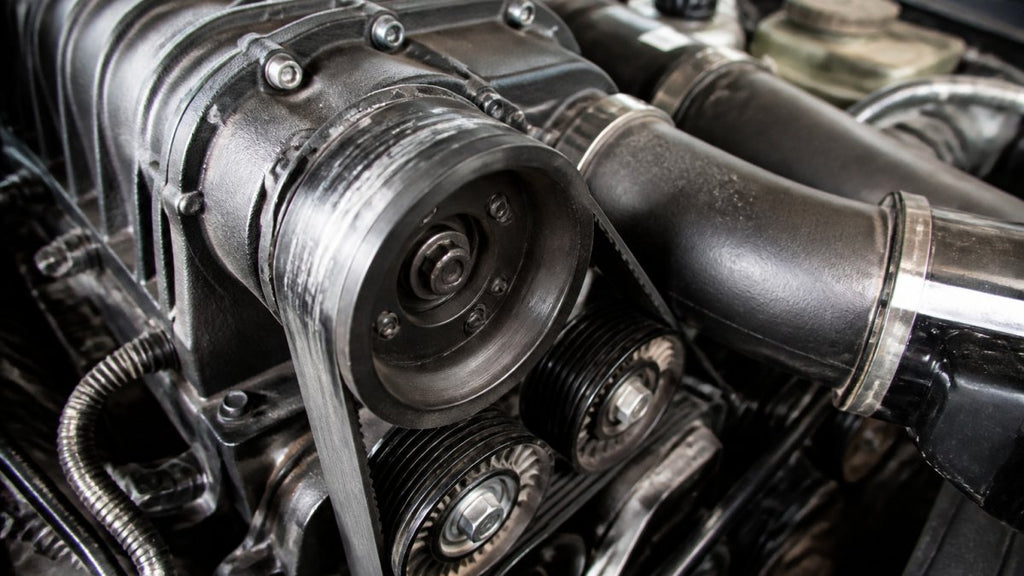
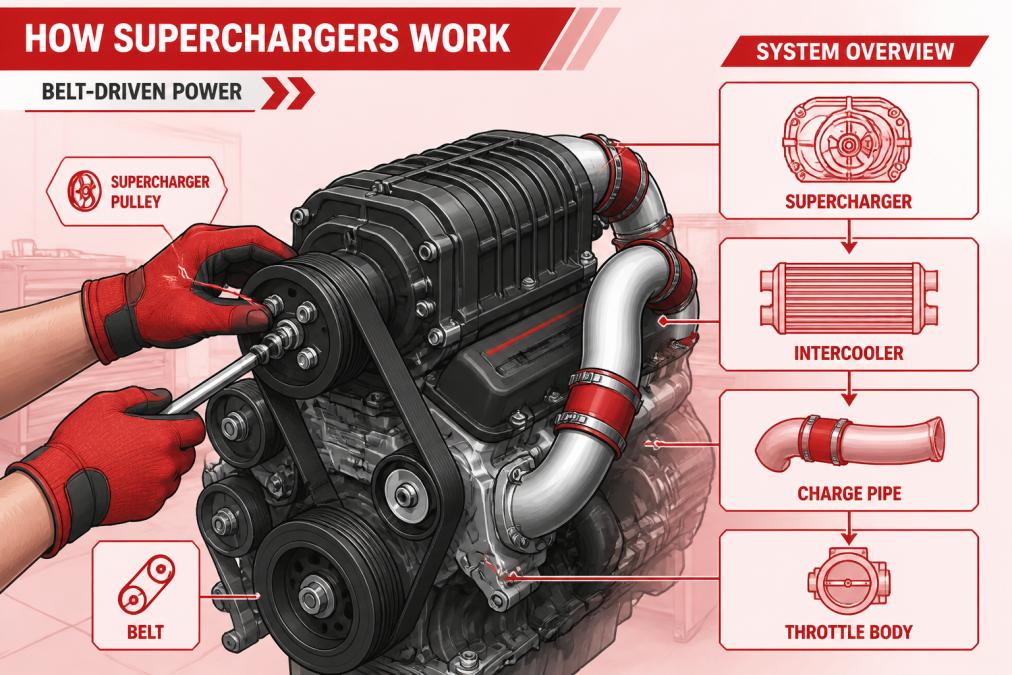
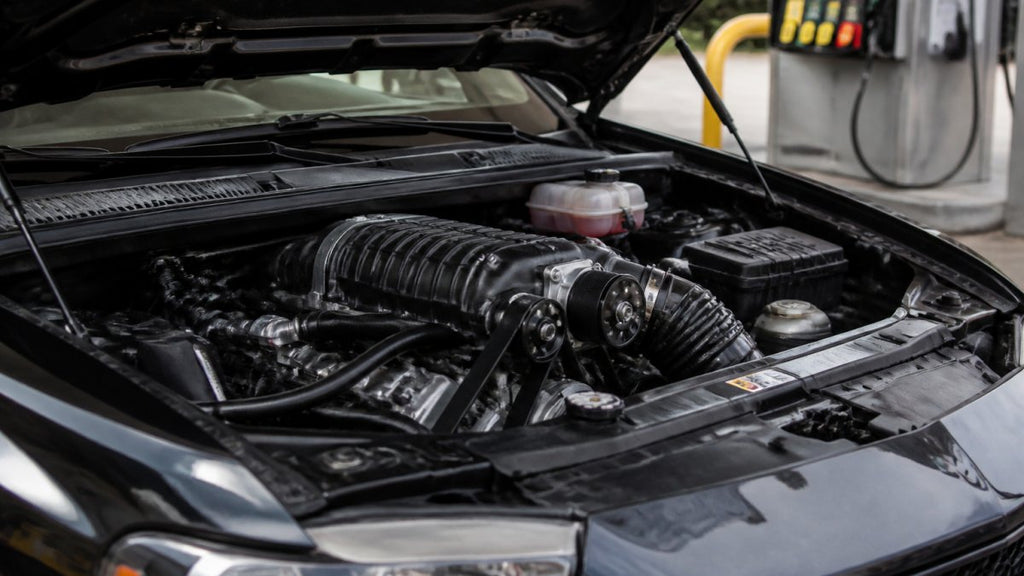
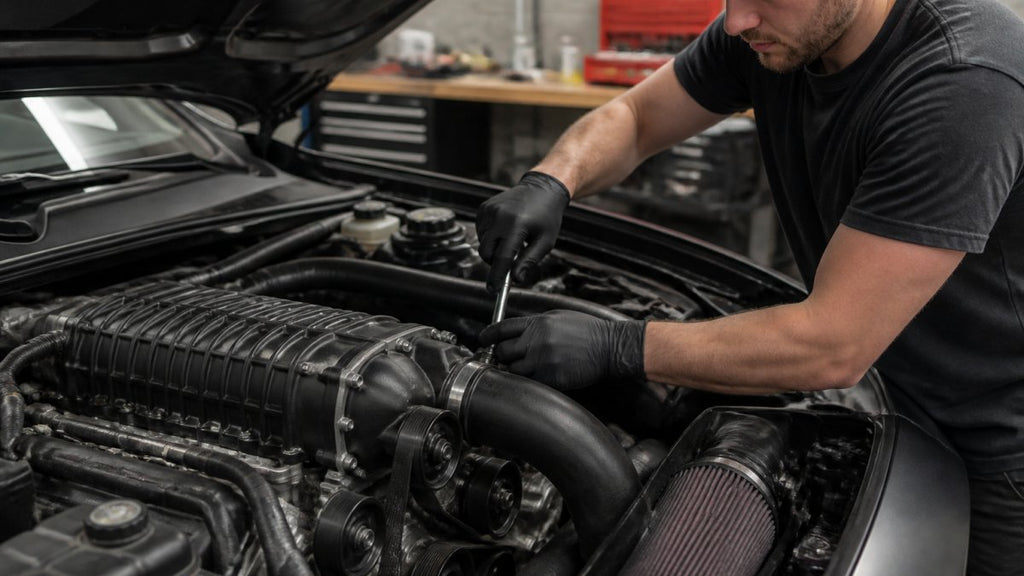
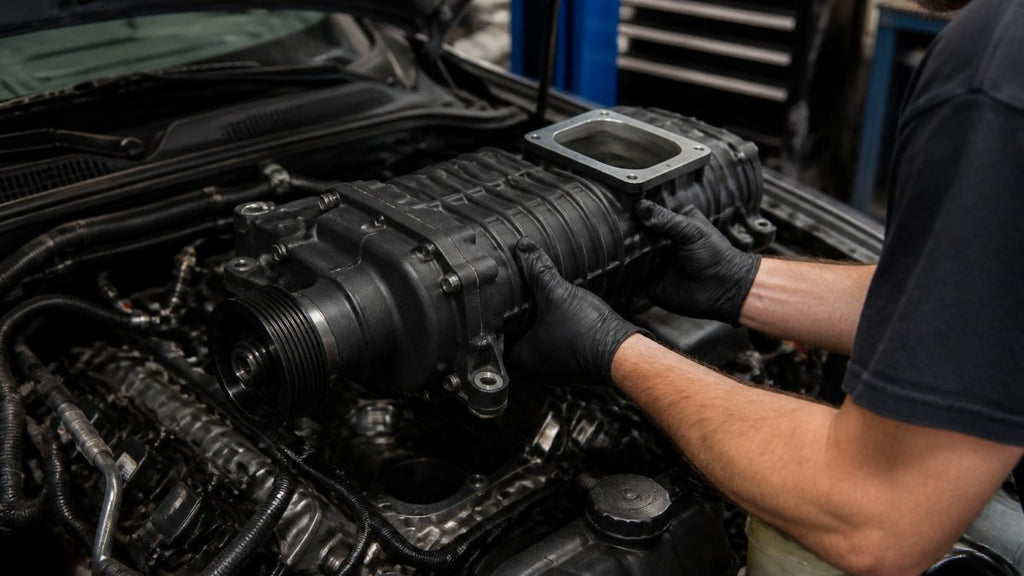
A supercharger is mechanically simple: a belt connected to your engine's crankshaft drives an internal compressor that forces air into the intake manifold. The moment you press the throttle, you get boost pressure instantly. This immediate response is why superchargers have dominated rock crawling and low-speed technical terrain for decades.
The compressor typically uses a rotary screw or centrifugal design. Screw superchargers deliver consistent boost across the RPM range, while centrifugal designs ramp up boost as RPM climbs. For off-road vehicles, this predictability is valuable, you know exactly how much power you'll have at any throttle position, which matters when picking a line through rocks or navigating tight switchbacks.
The tradeoff is parasitic loss. Because the supercharger is belt-driven directly from the crankshaft, it consumes engine power to operate, resulting in a small fuel economy penalty compared to naturally aspirated equivalents, even at cruise. For daily drivers with larger tires, this efficiency cost is often worth the low-end torque gains.
The Turbocharger: Exhaust-Gas-Powered Forced Induction
A turbocharger uses exhaust gas energy to spin a turbine, which drives a compressor on the same shaft. This recycles waste energy elegantly in theory, but introduces complexity and turbo lag, a critical timing delay that makes turbos challenging for off-road driving.
When you open the throttle, exhaust gas takes time to build pressure and spin the turbine up to boost-producing RPM. This delay can be 0.5 to 2+ seconds depending on engine, turbo size, and boost target. In rock crawling, it's a liability. You need power now, not after the turbo spools up.
Modern turbochargers address this with wastegates, variable geometry turbines, and smaller turbos that spool faster, but smaller turbos sacrifice high-RPM power, and variable geometry adds cost and maintenance complexity. The fundamental issue remains: turbos excel at sustained high-RPM power but struggle with the instant throttle response that technical off-road terrain demands.
Turbos are thermally efficient and don't consume parasitic power like superchargers, so fuel economy at cruise is better. For overlanders and desert racers who spend extended time at higher RPM, turbos deliver superior top-end power and better overall efficiency.
Supercharger vs Turbocharger: Performance Comparison Table
| Aspect | Supercharger | Turbocharger | Off-Road Winner |
|---|---|---|---|
| Throttle Response | Instant (0 lag) | 0.5-2+ sec lag | Supercharger |
| Low-End Torque | Peak at 2,000-4,000 RPM | Builds gradually | Supercharger |
| High-End Power | Plateaus at peak boost | Increases with RPM | Turbocharger |
| Fuel Economy | Parasitic loss (2-5% penalty) | Better at cruise | Turbocharger |
| Heat Management | Moderate (intercooler needed) | High (intercooler critical) | Supercharger |
| Mechanical Complexity | Medium (belt, pulleys, manifold) | High (turbine, wastegate, plumbing) | Supercharger |
| Installation Space | ~12-18 inches above engine | Exhaust manifold mounted | Turbocharger |
| Rock Crawling | Excellent (instant power) | Challenging (lag on throttle blips) | Supercharger |
| Desert Racing | Good (sustained power) | Better (high-RPM efficiency) | Turbocharger |
| Reliability (dusty/sandy) | Higher (fewer moving parts) | Lower (turbine wear, carbon buildup) | Supercharger |
| Maintenance Interval | 50K-100K miles (belt check) | 30K-60K miles (oil changes critical) | Supercharger |
| Cost (bolt-on kit) | $5,450-$6,950 | Similar range | , |
For off-road vehicles, the supercharger dominates in technical terrain. Instant boost pressure, predictable low-end torque, and simpler thermal management make it the choice for rock crawling and technical 4x4 work. Turbochargers win for high-altitude desert racing and sustained high-RPM power delivery, but that's a narrower use case.
Key Takeaway
Superchargers deliver instant throttle response and peak low-end torque, critical for rock crawling and technical terrain. Turbochargers excel at high-RPM power and fuel efficiency but introduce turbo lag that complicates precise throttle control in technical off-road driving.
Turbo Lag in Off-Road Driving: Why Throttle Response Matters
Turbo lag isn't just a performance metric, it's a real-world problem in technical off-road terrain. When navigating a rocky descent or picking a precise line through a tight switchback, you need power delivery that matches your throttle input instantly.
In rock crawling, drivers use small throttle blips to modulate wheel speed and maintain traction. With a supercharger, those blips translate immediately into boost pressure and engine torque. With a turbocharger, there's a delay, the turbine hasn't spooled yet, so the engine delivers less power than expected. The wheel loses traction momentarily, the vehicle lurches, and your line falls apart.
This becomes especially problematic with larger tires. A 2019 Ford F-150 with 35-inch tires already hunts gears on the highway because the engine works harder to turn the larger wheels. Add turbo lag, and you're fighting the transmission constantly while modulating throttle in technical terrain. A supercharger solves this by delivering consistent, predictable torque at any RPM, allowing the transmission to hold a gear and the vehicle to respond smoothly.
Desert racing is different, sustained high-RPM power matters more than instant response. But for 90% of off-road driving, technical terrain and rock crawling, the instant boost of a supercharger is the better choice.
Watch Out
Turbo lag in technical terrain can cause wheel spin, loss of traction, and unpredictable power delivery when modulating throttle over rocks or obstacles. Superchargers eliminate this problem by delivering instant boost pressure regardless of RPM.
Supercharger Low-End Torque Benefits for Rock Crawling
Low-end torque is where superchargers shine for off-road work. A supercharger's belt-driven design means boost pressure is available immediately, regardless of engine speed, creating a flat torque curve where maximum torque is available from low RPM.
For rock crawling at 1,500-3,000 RPM in low-range gearing, you need torque now. A supercharged engine delivers. The VT Superchargers kit for the Toyota Tacoma 3.5L, for example, adds 90 lb-ft of torque across the entire RPM range, with peak gains at the low end where rock crawling happens.

Compare this to a turbocharger. At 1,500 RPM, boost pressure is minimal because the turbine hasn't spooled. At 5,000+ RPM, the turbo is fully spooled and delivering maximum power. This RPM-dependent power curve is fine for highway driving but problematic for technical terrain where you need consistent torque across the entire crawl range.
Gear hunting on highways with larger tires is another area where low-end torque matters. A supercharger flattens this problem by delivering more torque at lower RPM, allowing the transmission to hold a gear longer without hunting. The result: fewer shifts, smoother power delivery, and better traction in technical terrain.
Forced Induction Reliability for 4x4 Vehicles
Reliability in off-road environments, dusty, sandy, extreme heat, is non-negotiable. A broken forced induction system can strand you miles from help.
Superchargers have fewer failure points. The belt, pulleys, and compressor are mechanical and simple, not relying on oil pressure or thermal management to the same degree as turbochargers. Maintenance is straightforward: check belt tension every 50K-100K miles and monitor the intercooler for debris.
Turbochargers are more complex. The turbine spins at 150,000+ RPM and relies on clean oil and consistent cooling to survive. In sandy or dusty terrain, turbo bearing wear accelerates if oil gets contaminated. Carbon buildup in the turbine reduces efficiency and can cause catastrophic failure. Water fording is another risk, if water enters the intercooler or intake, the turbo can hydro-lock and destroy itself instantly.
For altitude performance, superchargers also have an advantage. As air density drops at elevation, naturally aspirated engines lose power proportionally. A supercharger compensates by forcing more air into the engine regardless of altitude. A turbo also compensates, but less efficiently, thinner air means the turbine has less exhaust gas energy to work with, so boost pressure drops at altitude.
Pro Tip
In dusty or sandy off-road environments, superchargers are more reliable because they have fewer oil-dependent components. Turbochargers require cleaner oil and better cooling to survive extreme conditions, a significant maintenance burden in remote terrain.
Installation Complexity and Space Requirements
Installation difficulty directly impacts your build timeline and labor costs.
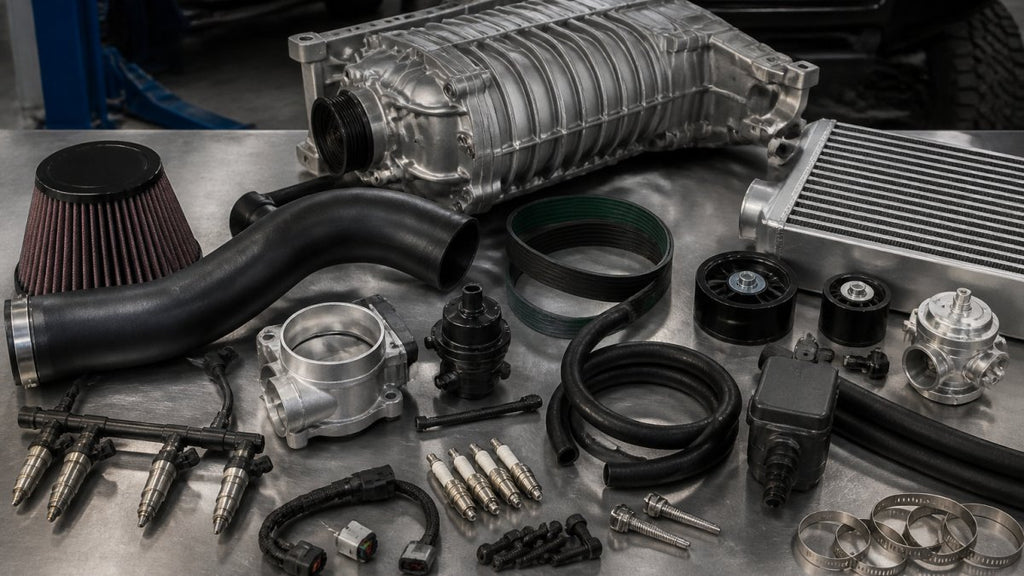
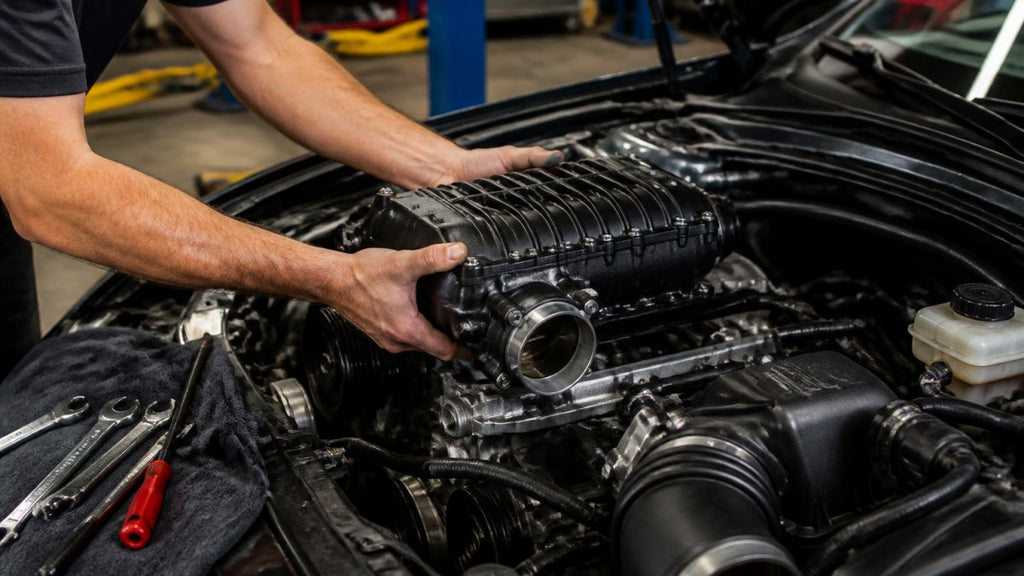
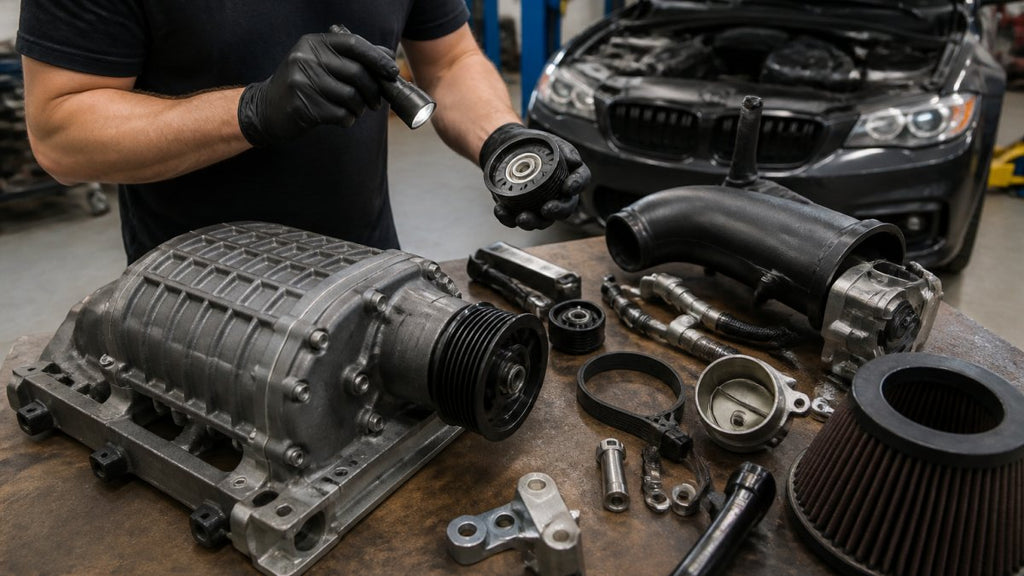
A bolt-on supercharger kit from VT Superchargers is engineered for OEM-style fitment. Installation typically requires 4-12 hours for a competent DIY builder or experienced shop. The supercharger mounts above the engine, requiring vertical clearance but not much extra room elsewhere. For most vehicles, the factory hood closes normally.

Turbocharger installation is more involved. The turbo mounts in the exhaust manifold location, requiring custom exhaust plumbing, intercooler lines, oil supply and return lines, boost control systems, and often ECU tuning. Installation time is typically 12-20 hours, and many builders prefer professional shop installation due to complexity.
For vehicles with existing aftermarket modifications, superchargers are easier to integrate because they don't require exhaust system changes. Turbochargers often conflict with custom exhaust work and require re-engineering.
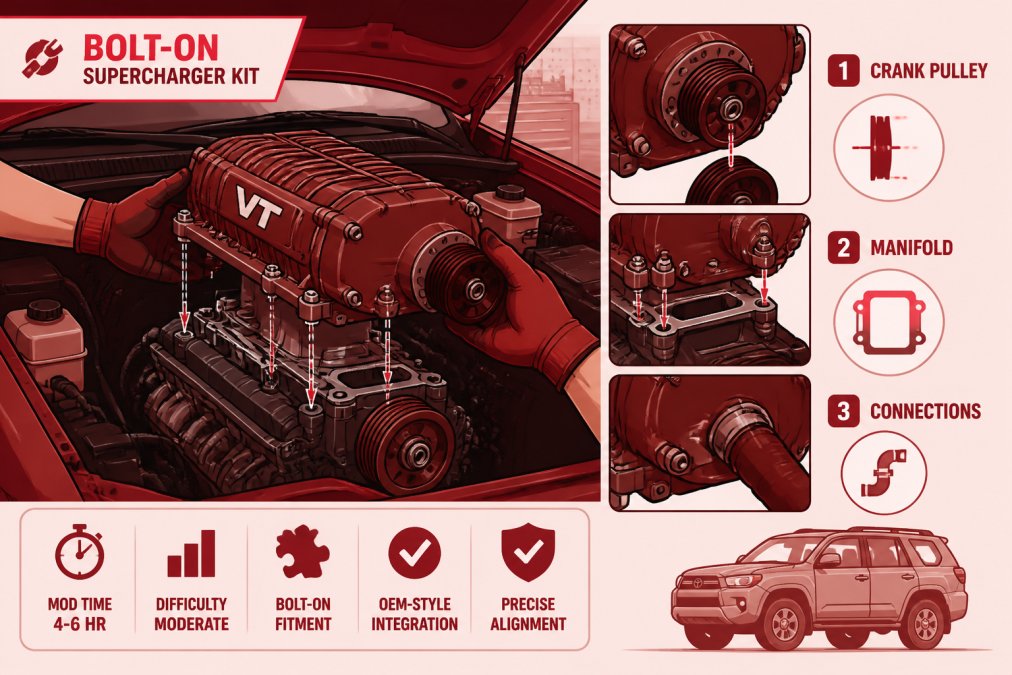
The labor cost difference is significant. A DIY supercharger install saves $1,500-$3,000 in shop labor. A turbo install almost always requires professional work, adding $2,000-$4,000 to total cost.
Cost, Warranty, and Long-Term Maintenance Considerations
Total cost of ownership includes the kit price, installation, and maintenance over time.
VT Superchargers kits range from $5,450 for the Suzuki Jimny to $6,950 for the Land Cruiser 5.7. These are complete bolt-on systems with OEM-style fitment. Professional installation adds $1,500-$2,500.

Turbocharger kits typically fall in a similar price range but often require additional expenses: custom exhaust fabrication, intercooler piping, oil lines, ECU tuning, and professional installation. Total turbo build cost often exceeds supercharger cost by $1,000-$3,000.
VT Superchargers provides a 24-month warranty on all kits, covering defects in materials and workmanship. VT also offers financing options, making upfront cost more manageable.
Long-term maintenance costs favor superchargers. Belt replacement every 50K-100K miles costs $200-$400. Turbochargers require more frequent oil changes and turbo bearing replacement, if needed, costs $1,500-$3,000 and requires professional work.
For daily drivers and off-road vehicles that see regular use, superchargers have a lower total cost of ownership over 5-10 years.
Best For
Daily drivers with larger tires needing low-end torque and simplified maintenance. DIY builders wanting straightforward installation without extensive fabrication. Off-road enthusiasts prioritizing reliability in dusty or sandy terrain.
Which System Should You Choose for Your Off-Road Build?
The answer depends on your specific use case, terrain, and priorities.
Choose a supercharger if:
You do primarily technical off-road driving, rock crawling, and tight trails. You need instant throttle response and predictable low-end torque. You're running larger tires and want to eliminate gear hunting on highways. You value simplicity and reliability in dusty or sandy environments. You want to DIY the installation. You're building a daily driver that also sees off-road use.
The VT Superchargers kit for your specific vehicle delivers these benefits with OEM-style fitment and a 24-month warranty. For a 2019 Ford F-150 with 35-inch tires, the supercharger solves gear-hunting by flattening the torque curve. For a Jeep or Toyota used for rock crawling, instant boost eliminates turbo lag and makes precise throttle modulation possible.
Choose a turbocharger if:
You do primarily high-speed off-road driving, desert racing, or dune running where sustained high-RPM power matters. You prioritize fuel efficiency at cruise and don't mind added maintenance complexity. You're willing to invest in professional installation and custom tuning. You have access to reliable maintenance in your area.
Turbochargers excel at sustained power delivery and thermal efficiency, making them better for desert racing and overlanding at consistent high RPM. But they require more maintenance, introduce turbo lag in technical terrain, and are more sensitive to water and dust contamination.
For most off-road builds, especially those combining daily driving with technical terrain, superchargers are the better choice. They deliver instant power, require less maintenance, cost less to install, and maintain reliability in extreme environments. The 24-month warranty from VT Superchargers and worldwide shipping with financing options make them accessible to builders at any experience level.
According to automotive engineering research on forced induction systems, superchargers provide superior throttle response consistency in variable-RPM environments, which is exactly what technical off-road terrain demands. For vehicles struggling with larger tires and transmission gear hunting, the low-end torque gains from a supercharger directly address the root problem.
For rock crawling, technical trails, and daily driving with performance demands, a supercharger from VT Superchargers delivers the instant response, reliability, and ease of installation that most off-road builders need.
Frequently Asked Questions
Why is a supercharger better for off-roading than a turbocharger?
Superchargers deliver instant boost pressure and low-end torque without turbo lag, which is critical for rock crawling and technical terrain where you need immediate throttle response. The belt-driven design provides consistent power delivery across the RPM range. Turbochargers excel at high-RPM power but introduce delay as the turbine spools, making them less ideal for low-speed technical driving where gradual, predictable power is essential.
Does turbo lag affect off-road performance in rock crawling situations?
Yes, significantly. In rock crawling, you operate at low RPMs with precise throttle control. Turbo lag creates a delay between throttle input and boost pressure delivery, causing the engine to hesitate when you need immediate response. This can make it harder to modulate power over obstacles and increases stalling risk. Superchargers eliminate this delay entirely, providing instant boost pressure the moment you apply throttle.
Which forced induction system offers better reliability for 4x4 vehicles in dusty or sandy environments?
Superchargers are generally more reliable in extreme off-road conditions because they have fewer moving parts and no turbine exposed to exhaust heat. Turbochargers require careful intake filtration and can suffer from heat soak in desert racing or sustained climbing. Both systems benefit from quality air filters and regular maintenance, but superchargers' simpler design means fewer potential failure points when operating in dusty, sandy, or high-heat environments common to off-roading.
Will a supercharger or turbocharger void my vehicle's factory warranty?
This depends on your manufacturer and how the modification is installed. Most forced induction kits, including VT Superchargers' bolt-on kits, are designed to maintain OEM-style fitment and won't automatically void your warranty. However, any engine damage caused by the upgrade may not be covered. VT Superchargers includes a 24-month warranty on their kits, and many reputable shops can install them without affecting your factory coverage. Always check your specific vehicle's warranty terms before installation.
Ready to eliminate gear hunting and unlock instant throttle response? The VT Superchargers kits deliver 40-100% more horsepower and low-end torque with OEM-style fitment, worldwide shipping, and a 24-month warranty. Financing available for qualified customers. [EXTERNAL_LINK: Explore VT Superchargers kits for your vehicle | vtsuperchargers.com] and register for technical support and installer resources today.
This article was written using GrandRanker
Related post
09
Oct
RECENT POSTS