Best Bolt-On Superchargers for Jeep Wrangler: 2026 Guide
Table of Contents
- Bolt-On Superchargers for Jeep Wrangler: Quick Comparison Table
- How We Selected the Best Bolt-On Superchargers
- Magnuson TVS1900 for Jeep Wrangler JL & Gladiator JT (2018-2021)
- RIPP Supercharger Kit: Best Supercharger for Jeep JK (2012-2018)
- Sprintex Gen 2 Supercharger: Efficient Forced Induction for JL/JT
- Magnuson TVS1900 for Jeep Wrangler JK 3.6L (2012-2018)
- RIPP Supercharger for Older JK Models (3.8L V6, 2007-2011)
- Jeep Wrangler Supercharger Kit Installation: DIY vs. Professional
Last Updated: July 23, 2026
Bolt-On Superchargers for Jeep Wrangler: Quick Comparison Table
Bolt-on supercharger kits deliver substantial horsepower and torque gains without engine replacement. The right system transforms acceleration, towing capacity, and off-road capability while maintaining OEM-style fitment and reliability.
| Supercharger Kit | Compatibility | Horsepower Gain | Starting Price | Best For |
|---|---|---|---|---|
| Magnuson TVS1900 (JL/JT) | 2018-2021 JL & JT 3.6L | 440 hp / 380 ft-lbs | $7,595 | On-road and off-road performance |
| RIPP Supercharger (JK 3.6L) | 2012-2018 JK 3.6L | 325 hp (rear-wheel) | $6,049 | Daily driving with reliability |
| Sprintex Gen 2 (JL/JT) | 2018+ JL & JT 3.6L | 310 hp (rear-wheel) | $6,450 | Low-end torque and efficiency |
| Magnuson TVS1900 (JK 3.6L) | 2012-2018 JK 3.6L | 400+ hp / 365 ft-lbs | $7,595 | V8-level performance without swap |
| RIPP Supercharger (JK 3.8L) | 2007-2011 JK 3.8L | 240 hp | $5,533 | Budget-conscious older models |
How We Selected the Best Bolt-On Superchargers
We assessed each kit across five critical dimensions: verified performance gains, installation complexity, compatibility with specific model years and engines, CARB certification status, and warranty coverage. We prioritized systems with documented dyno testing, real-world torque delivery, and bolt-on fitment requiring no cutting or welding. Compatibility is essential, a kit engineered for the 2018-2021 JL won't fit a 2012-2018 JK without modifications. We verified each recommendation against its intended model year and engine type.
Evaluation Criteria: Performance, Installation, Compatibility, and Warranty
Performance gains must be verified and consistent across real-world driving conditions. We prioritized kits with documented dyno testing and rear-wheel horsepower measurements that translate to actual drivability improvements.
Installation complexity separates weekend projects from multi-day shop visits. Bolt-on kits should require no cutting, welding, or custom fabrication, integrating with factory engine bays using existing mounting points.
CARB certification and 50-state legal status matter if you live in emission-controlled regions or plan to sell your vehicle later. We identified which systems have regulatory approval.
Warranty coverage and manufacturer support provide peace of mind after installation. A 24-month warranty backed by responsive customer service outperforms shorter coverage periods.
Pro Tip
Real-world torque matters more than peak horsepower for Jeep owners. Off-roading and towing demand low-end grunt. A supercharger delivering 80% of its torque by 3,500 RPM outperforms one requiring 5,000 RPM to reach full boost.
Magnuson TVS1900 for Jeep Wrangler JL & Gladiator JT (2018-2021)
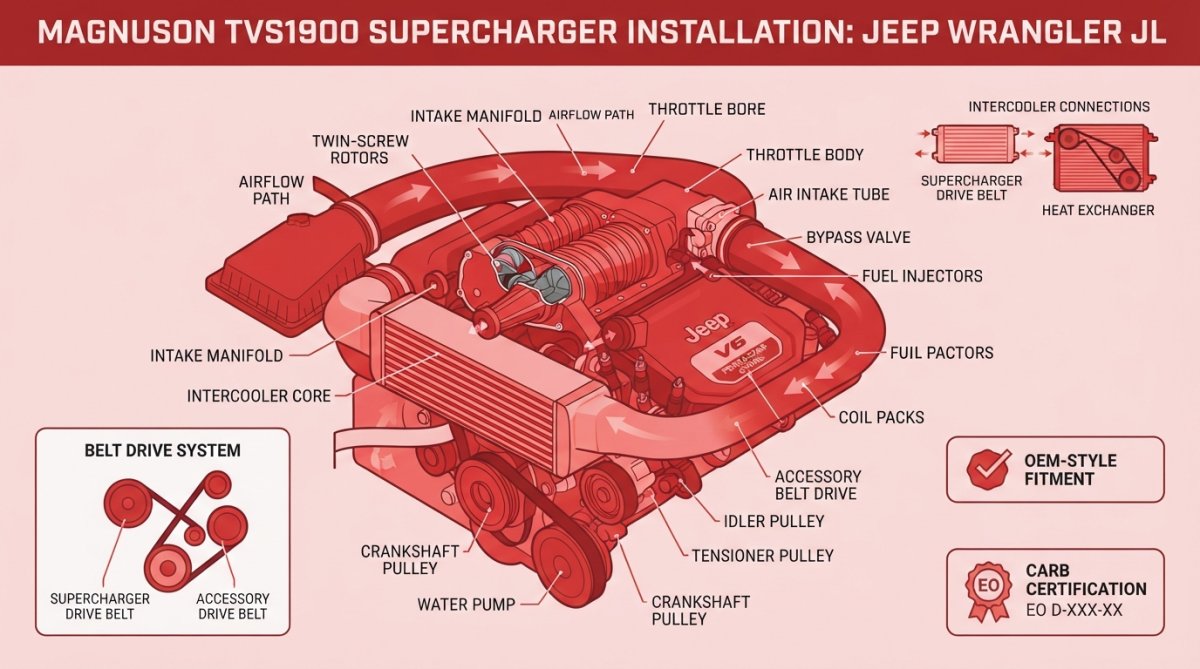
The Magnuson TVS1900 is the strongest all-around choice for newer Wrangler owners seeking maximum performance. It transforms the 3.6L Pentastar V6 into a powerhouse rivaling 5.7L HEMI performance.
Performance Gains & Real-World Numbers
The Magnuson TVS1900 produces 440 horsepower and 380 foot-pounds of torque at the crank, a 59% torque increase over stock. On the wheels, that translates to approximately 100 additional rear-wheel horsepower and 80 additional foot-pounds of torque, matching V8-level performance from a more efficient, lighter six-cylinder engine.
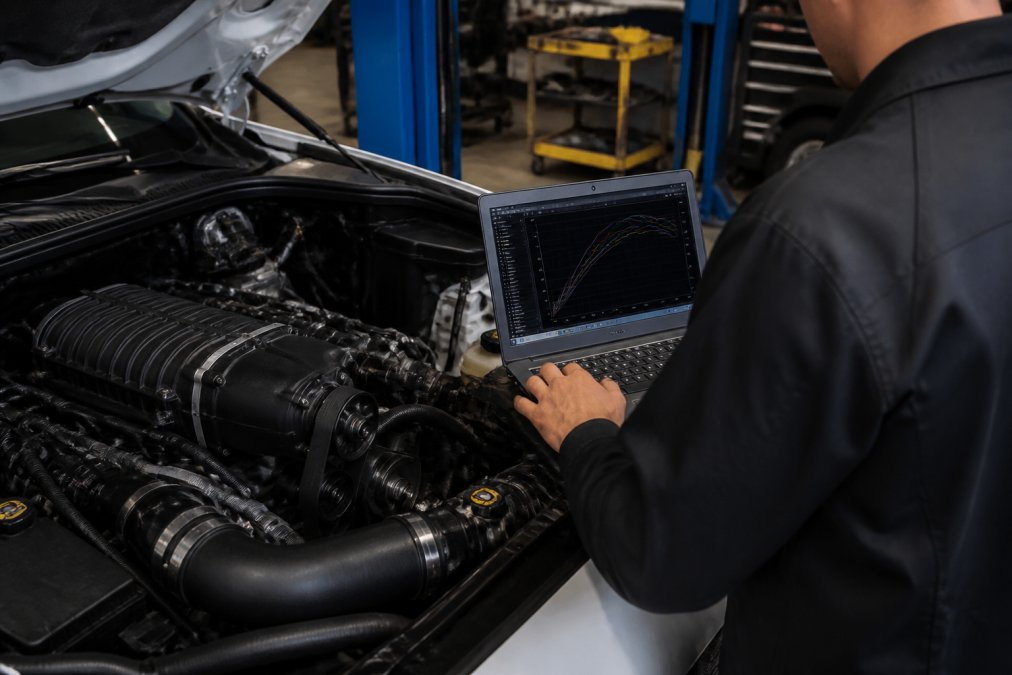
Dyno testing shows linear power delivery across the RPM range with 8.5 psi peak boost pressure. Off-roaders report dramatically improved throttle response in low-gear crawling, while highway drivers notice substantial passing power and towing capacity improvements. The twin-screw design delivers instant power response, critical for both on-road and off-road driving.
Watch Out
Non-eTorque vehicles (2018-2021 build dates) accept this kit readily. Models equipped with eTorque hybrid technology and GPEC5 computers (August 2021 onward) require ECU unlock and re-flash, adding complexity and downtime. Verify your specific build date with your dealer before purchasing.
Installation, Compatibility & CARB Certification
Installation typically requires one full day at a shop or two days for experienced DIY builders. The kit includes all necessary hardware, intercooler lines, belt drive system, fuel injectors, and MAP sensor. No cutting or welding is required.
The system is 50-state legal for specific 2018-2021 model years (CARB EO# D-488-52). Verify your vehicle's build date with VT Superchargers or Magnuson directly, as certification varies by production year. For non-eTorque vehicles, the factory computer accepts new parameters immediately. For eTorque models, send your PCM to Magnuson for unlock and re-flash, typically taking 3-5 business days.
RIPP Supercharger Kit: Best Supercharger for Jeep JK (2012-2018)
For owners of the previous-generation Wrangler JK, the RIPP Supercharger represents the most refined and proven forced-induction solution, with thousands of real-world miles documenting reliability and performance consistency.
Horsepower & Torque Delivery on the 3.6L Pentastar
The RIPP kit delivers 325 rear-wheel horsepower and 300 foot-pounds of torque on vehicles running 37-inch tires. Rather than chasing maximum peak power, RIPP calibrates the system for linear torque delivery and improved drivability. Owners report 1-4 mpg improvements in combined city/highway driving, a rarity in supercharged vehicles.
The Vortech V3 Si Trim supercharger operates with helical-cut gears, resulting in quieter operation than traditional Roots-type blowers. Throttle response is instantaneous with no lag, making the RIPP kit particularly effective for off-road driving where precise throttle control in technical terrain is essential.
Intercooler System & ECU Tuning
The front-mounted air-to-water intercooler keeps charge air temperatures low, preventing heat soak during extended driving or towing. The kit includes plug-and-play fuel injectors and a Diablo Sport Tuner pre-loaded with RIPP's proprietary tune. No ECU removal or external re-flash service is needed.
RIPP typically requires 10-14 days for assembly and shipping, as each kit is built to order. You'll provide your vehicle's VIN and current odometer reading; RIPP programs the tuner specifically for your engine's baseline parameters.
Sprintex Gen 2 Supercharger: Efficient Forced Induction for JL/JT
The Sprintex Gen 2 prioritizes low-end torque and efficiency, making it ideal for owners who value off-road capability and daily drivability over peak horsepower numbers.
Twin-Screw Design & Low-End Torque Benefits
Twin-screw superchargers deliver boost instantly across the entire RPM range. Unlike centrifugal units requiring RPM to build pressure, screw-type designs compress air proportionally to engine speed from idle onward. For Jeep owners navigating rocky terrain or towing, this characteristic is transformative.
The Sprintex Gen 2 produces 310 rear-wheel horsepower and 315 foot-pounds of torque at the wheels, with that torque arriving by 3,500 RPM. The system operates quietly, a significant advantage for daily drivers who don't want supercharger whine.
Water-to-Air Intercooler & Thermal Management
Sprintex includes a high-efficiency water-to-air intercooler that maintains consistent charge air temperatures during sustained driving. The system integrates with the factory cooling circuit, requiring no additional radiator or standalone cooling equipment.
DiabloSport provides dedicated tuning for Sprintex-equipped vehicles. CARB certification (EO: D-695-1 for JK models) confirms 50-state operation. The "No Tuner" option requires separate professional calibration, adding $500-800 to the total cost.
Magnuson TVS1900 for Jeep Wrangler JK 3.6L (2012-2018)
For JK owners seeking maximum performance without engine replacement complexity, the Magnuson TVS1900 delivers V8-level power through forced induction. The TVS1900 produces over 400 horsepower and 365 foot-pounds of torque at the crank, gains rivaling a 5.7L HEMI V8 swap, but with better weight distribution, lower complexity, and preserved resale value.
The kit includes all necessary components and maintains OEM appearance and fit. Installation requires no cutting or welding. Magnuson's TVS1900 design operates with exceptional thermal efficiency, ensuring consistent power delivery across extended driving sessions.
Key Takeaway
For 2015-2018 JK models, ECU unlock and re-flash adds 3-5 business days to the installation timeline. Earlier models (2012-2014) accept calibration parameters without external re-programming. Confirm your model year before purchasing.
RIPP Supercharger for Older JK Models (3.8L V6, 2007-2011)
Owners of 2007-2011 Wranglers with the 3.8L V6 engine have limited supercharger options, but RIPP's solution delivers substantial performance gains for this older platform. The 3.8L's modest stock output (210 horsepower) makes forced induction particularly effective.
Vortech V3 Si Trim & Instant Throttle Response
The RIPP kit for the 3.8L uses the Vortech V3 Si Trim supercharger, producing 240 horsepower on stock tire sizes and 230+ rear-wheel horsepower on 35-37 inch tires. Torque reaches 260+ foot-pounds, transforming the 3.8L from a modest performer into a capable engine.
The power curve is notably linear, with boost available across the entire RPM range. Off-road drivers report exceptional improvement in 4WD-low performance, where linear torque delivery and instant throttle response are essential for technical terrain navigation.
The system includes a front-mounted intercooler, Diablo Sport Tuner with RIPP tune, and all necessary hardware. Assembly and shipping typically require 10-14 days.
Jeep Wrangler Supercharger Kit Installation: DIY vs. Professional
Whether you tackle supercharger installation yourself or hire a professional shop significantly impacts timeline, cost, and risk.
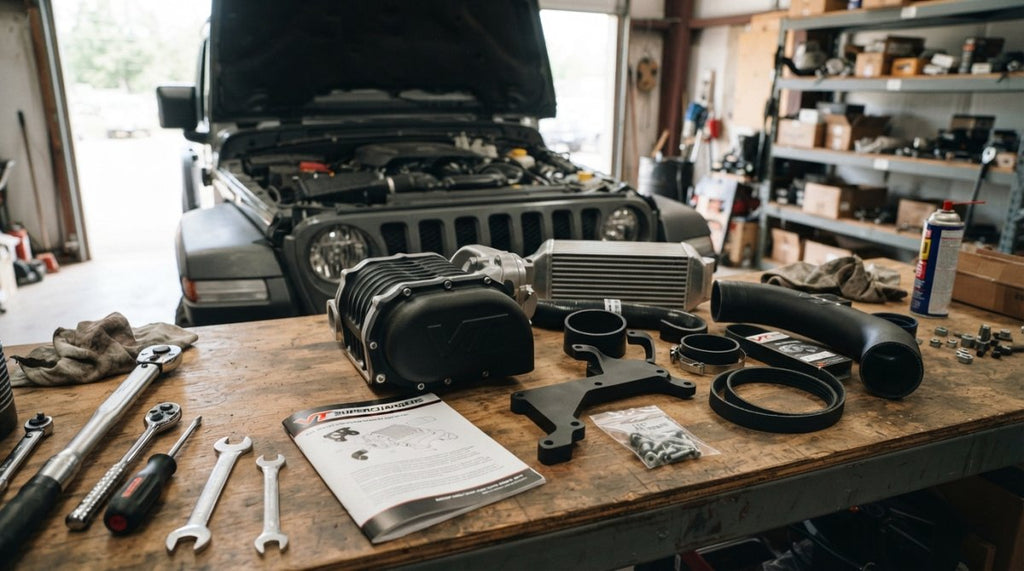
What's Included in Bolt-On Kits
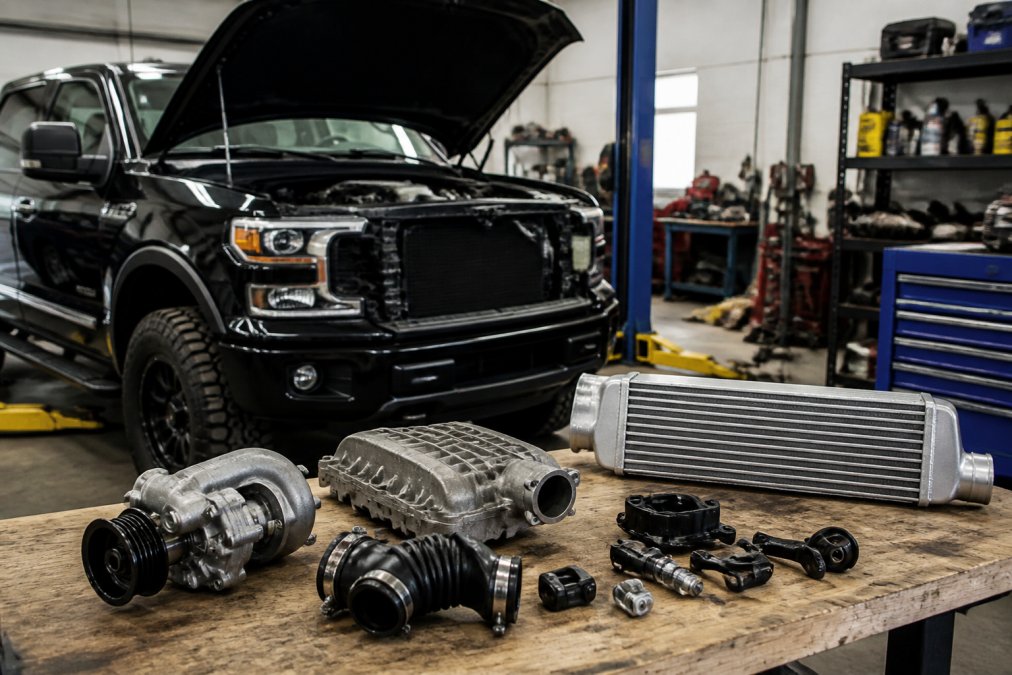
Complete bolt-on supercharger kits include the supercharger unit, intercooler and plumbing, belt drive system with tensioner, fuel injectors matched to the supercharger's air volume, MAP sensor, spark plugs, ECU calibration or tuner, and all mounting hardware. Most kits include detailed installation instructions with photographs or diagrams.
Kits typically don't include specialized tools (though most work uses standard shop tools), coolant and refrigerant for the intercooler circuit, or fuel system components beyond the injectors. VT Superchargers and other manufacturers include 24-month warranties covering defects in materials and workmanship. Review specific warranty terms before purchasing to understand coverage.
Step-by-Step Installation Overview
Professional shops typically complete supercharger installation in 8-12 hours of labor, spread across one or two days. DIY builders with mechanical experience can accomplish the same work in 12-16 hours.
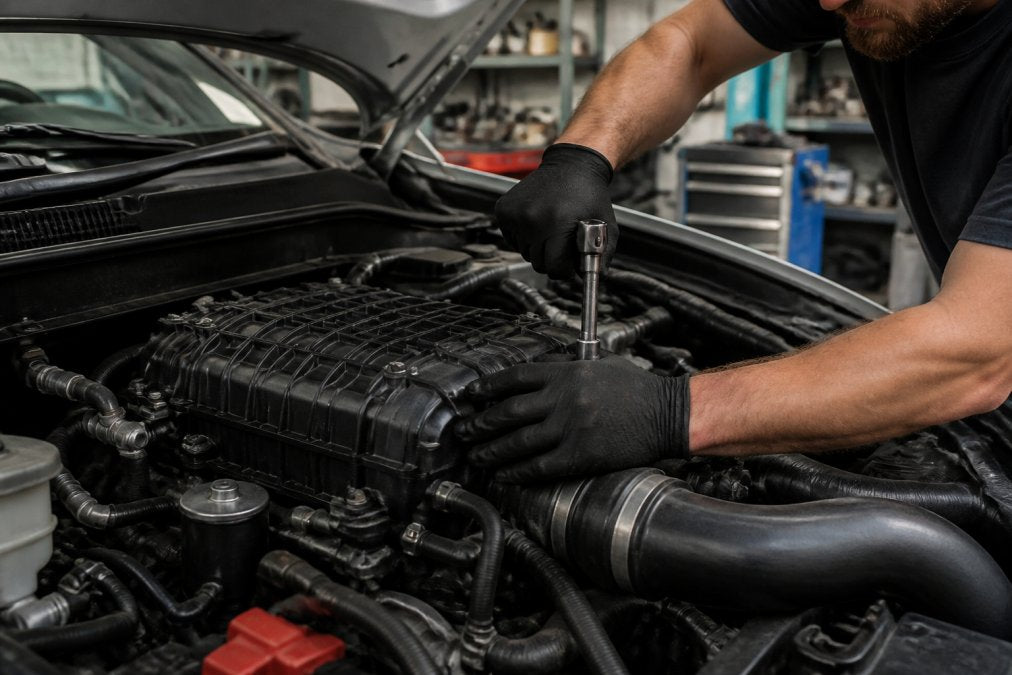
The process begins with battery disconnection and engine bay preparation. Remove the factory intake manifold, spark plugs, and interfering components. Install the supercharger mounting brackets and secure the unit using provided fasteners with proper torque specifications. Install the belt drive system, routing the serpentine belt around the supercharger pulley and adjusting tension to factory specifications. Connect intercooler inlet and outlet hoses, ensuring all connections are tight. Install the fuel injectors with proper seating and electrical connections. Map sensor installation requires tapping into the intake manifold or supercharger housing. Finally, load the ECU calibration or connect the tuner and verify all parameters.
Common Installation Mistakes & Troubleshooting
The most common mistake is improper belt tension. Belts that are too loose slip and lose power; belts that are too tight stress the supercharger bearings. Use a belt tension gauge if available, or follow the deflection method precisely.
Air leaks in the intercooler circuit or intake manifold sabotage performance and trigger check engine lights. Every connection must be tight, and hoses must be routed without kinks or damage. Pressure test the system before final assembly to catch leaks early.
Fuel injector seating errors cause misfires and rough idle. Injectors must seat fully in the fuel rail and connect properly to the electrical harness. ECU calibration mistakes result in poor drivability, hesitation, or limp mode. Ensure your tuner is programmed for your specific vehicle year, engine, and existing modifications.
Choosing the right bolt-on supercharger for your Jeep Wrangler depends on your model year, driving priorities, and budget. Whether you prioritize maximum horsepower, off-road low-end torque, or balanced performance, a proven supercharger kit exists for your needs. VT Superchargers specializes in engineered, bolt-on forced induction systems designed for OEM-style fitment and real performance gains. With a 24-month warranty and worldwide shipping, VT Superchargers provides the reliability and support you need to maximize your Jeep's potential. VT Superchargers supercharger kits for Jeep vehicles deliver verified horsepower and torque improvements across multiple Wrangler generations. Research from automotive performance testing data from major supercharger manufacturers and off-road performance studies on forced induction systems confirms that twin-screw designs deliver consistent boost across RPM ranges while providing low-end torque benefits critical for technical terrain.
Frequently Asked Questions
How much horsepower does a bolt-on supercharger add to a Jeep Wrangler?
Horsepower gains vary by Wrangler model and engine. The Magnuson TVS1900 for JL/JT models delivers 440 hp and 380 ft-lbs of torque at the crank (+100 rwhp to the wheels). RIPP kits for the 3.6L JK produce 325 WHP and 300 ft-lbs of torque on 37-inch tires. Older 3.8L models gain approximately 240 HP on stock tires. Real-world gains depend on tire size, gearing, and tuning calibration.
What is the cost of a bolt-on supercharger kit for a Jeep Wrangler?
Pricing ranges from $5,534 to $7,595 depending on the kit and Wrangler model. RIPP kits for 3.8L models start at $5,533.92. RIPP 3.6L kits are $6,049. Sprintex Gen 2 systems begin at $6,450 (without tuner). Magnuson TVS1900 kits for JL/JT and JK models are $7,595. Many manufacturers offer financing options to spread costs. Labor installation typically adds $1,500-$2,500 if outsourced to a shop.
Is a supercharger bad for your Jeep Wrangler engine long-term?
Bolt-on superchargers are engineered for OEM-style fitment and reliability when properly installed and maintained. Most reputable kits include 24-month warranties and CARB certification for emissions compliance. Potential concerns include increased fuel consumption, demand for higher-octane fuel, and stress on stock fuel injectors, all addressed by modern ECU calibration and intercooler systems. Long-term durability depends on maintenance, tuning quality, and driving habits. Built engines with quality fuel systems handle forced induction well.
How long does it take to install a bolt-on supercharger on a Jeep Wrangler?
Most bolt-on supercharger installations complete in 6-12 hours for experienced technicians or DIY builders. The Magnuson TVS1900 is often installed in a single day. Older 2015-2018 JK models may require additional time for ECU unlock/re-flash, adding 1-2 days of downtime. DIY installation time depends on mechanical skill and tool availability. Professional shops typically schedule 1-2 days. Kit assembly and shipping may add 1-2 weeks before installation begins.
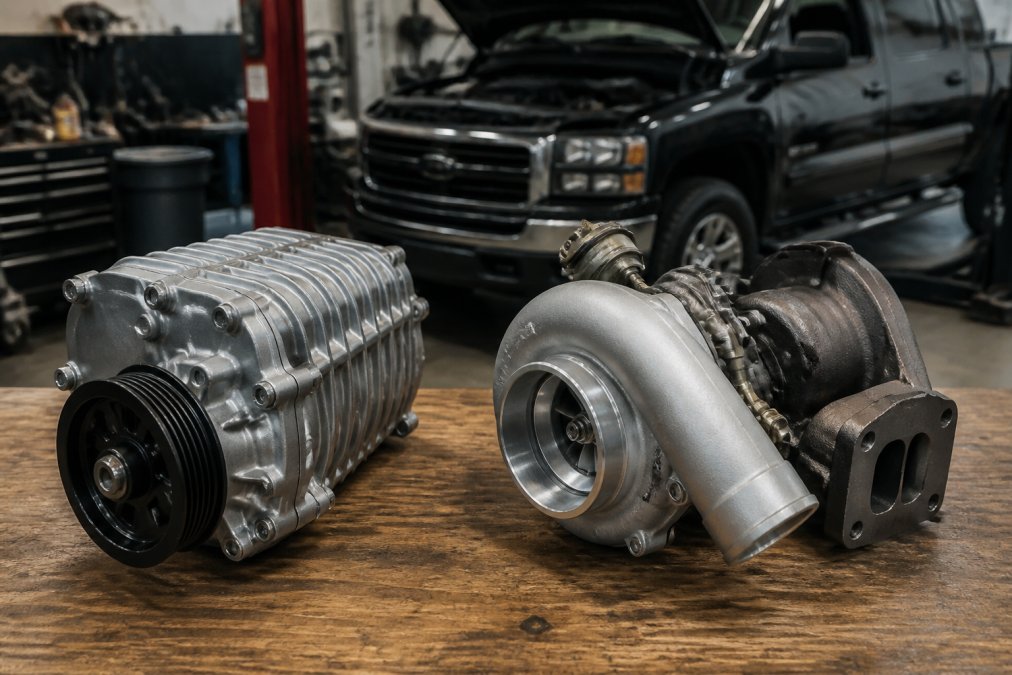
What is the difference between a supercharger and turbo for a Jeep Wrangler?
Superchargers deliver instant boost via a belt-driven compressor, providing immediate throttle response ideal for off-road driving. Turbos use exhaust gases and may experience lag before peak power. Superchargers are easier to install as bolt-on kits with minimal engine modifications. Turbos require exhaust manifold and intercooler plumbing, making them more complex. For Wrangler applications, superchargers dominate because they offer linear power delivery, better low-end torque for rock crawling, and simpler installation without sacrificing durability.
This article was written using GrandRanker
Related post


RECENT POSTS