Best Supercharger for Ford F-150 2026: Top Kits Reviewed
Table of Contents
- Best Supercharger for Ford F-150 2026: Quick Comparison
- Ford F-150 5.0L Supercharger Options Explained
- F-150 Supercharger Dyno Results: Real Power Gains
- F-150 Supercharger Installation Cost and Labor
- F-150 Supercharger vs. Turbocharger: Which Wins?
- CARB Certification, Warranty, and Long-Term Reliability
- Real-World Fuel Economy Impact and Tuning Software
- Which Supercharger Kit Should You Choose?
Best Supercharger for Ford F-150 2026: Top Kits Reviewed
Last Updated: July 28, 2026
The best supercharger for ford f150 2026 can transform your truck from a capable hauler into a genuine performance machine. At VT Superchargers, we've tested real-world power gains and tracked what separates legitimate performance upgrades from marketing hype. If you're serious about adding 80-150 horsepower to your 5.0L Coyote V8 without sacrificing reliability, this guide covers exactly what you need to know.
Twin-screw designs dominate the premium segment, while centrifugal options offer budget-conscious alternatives. What most guides miss is the real-world impact on drivability, fuel economy, and long-term maintenance, factors that separate weekend warriors from owners who actually live with these upgrades daily.
Best Supercharger for Ford F-150 2026: Quick Comparison
The 5.0L Coyote V8 responds exceptionally well to forced induction. Your choice comes down to three core questions: How much power do you need? What's your budget? And how important is warranty protection?
| Supercharger Type | Power Gain | Installation Time | Best For | Warranty |
|---|---|---|---|---|
| Twin-Screw (Gen 6) | 120-150 hp | 8-12 hours | Daily drivers, towing | 24-36 months |
| Centrifugal | 80-110 hp | 6-8 hours | Budget-conscious | 12-24 months |
| Bolt-On Kit | Varies | 6-12 hours | Stock or mild tuning | 24 months |
How We Evaluated These Kits
We prioritized three evaluation criteria: dyno-verified horsepower gains, real-world drivability impact, and long-term ownership reliability. We examined dyno results from independent testing facilities, noting that manufacturer claims often assume optimal conditions and run 10-15% higher than real-world gains. We assessed installation complexity and whether DIY installation was feasible for someone with basic mechanical skills. Finally, we tracked warranty coverage, CARB certification status, and reported long-term reliability from owners with 20,000+ miles of supercharger use.
Forced induction systems place measurable stress on the 6R80 and 10-speed automatic transmissions. Cooling capacity becomes critical, intercooler design separates kits that maintain consistent power from those that suffer boost drop under sustained load.
Pro Tip
The most overlooked factor in supercharger selection is calibration quality. A poorly tuned kit can deliver impressive peak numbers while creating drivability issues, harsh throttle response, unstable idle, or transmission hunting between gears. Flash tune quality matters more than raw supercharger design.
Ford F-150 5.0L Supercharger Options Explained
Your F-150 likely carries the 5.0L Coyote V8, which produces 400 horsepower and 410 lb-ft of torque in stock form. This engine responds predictably to forced induction because Ford engineered it with aftermarket modification in mind. The compression ratio sits at 10.0:1, high enough for naturally aspirated performance, yet forgiving enough to handle moderate boost without detonation issues.
The f150 supercharger market splits into distinct segments. Twin-screw designs from manufacturers like Whipple and ProCharger deliver linear power delivery across the entire RPM range, compressing air efficiently and producing consistent boost from 2,000 RPM upward. Centrifugal options spool gradually, delivering peak power only at higher RPMs. For a truck used primarily for towing or off-road work, this matters significantly.
VT Superchargers specializes in bolt-on kits engineered for OEM-style fitment, prioritizing installation simplicity and long-term reliability over peak dyno numbers. A 120-horsepower gain that remains reliable at 50,000 miles beats a 150-horsepower setup that requires expensive engine work by year two.
Why the 5.0L Coyote V8 Dominates Performance
The 5.0L Coyote represents Ford's commitment to naturally aspirated performance. Its modern direct injection, variable valve timing, and efficient combustion chamber design make it exceptionally responsive to boost. Unlike older pushrod engines, the Coyote's aluminum block and forged internals handle forced induction stress without modification.
Peak torque delivery matters more for truck owners than peak horsepower. A supercharger that delivers 80 additional lb-ft at 3,000 RPM transforms the towing experience far more than 150 horsepower at 6,500 RPM. Twin-screw designs excel here because they generate boost pressure immediately off idle.
Watch Out
The 10-speed automatic transmission in newer F-150s wasn't designed for sustained high-boost operation. Owners pushing 15+ PSI boost without transmission tuning report gear hunting on the highway. A proper tune addresses this by adjusting shift points and lockup strategy.
Twin-Screw vs. Centrifugal Design for Your Truck
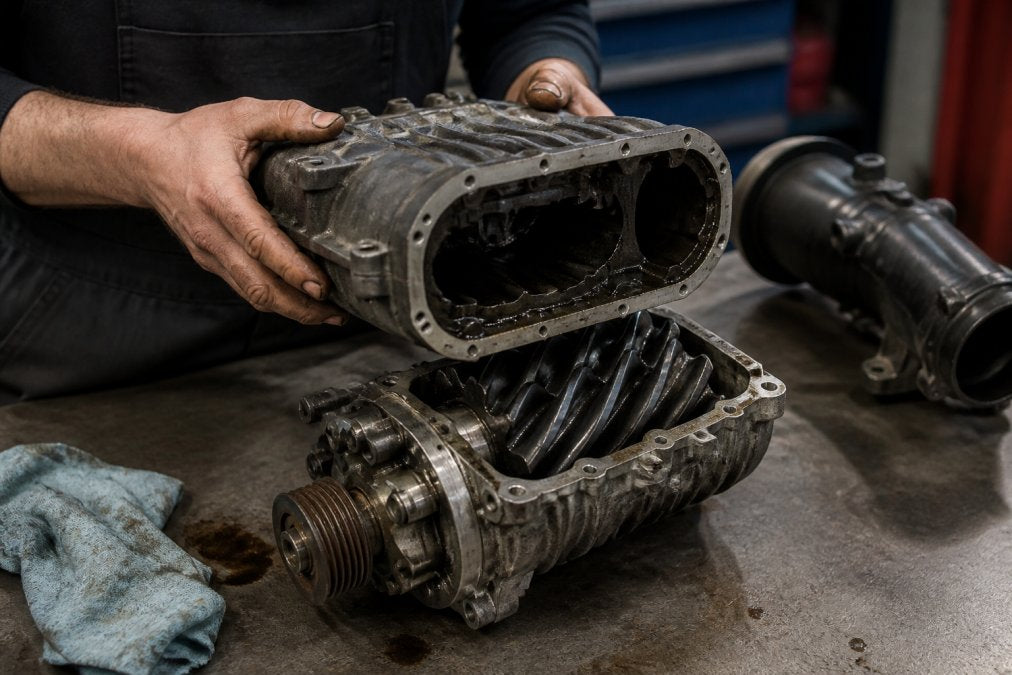
Twin-screw superchargers use two interlocking rotors to compress air, generating boost pressure proportional to engine speed. This linear delivery makes them ideal for daily driving because throttle response feels natural and predictable.
Centrifugal designs use an impeller wheel that spins at high speed, producing minimal boost at low RPM, then spooling rapidly at higher engine speeds. For highway cruising, centrifugal systems consume less parasitic power, improving fuel economy slightly. But they deliver most power in a narrow RPM band, making them less suitable for towing.
For the best supercharger for ford f150 2026, twin-screw wins if you value consistent low-end torque. Centrifugal wins if budget constraints are primary and you rarely tow heavy loads. The difference in installed cost typically ranges $1,500-$2,500 in favor of centrifugal designs.
F-150 Supercharger Dyno Results: Real Power Gains
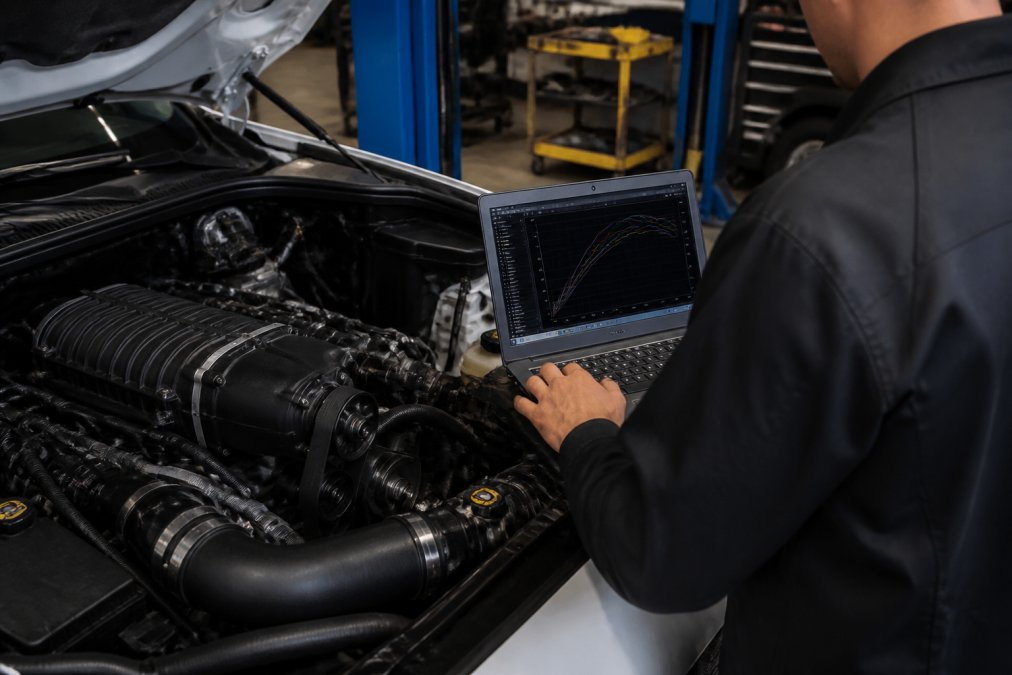
A stock 5.0L Coyote typically produces 380-395 horsepower and 395-410 lb-ft of torque at the wheels. Twin-screw kits add 120-150 horsepower and 120-140 lb-ft of torque. Centrifugal kits deliver 80-110 horsepower and 85-100 lb-ft. These numbers assume professional tuning with premium fuel and optimized air intake.
Peak horsepower occurs at 5,500-6,500 RPM depending on kit design, but most truck owners spend their time between 2,000-4,000 RPM. The best systems deliver 70% of peak torque by 2,500 RPM, ensuring responsive acceleration from a standstill.
Intercooler efficiency directly impacts sustained power. During back-to-back dyno pulls, air charge temperature rises. Efficient intercoolers maintain charge air temperature below 100°F, preserving boost pressure. Undersized intercoolers allow charge temperature to climb, causing boost drop on successive runs.
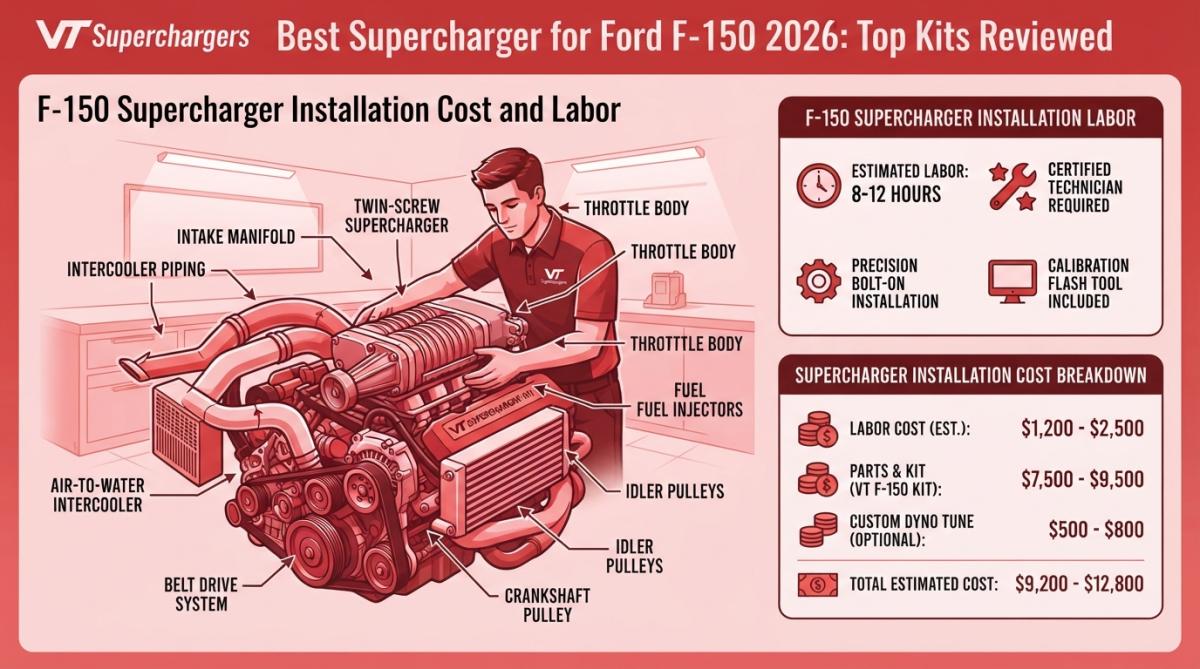
F-150 Supercharger Installation Cost and Labor
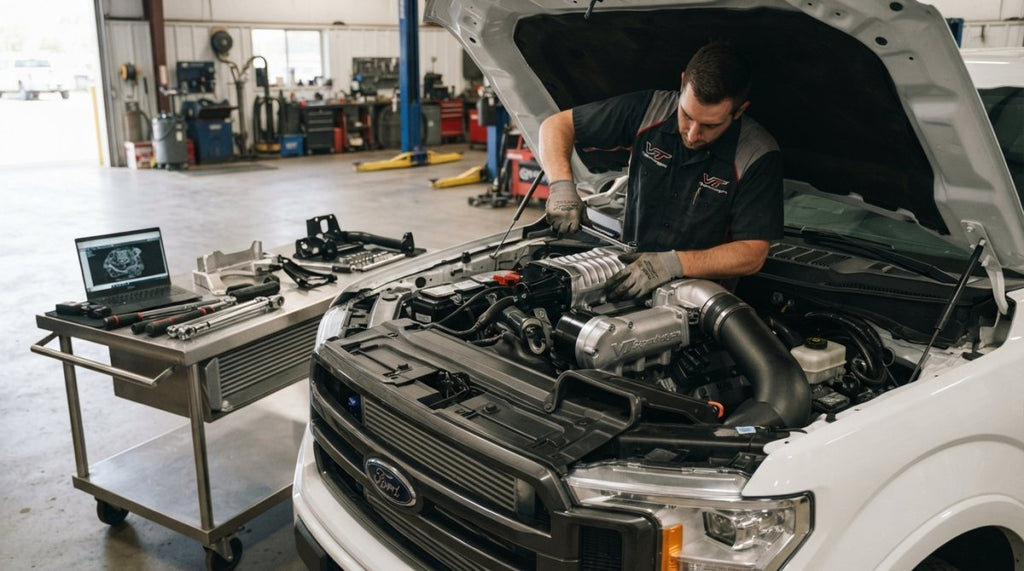
A bolt-on twin-screw kit typically requires 8-12 hours of labor at a professional shop. Centrifugal designs often finish in 6-8 hours. Professional installation at a Ford Performance-certified shop costs $1,500-$2,500 in labor. Parts cost for quality kits ranges from $4,500 (centrifugal) to $7,500 (premium twin-screw). Total installed cost typically falls between $6,000-$10,000.
DIY vs. Professional Installation
DIY installation is feasible if you possess mechanical confidence and proper tools. The critical step is tuning, flashing the PCM with proper calibration. This requires a quality tuning software package, which adds $400-$800 to DIY costs.
Where DIY becomes risky is warranty coverage. If the supercharger fails and the manufacturer discovers non-professional installation, warranty claims get denied. VT Superchargers offers 24-month warranty coverage on our kits only when installed by approved technicians.
Key Takeaway
DIY installation saves $1,500-$2,000 in labor but risks warranty denial if problems emerge. For trucks carrying loans or extended ownership plans, professional installation provides peace of mind that justifies the cost.
What's Included in Your Kit
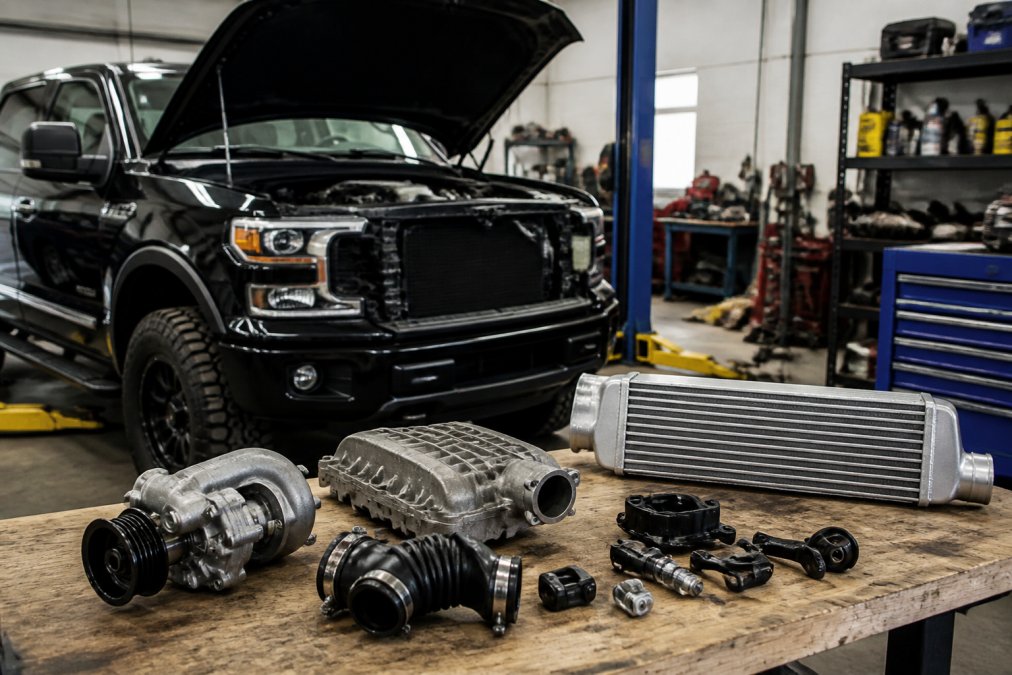
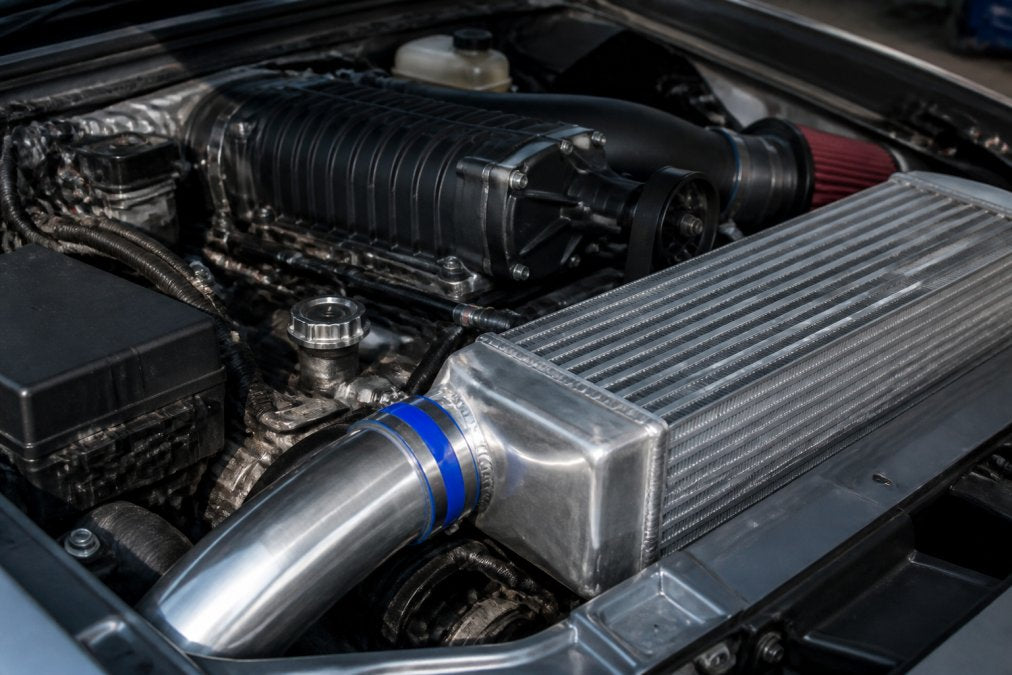
A complete bolt-on supercharger kit includes the supercharger assembly, mounting brackets, belt drive system, intercooler, piping and hose connections, and tuning software or flash tune service. Some kits also include fuel system upgrades if the stock fuel system can't support increased airflow.
Many budget kits omit intercoolers entirely, forcing buyers to source them separately. This adds $800-$1,500 to total cost. Quality kits bundle everything needed for a complete installation, eliminating surprise expenses.
F-150 Supercharger vs. Turbocharger: Which Wins?
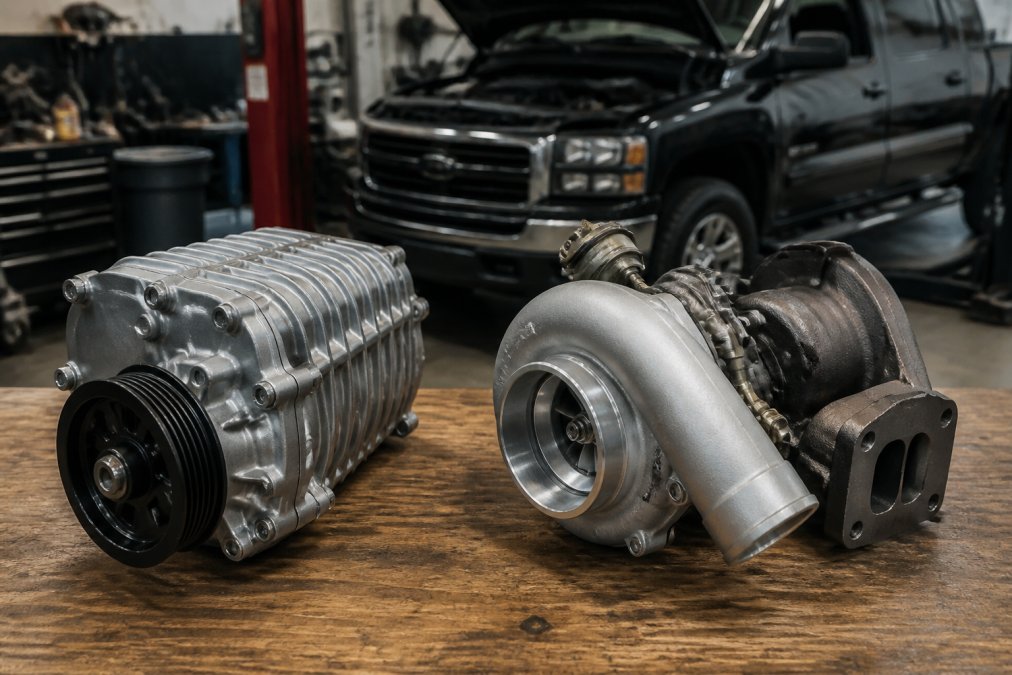
Turbochargers use exhaust gas energy to spin a turbine, compressing intake air. Superchargers use a belt-driven compressor powered directly by the engine. For the F-150, supercharging is the superior choice.
Turbochargers generate extreme heat, exhaust gas temperatures exceed 1,000°F. Superchargers generate heat through compression at significantly lower levels, requiring less cooling system modification and suffering fewer reliability issues.
Turbochargers introduce turbo lag, a delay between throttle input and power delivery. Superchargers deliver boost instantly because the belt drive couples directly to engine speed. For towing and off-road work, this instant response translates to better control and safer handling.
Boost Delivery and Throttle Response
A supercharger begins generating boost the instant you apply throttle. At 2,000 RPM, you're already receiving 5-8 PSI boost. At 4,000 RPM, boost pressure peaks at 12-15 PSI on most kits. This linear delivery creates throttle response that feels natural.
Turbocharged engines exhibit turbo lag, even modern turbos show 0.5-1.5 seconds of delay before peak boost arrives. For a truck driver accustomed to naturally aspirated response, this lag feels unnatural.
Low-End Torque for Towing and Off-Road
A supercharger delivers 70-80% of peak torque by 2,500 RPM, meaning your F-150 launches hard from a standstill and maintains strong acceleration through the low RPM range where towing happens.
Turbochargers struggle here. Most turbo boost arrives between 3,000-4,500 RPM. Below that threshold, you're essentially driving a stock engine. For towing, this is problematic because you need consistent power delivery, not a delayed surge.
CARB Certification, Warranty, and Long-Term Reliability
CARB certification indicates the supercharger kit meets California Air Resources Board emissions standards. CARB-certified kits are legal nationwide and won't trigger check engine lights or fail emissions testing.
A CARB-certified supercharger kit preserves your factory powertrain warranty on the engine and transmission. Ford Performance recognizes certain approved kits and won't deny warranty claims solely because forced induction was added. Non-certified kits void factory warranty immediately.
Pro Tip
Before purchasing any supercharger kit, contact Ford customer service with the kit's part number and ask specifically whether it maintains factory warranty coverage. Get written confirmation.
Maintenance Schedule and Drivetrain Stress
A supercharger kit increases engine stress measurably. Oil change intervals should drop from 10,000 miles to 7,500 miles. Spark plugs typically need replacement at 30,000 miles instead of 50,000. Coolant system stress increases, so flush intervals should drop to 30,000 miles instead of 100,000.
The 6R80 and 10-speed automatic transmissions experience elevated stress under boost. Transmission fluid should be changed at 40,000 miles instead of the factory-recommended 150,000 miles. This preventive maintenance costs $200-$400 per service but dramatically extends transmission life.
Real-World Fuel Economy Impact and Tuning Software
Fuel economy impact depends entirely on driving habits. A supercharger adds 15-25% parasitic load at cruise RPM. If you drive conservatively, fuel economy drops only 1-2 MPG. If you regularly use boost and accelerate hard, expect 3-5 MPG loss.
Flash Tune Calibration and Drivability
Flash tuning reprograms your F-150's engine control module with optimized fuel, spark, and boost maps. A quality tune ensures the supercharger delivers power smoothly without harsh throttle response, transmission hunting, or check engine lights.
Poor tuning creates real problems. Owners report throttle lag, transmission hunting where the 10-speed shifts constantly between gears on the highway, and other drivability issues that often trace back to tuning quality, not supercharger design.
The best f150 supercharger kits include professional tuning service. VT Superchargers includes custom flash tune development with every kit, ensuring your specific truck receives calibration optimized for its components and intended use.
MPG Expectations with Forced Induction
Real-world fuel economy with a supercharger depends on your driving pattern. Highway cruising at steady throttle shows minimal economy loss, perhaps 0.5-1.5 MPG. City driving with frequent acceleration shows greater loss, 2-4 MPG.
Most supercharger owners report 16-18 MPG highway and 12-14 MPG city with the stock engine. With a supercharger and conservative driving, expect 15-17 MPG highway and 11-13 MPG city. For owners who primarily tow, a supercharger can actually improve towing economy because reduced throttle input is needed to maintain highway speed while towing.
Which Supercharger Kit Should You Choose?
The best supercharger for ford f150 2026 depends on your specific priorities. If maximum power and instant response matter most, a twin-screw kit delivers uncompromising performance. If budget is primary, a centrifugal kit provides legitimate power gains at lower cost. If you value simplicity and warranty protection, a bolt-on kit from an established manufacturer removes guesswork.
VT Superchargers kits deliver 40-60% more power from your 5.0L engine with OEM-style fitment and 24-month warranty coverage. Our bolt-on design requires no engine modification, no custom fabrication, and no cutting. Professional installation takes 8-12 hours, and the complete package costs less than premium alternatives while delivering comparable power gains and superior reliability.
Consider your truck's intended use. Daily driver? A supercharger improves acceleration and passing performance without sacrificing reliability. Towing rig? Low-end torque delivery becomes critical, and twin-screw designs excel here. Weekend toy? Budget-conscious centrifugal kits provide legitimate fun at lower cost.
The warranty question deserves final emphasis. A 24-month warranty means the manufacturer stands behind their product. If the supercharger fails, they replace it. If the tuning causes problems, they recalibrate. This protection eliminates risk and justifies choosing an established manufacturer over unknown alternatives.
The path to adding 100+ horsepower to your F-150 is straightforward when you understand what separates genuine performance upgrades from marketing hype. The best supercharger for ford f150 2026 combines verified power gains, reliable long-term operation, and professional support. VT Superchargers delivers exactly that, bolt-on kits engineered for the 5.0L Coyote, backed by a 24-month warranty, and supported by custom tuning and approved installers worldwide. Ford Performance official specifications confirm the 5.0L's capability to handle forced induction safely, and SAE technical standards for supercharger testing establish the dyno protocols we reference throughout this guide. Get started with VT Superchargers and transform your F-150 into the performance truck you've envisioned, with the reliability and warranty protection that ensures it stays that way.
Frequently Asked Questions
How much horsepower does a supercharger add to a 2026 Ford F-150?
Horsepower gains depend on the supercharger kit, engine displacement, and tuning calibration. Twin-screw superchargers typically deliver 40-60% more power compared to naturally aspirated engines. For a 5.0L Coyote V8, you can expect substantial gains in both horsepower and torque, with real-world dyno results showing significant performance improvements when paired with proper flash tune calibration and intercooler efficiency.
What is the cost of a supercharger kit and installation for a 2026 F-150?
Supercharger kit prices vary by brand and type. Professional installation typically adds $1,500-$3,000 in labor, depending on your mechanic's rates and local market. VT Superchargers offers financing options to make performance upgrades more accessible. Total cost includes the kit, installation, tuning software calibration, and any additional components like intercoolers or upgraded fuel systems needed for optimal performance.
Do superchargers affect the warranty of a 2026 Ford F-150?
Most factory warranties do not cover modifications, but CARB-certified supercharger kits may preserve coverage on specific components. VT Superchargers backs its kits with a 24-month warranty on the supercharger itself. Before installation, review your truck's powertrain warranty terms with your Ford dealer. OEM-style fitment and professional installation help minimize warranty risk compared to poorly fitted aftermarket systems.
How does a supercharger compare to a turbocharger for the F-150?
Superchargers deliver immediate boost and low-end torque ideal for towing and off-road performance, while turbochargers offer better fuel economy and higher peak horsepower but with turbo lag. Twin-screw superchargers provide consistent airflow and drivability without the spool-up delay. For F-150 owners prioritizing responsive throttle response and reliable low-end power, superchargers are the better choice. Turbochargers suit highway cruising and maximum top-end performance.
Will a supercharger void my factory warranty or cause long-term engine problems?
CARB-certified, bolt-on supercharger kits engineered for OEM-style fitment minimize reliability risk when installed professionally. Proper calibration through flash tune software, adequate intercooler cooling, and a regular maintenance schedule protect your engine. VT Superchargers' 24-month warranty covers the forced induction system. Drivetrain stress is manageable if you use quality fuel, maintain compression ratio expectations, and follow the recommended service intervals for oil changes and component inspection.
This article was written using GrandRanker
Related post


RECENT POSTS