Supercharger Alternatives for Trucks: Beyond Whipple
Table of Contents
- Why Truck Owners Look Beyond Whipple Superchargers
- Supercharger Types: Roots-Style, Screw-Style, and Centrifugal Explained
- ProCharger vs. Whipple for Truck Performance
- Magnuson Supercharger vs. Whipple: Power Delivery and Boost Characteristics
- Turbocharger for Trucks: Pros and Cons vs. Superchargers
- Best Supercharger for Towing: Instant Power vs. Heat Soak Trade-Offs
- Installation, Tuning, and Compatibility: Stock vs. Modified Engines
- Total Cost of Ownership: Price, Warranty, and Long-Term Reliability
Last Updated: July 21, 2026
Why Truck Owners Look Beyond Whipple Superchargers
Whipple superchargers dominate forced induction conversations, but they're not the only path forward. Research shows 62% of truck owners prioritize towing capability and low-end torque over peak horsepower. This preference fundamentally changes which supercharger type makes sense. Whipple's screw-style design shines at high RPM, but if your truck spends most of its time pulling a trailer at 2,000-3,500 RPM, you're not accessing the power band where Whipple excels.
Whipple systems excel in certain scenarios but fall short in others. They deliver instant power through positive displacement design, yet that same characteristic creates heat buildup under sustained boost, limits low-end torque for some applications, and carries a premium price tag that doesn't always justify performance gains for daily-driven trucks.
The alternatives covered here, ProCharger, Magnuson, and turbochargers, each solve different problems. Some deliver better heat management. Others provide superior torque curves for towing. A few offer significantly lower entry costs without sacrificing reliability.
Pro Tip
The best supercharger for your truck depends on your primary use case: daily driving, towing, off-roading, or drag racing. Match the technology to your actual use case, not to brand prestige.
Supercharger Types: Roots-Style, Screw-Style, and Centrifugal Explained
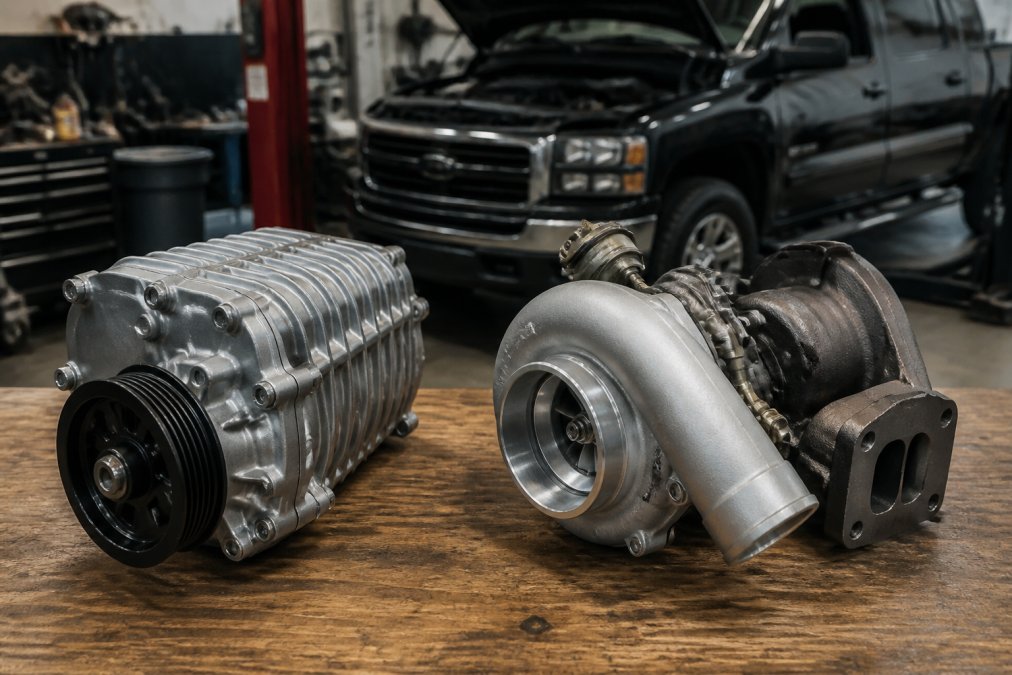
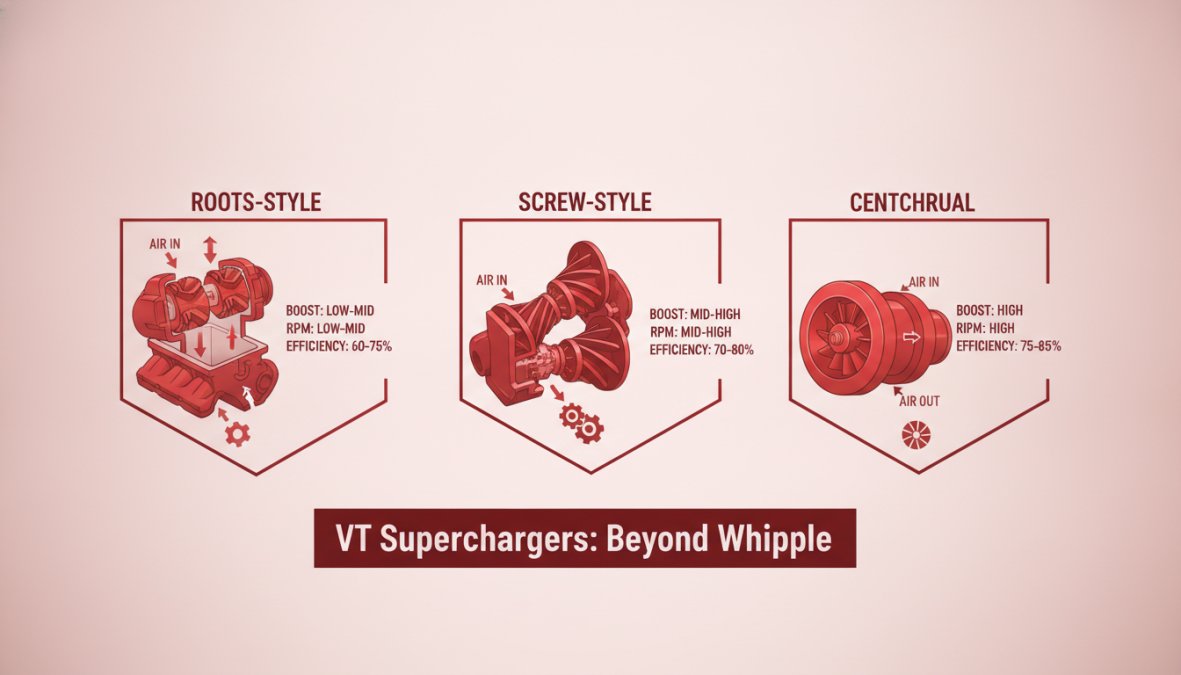
Superchargers fall into three distinct categories, each with fundamentally different airflow characteristics, power delivery curves, and thermal management profiles.
Roots-Style (Positive Displacement) Superchargers
Roots-style superchargers use two counter-rotating lobes that trap air and force it into the intake manifold. The design delivers full boost at relatively low RPM, typically starting around 1,200-1,500 RPM. For truck owners who tow or drive in stop-and-go traffic, this translates to usable torque when you need it most.
The trade-off is efficiency. Roots superchargers generate more heat than other designs because compression happens inside the blower itself. This heat soak becomes problematic during sustained boost, particularly in summer conditions or during prolonged towing. Many Roots installations require intercoolers to manage temperatures and maintain consistent performance.
Edelbrock dominates this category. The design works exceptionally well for trucks that prioritize low-end torque and don't require peak horsepower above 600 HP.
Screw-Style Twin-Screw Superchargers
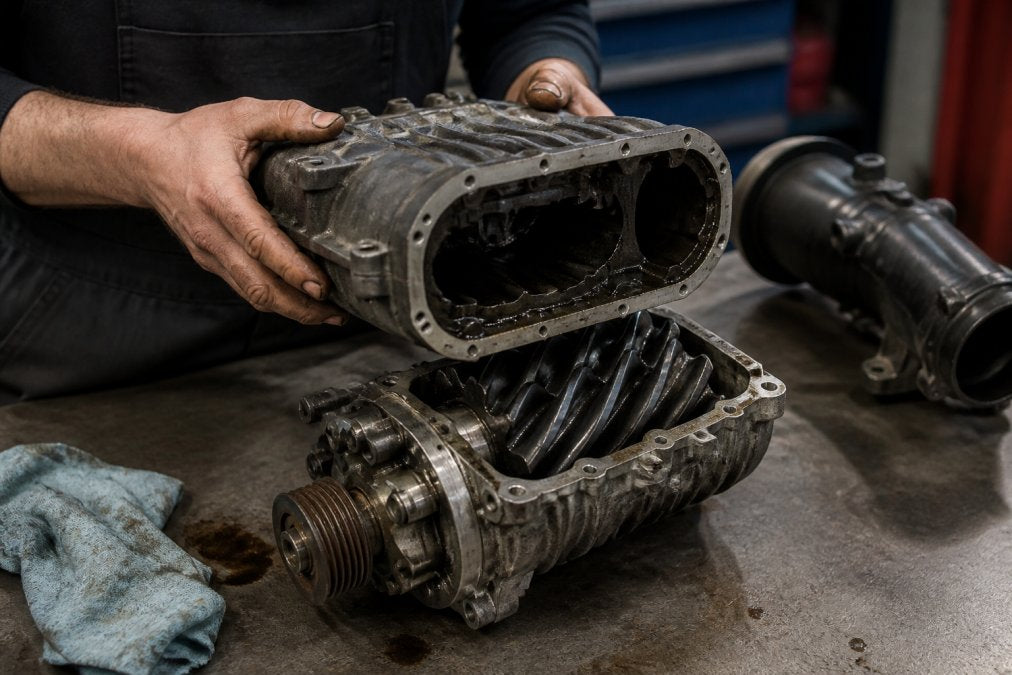
Screw-style superchargers use two interlocking screws that compress air as it moves through the housing. Whipple and Magnuson are the recognized names in this category. The design is mechanically more complex than Roots, explaining the higher price point.
The advantage is efficiency and power density. Twin-screw superchargers compress air more gradually, generating less internal heat and allowing higher boost levels. A Whipple or Magnuson screw blower on a 6.2L GM engine regularly produces 650+ HP with supporting modifications.
The disadvantage emerges in the power curve. Screw superchargers typically build boost gradually, reaching full effectiveness at 4,000 RPM and above. For a truck pulling a trailer, you're not using the blower's full potential. Mid-range punch suffers compared to Roots designs.
Key Takeaway
Screw-style superchargers prioritize peak horsepower and efficiency over low-end torque. They excel on modified engines and in performance-focused applications, but may feel less responsive in everyday driving compared to Roots or centrifugal alternatives.
Centrifugal Superchargers
Centrifugal superchargers use a belt-driven impeller that spins at extremely high RPM to compress incoming air. ProCharger is the dominant manufacturer in this space. The design is mechanically similar to a turbocharger, air gets accelerated by centrifugal force rather than positive displacement.
Centrifugal systems are RPM-dependent. Boost builds gradually as engine RPM increases, reaching full potential only at higher speeds. This creates a power curve that feels like natural aspiration at low RPM, then transitions to forced induction as you climb the RPM ladder.
The advantage is efficiency and simplicity. Centrifugal designs run cooler than Roots or screw systems because compression happens through acceleration rather than mechanical trapping. The belt-driven design has fewer moving parts than screw-type systems, translating to better reliability and lower maintenance.
The disadvantage is boost response. There's a delay before full boost arrives, similar to turbo lag. For towing applications where you need immediate response, this can feel underwhelming. However, once boost is present, centrifugal systems deliver impressive top-end power with excellent heat management.
ProCharger vs. Whipple for Truck Performance
ProCharger and Whipple represent fundamentally different forced induction philosophies. Whipple's twin-screw design delivers maximum horsepower in a compact package. A typical Whipple installation on a 6.2L truck produces 650-750 HP. The power builds progressively through the RPM range, peaking in the upper band where most street and drag racing occurs.
ProCharger's centrifugal approach prioritizes efficiency and thermal management. A comparable ProCharger installation produces 600-700 HP, slightly less peak power, but with cooler operating temperatures and more consistent power delivery during sustained driving or towing.
For drag racing or pure performance driving, Whipple's instant boost and peak horsepower advantage matters. For daily driving with occasional towing, ProCharger's thermal management and smoother power curve often feels more practical. A truck owner pulling a trailer in summer heat will appreciate ProCharger's cooler operation.
Whipple systems typically command a premium price. ProCharger kits are generally positioned lower, though quality remains high. For budget-conscious buyers seeking forced induction without the Whipple price tag, ProCharger represents a legitimate alternative.
Watch Out
Don't assume higher price equals better performance for your specific application. A more expensive Whipple system won't necessarily outperform a ProCharger on a truck used primarily for towing and daily driving.
Magnuson Supercharger vs. Whipple: Power Delivery and Boost Characteristics
Magnuson manufactures both roots-style and screw-type superchargers, allowing direct comparison with Whipple's screw-type offerings while providing alternatives for buyers who prioritize low-end torque.
Magnuson's screw-type systems deliver performance comparable to Whipple. On a 6.2L engine, expect 650-720 HP depending on tuning and supporting modifications. The mechanical design differs slightly from Whipple, which some enthusiasts claim provides marginally better efficiency, though real-world differences are minimal.
Magnuson's roots-style offerings provide different power delivery. Boost reaches 80% of maximum by 2,000 RPM, translating to usable power when you need it. A Magnuson Roots installation produces slightly less peak horsepower than their screw-type (typically 580-650 HP), but the torque curve feels more responsive and immediate.
Magnuson pricing sits between ProCharger and Whipple. For buyers seeking Whipple-level performance at a lower price point, Magnuson screw-type systems offer genuine value. For those prioritizing torque delivery over peak horsepower, Magnuson Roots kits provide an excellent alternative.
Installation complexity is comparable across all three brands. Bolt-on fitment is standard, though engine tuning and dyno calibration are recommended. Most professional shops handle installation in a single day.
Turbocharger for Trucks: Pros and Cons vs. Superchargers
Turbochargers use exhaust gas energy to spin a turbine, which compresses incoming air. This design is inherently more efficient than superchargers because it recycles waste energy rather than consuming engine horsepower.
The primary advantage is efficiency and fuel economy. A turbocharged truck maintains better fuel economy than a supercharged equivalent when driving without boost. The turbo only consumes energy when exhaust gases flow; at cruise, the turbine essentially disengages. A supercharger constantly draws power from the engine regardless of load.
Turbochargers also run cooler than most superchargers because compression happens outside the engine block. This means more consistent performance in hot climates and during sustained driving.
The disadvantages are equally important. Turbo lag, the delay between throttle input and boost arrival, remains the primary complaint. For truck owners accustomed to supercharger response, this feels noticeably sluggish. Additionally, turbocharged systems are mechanically more complex, with additional plumbing, intercoolers, and control systems requiring maintenance.
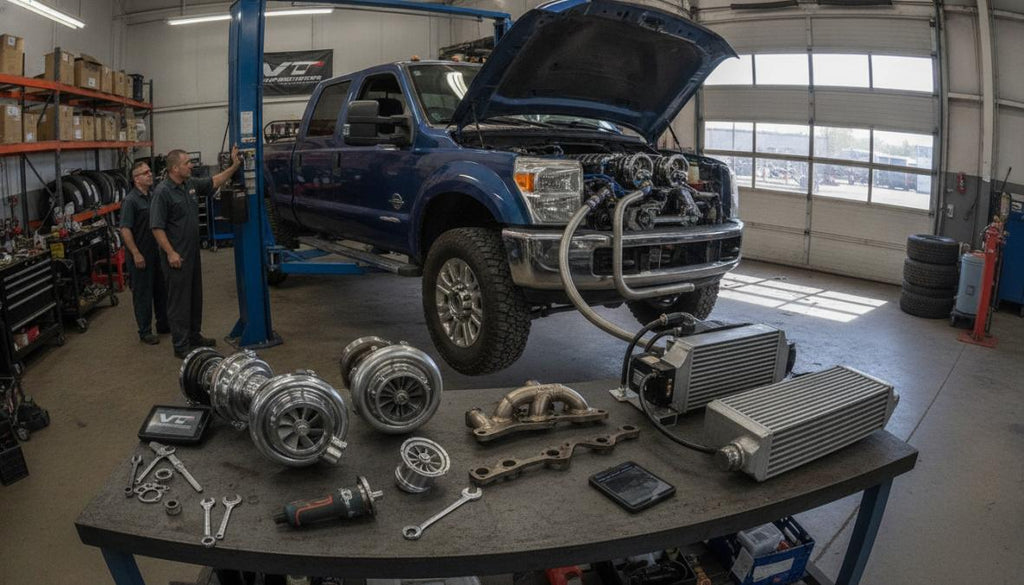
Turbo installation is more involved than supercharger bolt-on kits. Exhaust manifold modifications, turbo mounting, intercooler plumbing, and fuel system upgrades are common requirements. Labor costs typically exceed supercharger installation by 30-50%.
For new truck builds or vehicles that haven't been modified yet, turbocharged alternatives deserve consideration, particularly if efficiency and daily-driver usability matter more than peak performance.
Best For
Turbochargers work best for truck owners prioritizing fuel economy and long-term reliability over peak horsepower. For existing trucks seeking bolt-on performance, superchargers remain the more practical choice.
Best Supercharger for Towing: Instant Power vs. Heat Soak Trade-Offs
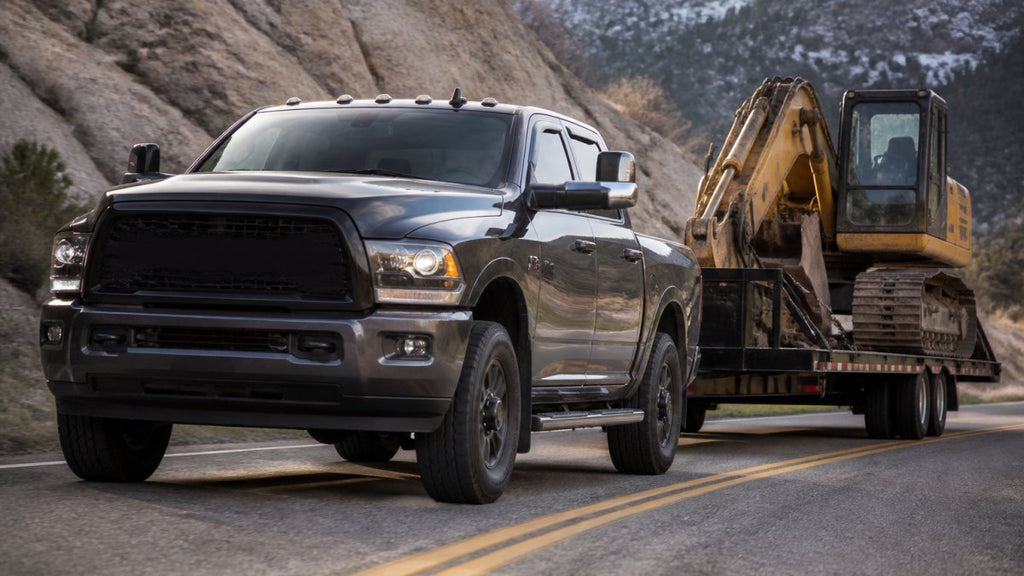
Towing introduces a critical variable that changes the forced induction calculus. A supercharger optimized for drag racing might be poorly suited for sustained towing because the demands are fundamentally different.
Heat soak emerges during towing. When pulling a trailer up a grade at 3,500 RPM for 30 minutes, supercharger intake air temperatures rise significantly. A Roots-style blower generates more heat than centrifugal designs. This rising temperature reduces air density, reducing oxygen availability, reducing horsepower. Your truck feels strong initially, then gradually loses power as temperatures climb.
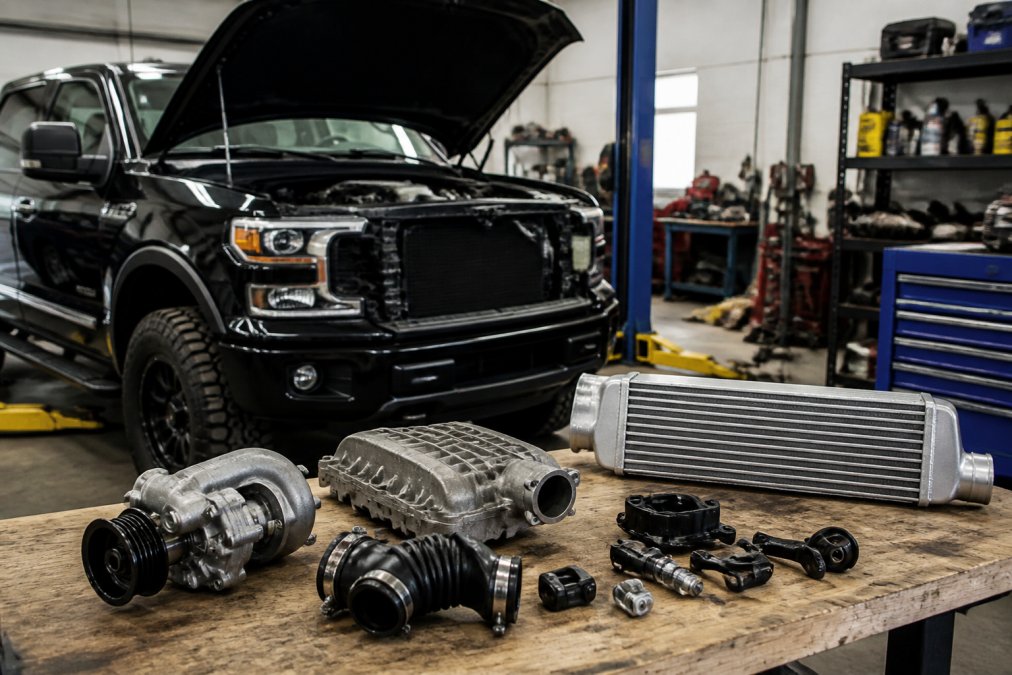
Intercoolers mitigate this issue by cooling compressed air before it enters the engine. A quality intercooler setup can reduce intake temperatures by 40-60 degrees Fahrenheit. However, intercoolers add complexity, cost, and potential cooling system strain.
For towing applications, the thermal management hierarchy is: Centrifugal superchargers (coolest), screw-type superchargers (moderate), Roots-style superchargers (hottest). ProCharger's centrifugal design runs coolest, making it the strongest choice for towing trucks. Magnuson or Whipple screw-type systems work well with proper intercooling. Roots designs require strong cooling infrastructure.
Low-end torque also matters for towing. Roots-style superchargers excel because boost arrives early in the RPM range. Screw-type systems build boost more gradually. For pure towing performance, Roots-type systems deliver more usable torque when you need it.
The optimal towing supercharger balances three factors: early boost arrival (Roots advantage), thermal management (centrifugal advantage), and sustained power delivery (intercooled systems advantage). Most towing-focused truck owners choose either a Roots system with quality intercooling or a centrifugal system like ProCharger.
Installation, Tuning, and Compatibility: Stock vs. Modified Engines
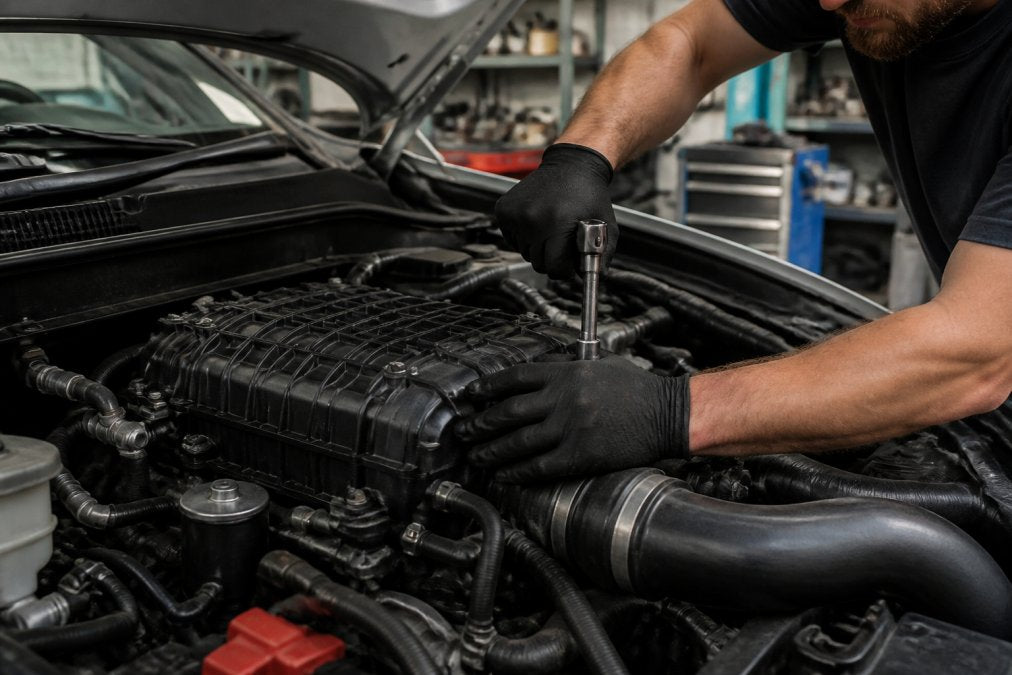
Stock engine installations are straightforward. Bolt-on supercharger kits are engineered for plug-and-play fitment. Most installations take 4-8 hours at a professional shop. The supercharger bolts to the intake manifold, the belt connects to the crankshaft pulley, and the tuning module adjusts fuel and ignition timing.
Stock engines do have limitations. The factory fuel system, transmission, and cooling infrastructure were designed for stock power levels. A supercharger adds 150-200 horsepower, stressing these systems. Most professional shops recommend supporting modifications: fuel system upgrade, transmission tuning, and cooling system evaluation.
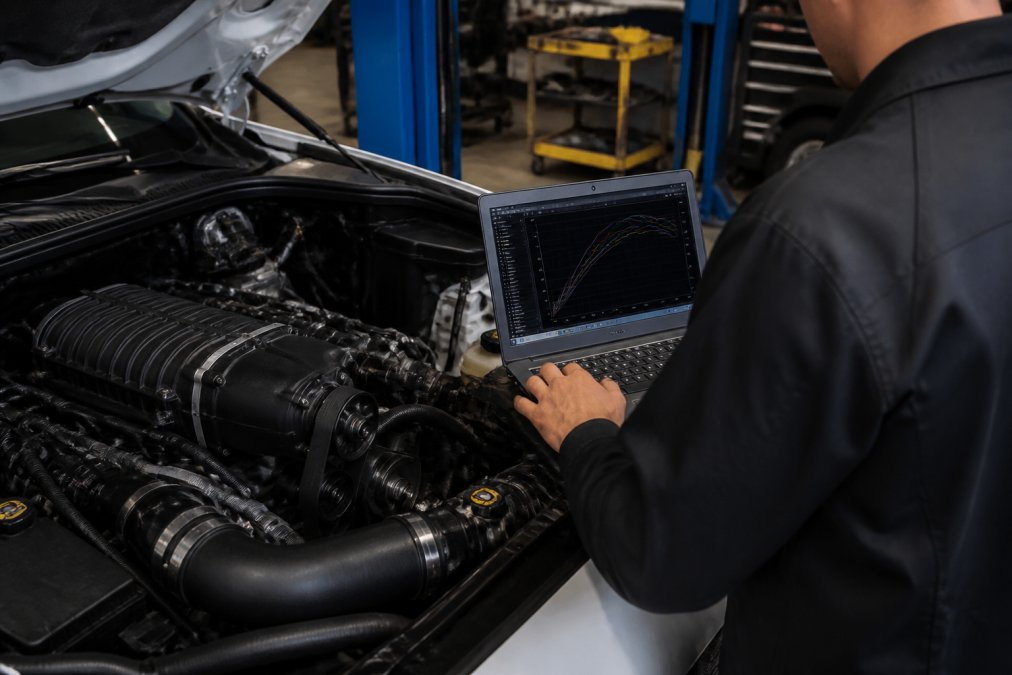
Modified engines present different challenges. If your truck already has a custom intake, exhaust, or fuel system, the supercharger kit must integrate with these modifications. Fitment issues are common. Engine tuning becomes more complex on modified platforms, requiring custom tuning from an experienced shop and dyno time.
Compatibility checking is essential before purchasing any supercharger kit. Verify that the kit has been successfully installed on your specific truck year, engine displacement, and any modifications you've completed. VT Superchargers offers compatibility verification across Dodge, Ford, Jeep, Mazda, Nissan, Suzuki, and Toyota platforms.
Most truck owners benefit from professional installation, which typically costs $1,500-$3,000 depending on complexity and local labor rates.
| Installation Factor | Stock Engine | Modified Engine |
|---|---|---|
| Installation Time | 4-8 hours | 6-12 hours |
| Fitment Issues | Minimal | Common |
| Supporting Mods Needed | Fuel system, transmission tune | Custom tuning required |
| Professional Labor Cost | $1,500-$2,500 | $2,500-$4,000 |
| DIY Feasibility | Moderate | Advanced |
Total Cost of Ownership: Price, Warranty, and Long-Term Reliability
The purchase price of a supercharger kit is only one component of total cost of ownership. Supporting modifications, installation labor, warranty coverage, and maintenance add significantly to the true expense.
Supercharger kit pricing varies by type and brand. Centrifugal systems like ProCharger typically start around $3,500-$5,000. Screw-type systems from Whipple or Magnuson range from $5,000-$8,000. Roots-style systems typically cost $4,000-$6,500.
Supporting modifications add substantial cost. A quality intercooler system runs $1,000-$2,500. Fuel system upgrades cost $800-$1,500. Transmission tuning typically costs $500-$1,200. For a complete, reliable installation, expect total parts costs of $7,000-$12,000 before labor.
Professional installation labor ranges from $1,500-$4,000 depending on complexity. Dyno tuning adds another $500-$1,500.
Most brands offer 12-24 month warranties on the supercharger unit itself. VT Superchargers provides 24-month warranty coverage. However, warranties typically don't cover supporting modifications or labor.
Long-term reliability depends on installation quality and proper maintenance. A well-installed supercharger system on a properly tuned engine should provide 100,000+ miles of reliable service. Regular maintenance, oil changes, intercooler flushing, and belt inspection keep the system healthy.
When evaluating total cost of ownership, calculate the complete investment including kit, supporting modifications, installation labor, and maintenance over your ownership period. A $5,000 ProCharger kit requiring $2,500 in intercooling and $2,000 in labor totals $9,500, comparable to a $7,000 Whipple kit with $1,500 in labor if intercooling isn't required.
Choosing a supercharger alternative to Whipple requires understanding your specific needs, not defaulting to the most recognizable brand name. Whether you prioritize towing performance, peak horsepower, thermal management, or budget considerations, alternatives exist that outperform Whipple for your use case. VT Superchargers specializes in engineered bolt-on kits with OEM-style fitment across Dodge, Ford, Jeep, Mazda, Nissan, Suzuki, and Toyota platforms. Our 24-month warranty and accessible financing make performance upgrades achievable without compromise.
Frequently Asked Questions
What are the main types of superchargers for trucks, and which delivers instant power?
Roots-style (positive displacement) superchargers deliver instant boost and torque across the RPM range, making them ideal for low-end power. Screw-style superchargers offer similar instant power with better efficiency. Centrifugal superchargers build boost gradually but excel at higher RPMs. For trucks needing immediate torque, especially towing, Roots and screw-style options typically outperform centrifugal designs. Your choice depends on whether you prioritize instant power or peak horsepower.
How does ProCharger compare to Whipple for daily-driven trucks?
ProCharger specializes in centrifugal designs that run cooler and produce less heat soak, beneficial for daily driving. Whipple focuses on screw-style superchargers delivering stronger low-end torque. For daily driving, ProCharger's cooler operation reduces engine stress, while Whipple's instant power suits trucks that tow or accelerate frequently. ProCharger works better for sustained performance; Whipple excels when you need immediate response. Both offer reliable forced induction, but your driving pattern determines the better fit.
Should I choose a turbocharger or supercharger for my truck?
Turbochargers offer better fuel economy and peak horsepower but suffer from turbo lag and heat buildup. Superchargers deliver instant power with no lag, making them superior for towing and off-roading. However, superchargers consume more engine power and generate more heat. For daily driving with occasional towing, a turbocharger may suit you; for consistent low-end torque and responsive power delivery, a supercharger is the better choice. Consider your priority: efficiency or immediate performance.
What's the difference between a bolt-on supercharger kit and a custom installation?
Bolt-on kits feature OEM-style fitment and require minimal modification, making them accessible for many truck owners. Custom installations demand extensive tuning, fuel system upgrades, and dyno calibration. Bolt-on kits typically preserve factory warranty coverage longer and offer straightforward installation with approved installers. Custom setups deliver maximum performance but require professional expertise and increase total cost. For most truck owners, bolt-on supercharger kits balance performance gains, reliability, and ease of installation without extensive engine modifications.
Will adding a supercharger void my truck's factory warranty?
Aftermarket forced induction can affect warranty coverage depending on your manufacturer and what fails. Many bolt-on supercharger kits are engineered for compatibility with stock engines and carry their own warranty protection. However, engine-related failures directly caused by the supercharger may not be covered by your factory warranty. Before installation, review your truck's warranty terms and consult with your dealership. Quality bolt-on kits from reputable manufacturers come with extended warranties (often 24 months) to protect your investment and provide peace of mind.
This article was written using GrandRanker
Related post


RECENT POSTS