Supercharger Kits for Dodge HEMI Engines: 2026 Guide
Table of Contents
- Supercharger Kits for Dodge HEMI Engines: Quick Comparison
- How We Evaluated These Supercharger Kits
- Best 5.7L HEMI Supercharger Kit Options
- HEMI Supercharger Installation: What to Expect
- HEMI Supercharger Cost: Budget Breakdown and Financing
- Centrifugal vs. Roots-Style: ProCharger HEMI Comparison
- Horsepower Gains, Torque, and Real Dyno Results
- Emissions Compliance and Legal Considerations
Supercharger Kits for Dodge HEMI Engines: 2026 Guide
Last Updated: July 27, 2026
The HEMI engine has defined American muscle car performance for nearly two decades, but factory horsepower leaves serious power on the table. Supercharger kits for dodge hemi engines transform these legendary V8s into tire-smoking machines capable of crushing 500+ horsepower with bolt-on simplicity. Whether you're piloting a RAM 1500, Dodge Charger, or Challenger, the right supercharger delivers immediate torque at low RPM and sustained power all the way to redline. At VT Superchargers, we've engineered kits for multiple HEMI platforms, and owners consistently report 100-150 horsepower gains with stock internals and zero engine modifications required.
Supercharger Kits for Dodge HEMI Engines: Quick Comparison
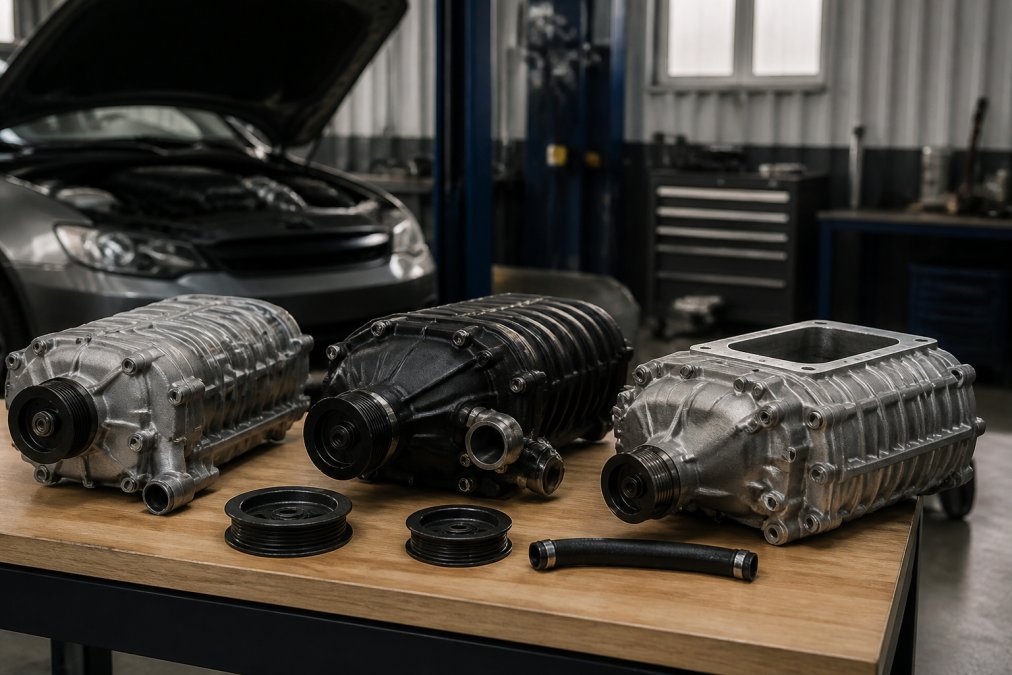
Three core variables determine your choice: supercharger type (centrifugal vs. roots-style vs. twin-screw), your specific HEMI displacement (5.7L, 6.1L, or 6.4L), and your vehicle platform (RAM truck, Charger, Challenger).
The Magnuson Superchargers system uses Eaton TVS technology, a hybrid roots-type design that balances efficiency across the entire RPM range. Vortech offers centrifugal designs that excel at high-RPM power and heat management. Kenne Bell delivers twin-screw aggression with instantaneous boost response and the ability to support extreme power levels through pulley changes alone.
Pricing ranges from $3,600 for entry-level TorqStorm centrifugal kits to $8,441 for fully equipped Vortech systems with integrated tuning. Most complete, bolt-on packages land between $6,800 and $7,400.
| Supercharger Type | Best For | Boost Onset | Peak Power RPM | Typical Cost |
|---|---|---|---|---|
| Roots-Style (Magnuson TVS) | Daily drivers seeking smooth power delivery | 2,500 RPM | 5,500-7,000 RPM | $6,800-$7,200 |
| Centrifugal (Vortech, Paxton, TorqStorm) | High-RPM power and efficiency | 4,500+ RPM | 6,500-7,500 RPM | $4,770-$8,441 |
| Twin-Screw (Kenne Bell) | Maximum low-end torque and customization | 2,000 RPM | 5,000-6,500 RPM | $7,399+ |
How We Evaluated These Supercharger Kits
Our assessment focused on real-world performance, installation feasibility, long-term reliability, and value relative to cost. We prioritized kits engineered specifically for HEMI platforms, not generic forced induction solutions adapted from other engines. OEM-style fitment matters, when a supercharger is designed for your exact displacement and vehicle, you avoid custom bracket work, fuel system guessing games, and ECU tuning nightmares. We excluded kits that only work on a single year or engine code and favored brands with active technical support and proven track records in the HEMI community.
Best 5.7L HEMI Supercharger Kit Options
The 5.7L HEMI is the most popular target for supercharging, offering the deepest kit selection and most competitive pricing. If you own a 2003-2024 RAM 1500, Dodge Charger, or Challenger with the standard HEMI, you have excellent options across all three supercharger architectures.
Magnuson Superchargers: Roots-Style TVS Technology
Magnuson's hybrid roots-type system represents the sweet spot for daily drivers. The Eaton TVS2650 head unit features high-helix, four-lobe rotors that minimize heat generation and mechanical noise. You get smooth, predictable boost starting around 2,500 RPM and peaking in the 5,500-7,000 RPM range.
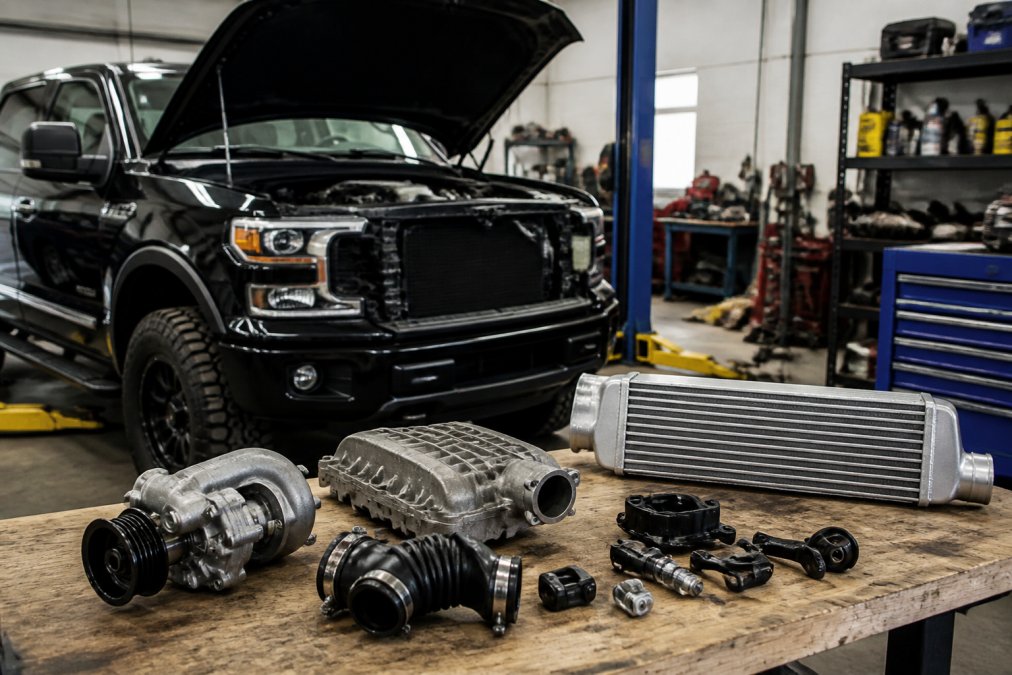
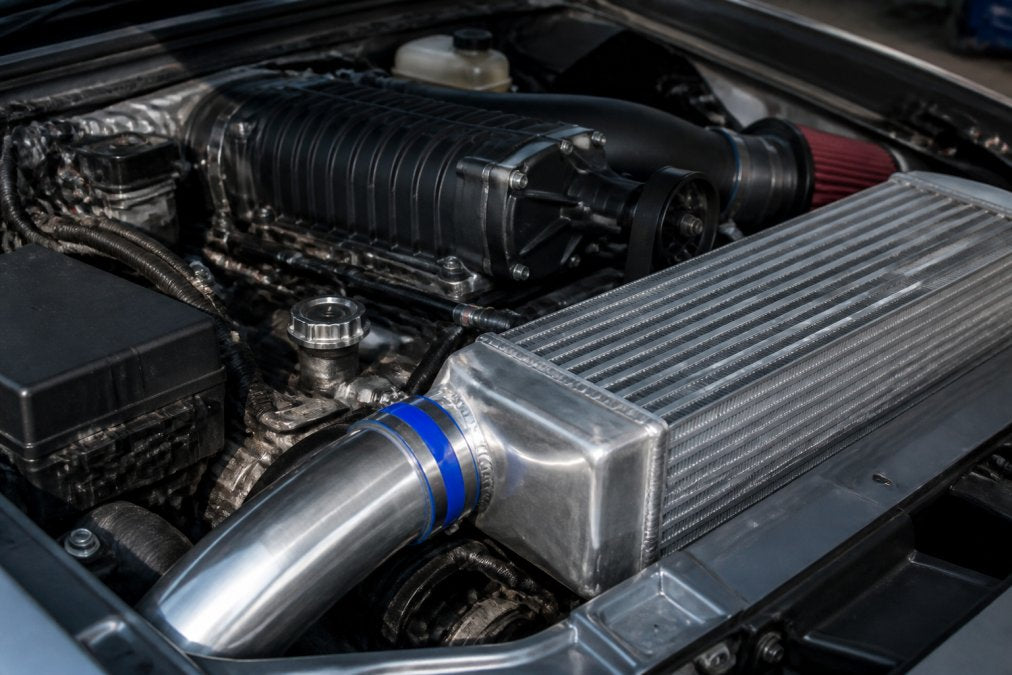
The complete kit includes a high-flow dual charge air cooler, vacuum bypass system for improved fuel economy during light throttle, and a handheld tuner with calibration already loaded. Installation typically runs 10-12 hours. The system maintains factory drivability with no rough idle, stumbling, or fuel economy penalty under normal driving.
Magnuson kits start at $6,805.37 with a 3-year/36,000-mile limited warranty. Many owners report 110-130 horsepower gains at the wheels with stock internals.
Pro Tip
The vacuum bypass system closes at wide-open throttle but opens during cruise, allowing boost to bleed off and improving highway fuel economy by 1-2 MPG compared to non-bypass roots designs.
Vortech V-3 Si Centrifugal Systems
Vortech's centrifugal supercharger delivers linear power scaling without early-RPM boost. The V-3 Si-Trim features a patented oil control system that eliminates external oil supply and return lines. Air-to-water charge cooling keeps inlet temperatures drastically lower than air-to-air designs, preserving density at high boost levels.
This kit suits builders planning to push beyond 500 horsepower through pulley changes and custom tuning. Centrifugal units don't hit their stride until 4,500+ RPM, but once spinning, they accelerate power linearly to 7,500+ RPM. Vortech kits start at $8,441.99 and include a fully calibrated base map via HP Tuners RTD. Installation takes 12-14 hours. The system is 50-state CARB-compliant, which matters in California or other states with strict emissions oversight.
Kenne Bell Twin-Screw Solutions
Kenne Bell's twin-screw supercharger delivers immediate boost response. The Mammoth 2.8LC or 4.9LC head unit generates full boost by 2,000 RPM. Liquid intercooling keeps charge air temps in check, and Kenne Bell includes their Boost-A-Pump fuel system booster plus high-flow fuel injectors in the complete kit.
This kit suits owners wanting maximum low-end torque for towing, off-roading, or acceleration. The twin-screw geometry also supports extreme pulley changes, you can go from 6 PSI to 15+ PSI with nothing more than a new pulley and a dyno tune. Kenne Bell kits start at $7,399 and often complete installation in a weekend, though fuel system work adds time.
Watch Out
Twin-screw superchargers are louder than roots or centrifugal designs. The mechanical whine is aggressive and audible even at cruise. If you want stealth performance, this isn't the kit.
HEMI Supercharger Installation: What to Expect
Installing a supercharger isn't a weekend project for most owners, but it's achievable with intermediate mechanical skills and proper tools.
DIY vs. Professional Installation
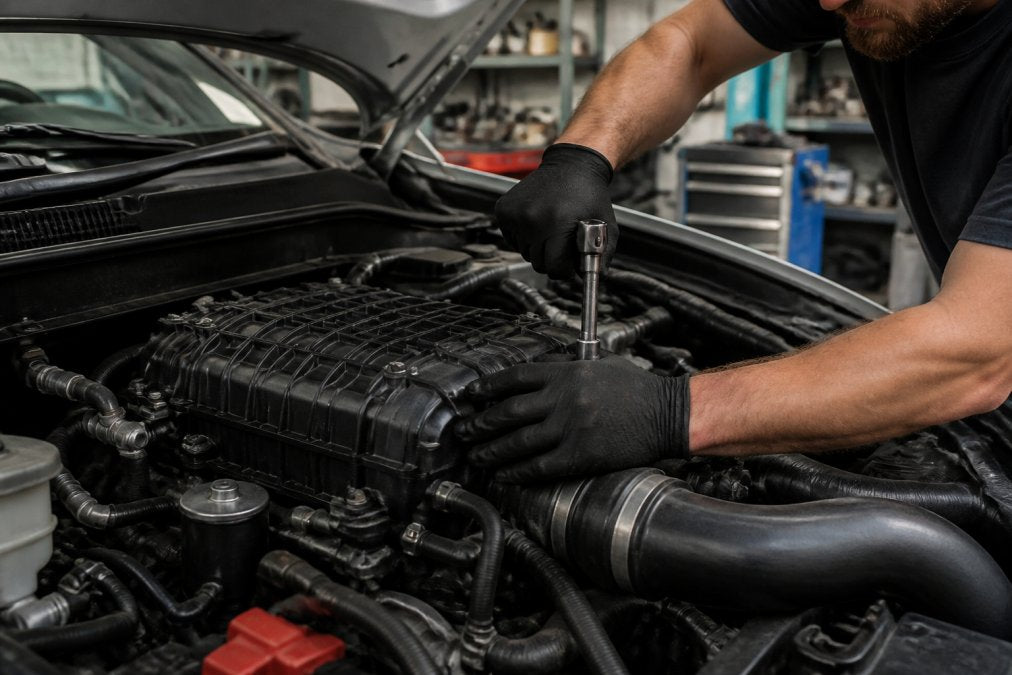
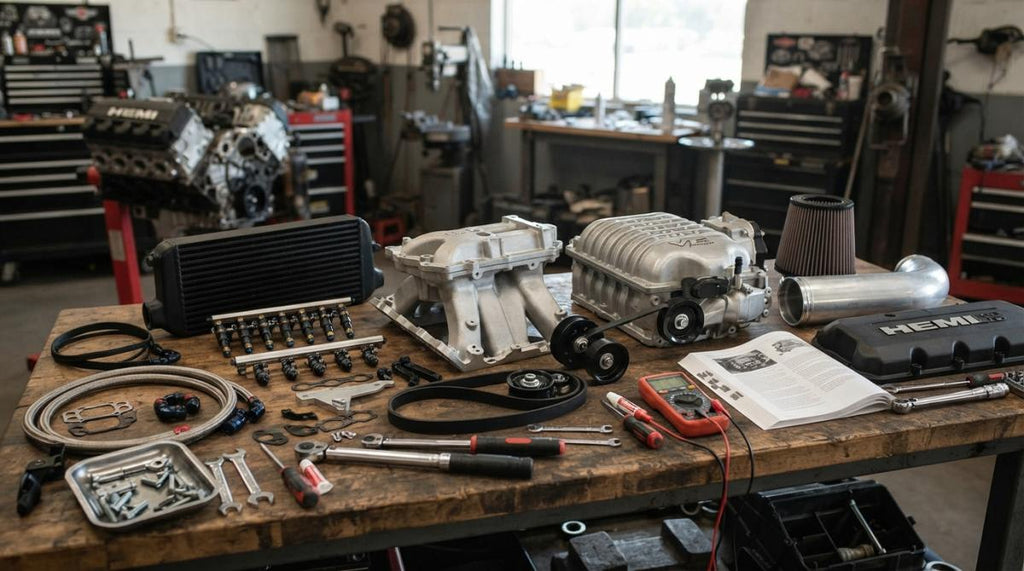
A competent DIYer with a lift, basic hand tools, and mechanical confidence can install most HEMI supercharger kits in 12-16 hours spread across two or three days. You'll remove the intake manifold, install the supercharger mounting bracket, route the belt, plumb the intercooler coolant lines, and connect fuel injectors and fuel pump wiring.
Professional installation at a reputable shop costs $1,500-$2,500 depending on location and shop experience. A shop specializing in forced induction will finish in 8-10 hours and catch issues a first-timer might miss.
ECU Tuning and Calibration Requirements
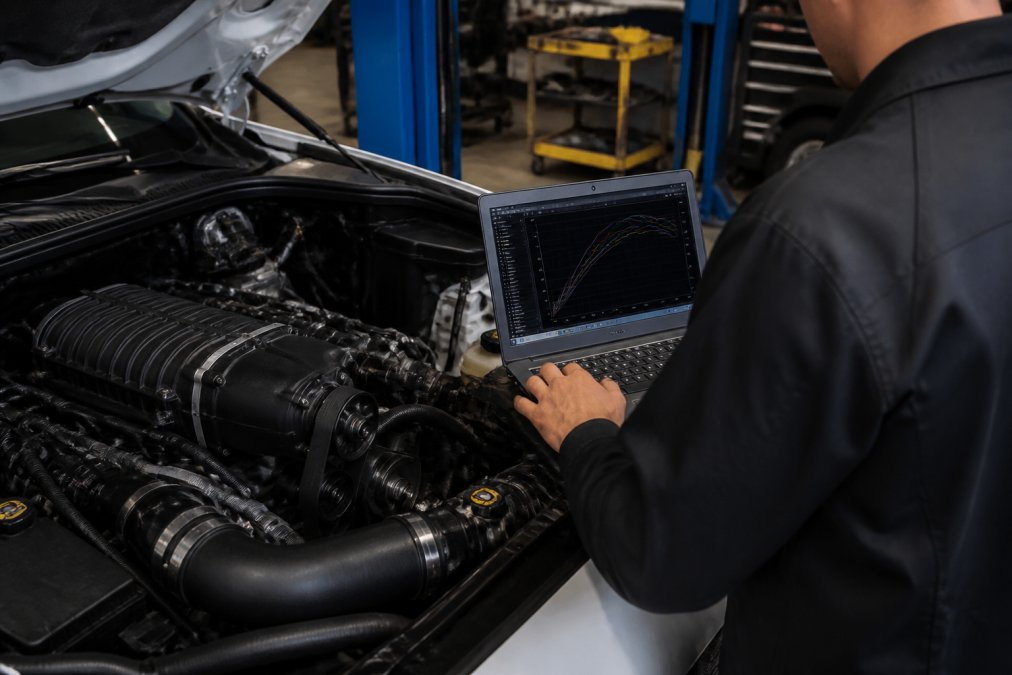
Every HEMI supercharger kit requires ECU tuning. The factory tune assumes naturally aspirated operation. Bolt a supercharger on without tuning and you'll run dangerously lean, detonate under load, and potentially destroy the engine.
Most complete kits include a basemap tune via HP Tuners RTD or a handheld tuner device. This basemap assumes stock engine internals, stock fuel pressure, and a catback exhaust. Professional dyno tuning costs $600-$1,200 and involves logging multiple wide-open-throttle runs and adjusting fuel, ignition timing, and boost target until power plateaus and knock is eliminated.
Key Takeaway
Basemap tuning is safe but conservative. Dyno tuning unlocks 10-20% more power and ensures your engine is protected across the entire power band. If you're spending $7,000 on a supercharger, $1,000 on tuning is the right investment.
HEMI Supercharger Cost: Budget Breakdown and Financing
A complete, ready-to-install supercharger kit for a 5.7L HEMI costs $6,800-$8,400. Add professional installation ($1,500-$2,500), dyno tuning ($600-$1,200), and supporting modifications like fuel injectors or a fuel pump upgrade ($500-$1,500 if not included), and your total lands between $9,400 and $13,600.
VT Superchargers offers financing on kits, spreading the cost across 12-36 months. A $7,000 kit financed over 24 months is roughly $290/month.
Long-Term Maintenance and Durability
A quality supercharger kit adds negligible maintenance burden to your HEMI. The supercharger itself has no serviceable parts. Supporting systems require attention: intercooler coolant needs flushing every 50,000 miles, fuel injectors benefit from periodic cleaning, and the serpentine belt should be inspected annually for wear.
Long-term durability depends entirely on tune quality and driving habits. A conservative dyno tune on a stock-internals HEMI will run reliably for 100,000+ miles.
Centrifugal vs. Roots-Style: ProCharger HEMI Comparison
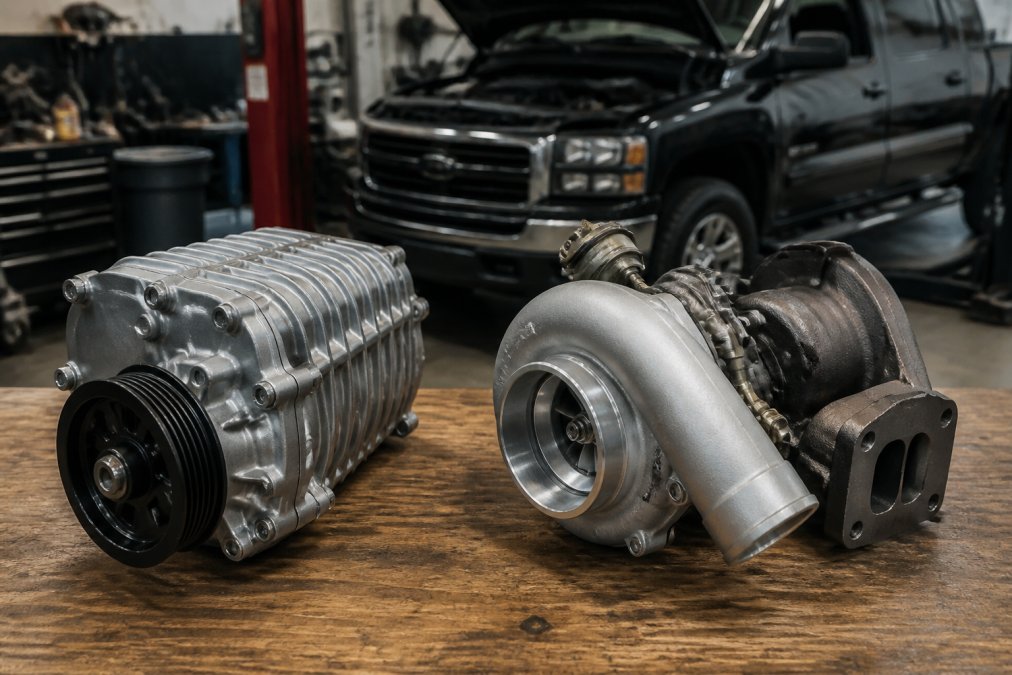
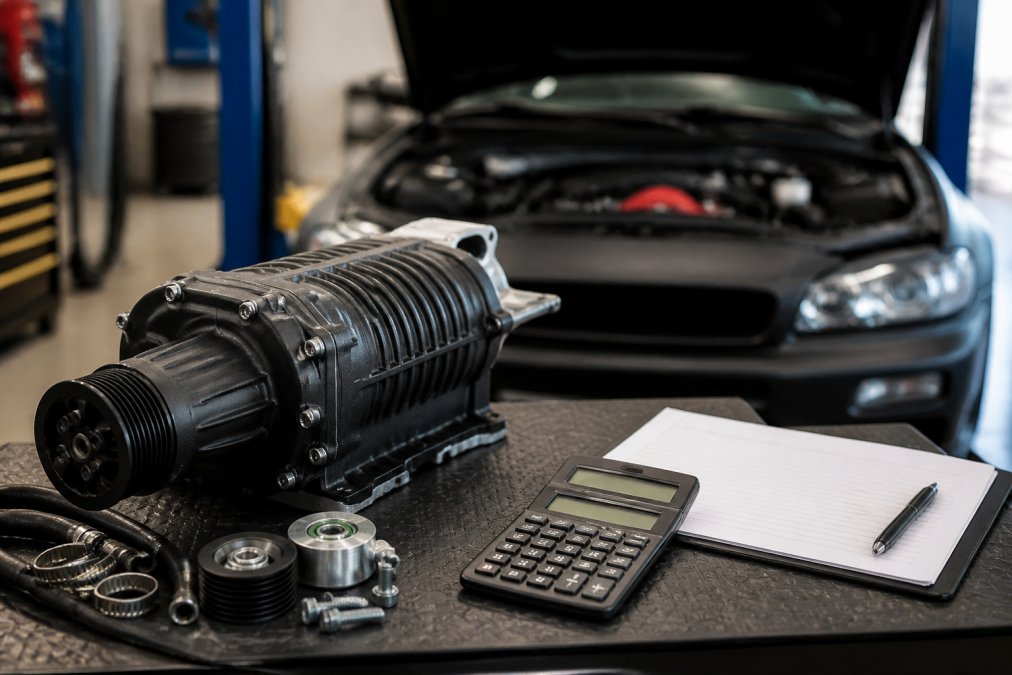
Centrifugal superchargers work like a turbocharger without the exhaust turbine. An impeller spins at up to 65,000 RPM, compressing air through centrifugal force. Boost builds gradually as engine RPM climbs, peaking around 6,000+ RPM. This design is efficient with little wasted heat and excellent cooling characteristics, but requires higher RPM to generate meaningful boost.
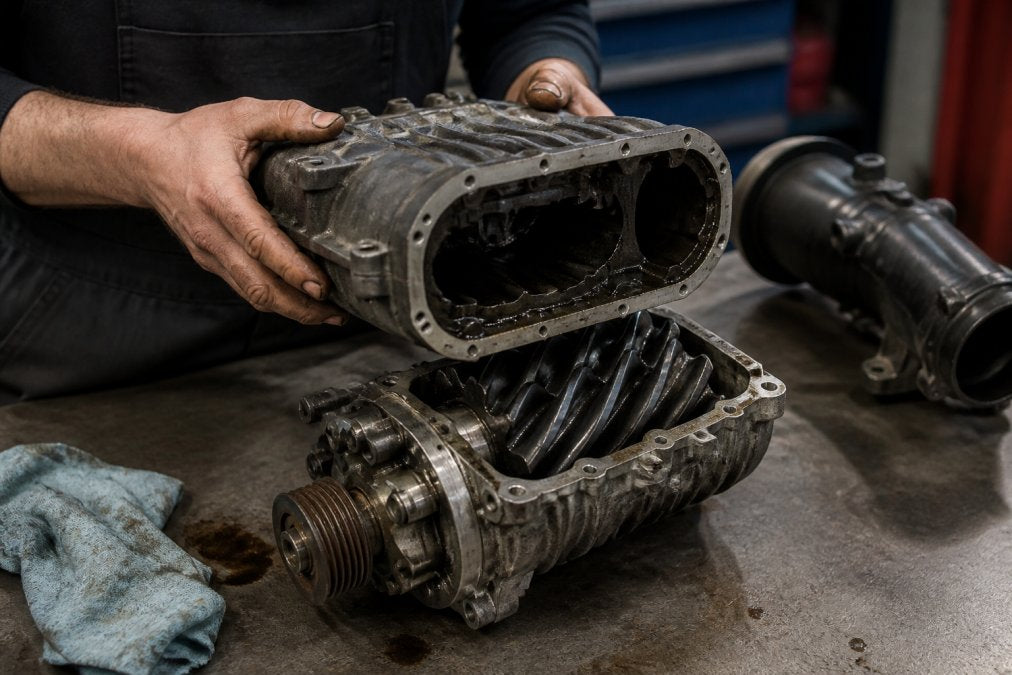
Roots-style superchargers function like a mechanical air pump. Two interlocking rotors trap air and force it into the intake manifold with each rotation. Boost builds early, sometimes by 2,500 RPM, and remains relatively flat across the RPM range. This design generates heat and mechanical noise but delivers immediate throttle response.
Centrifugal Superchargers: Efficiency and Heat Management
Centrifugal designs like Vortech and ProCharger excel at heat management. The impeller doesn't compress air as aggressively as a roots design, so charge air temperatures stay lower despite higher boost levels. This density advantage translates to more oxygen molecules entering the cylinder, meaning more power per PSI of boost. For highway driving, road course work, and owners planning future engine modifications, centrifugal kits are ideal.
Roots-Style Superchargers: Immediate Boost Response
Roots-style designs deliver boost immediately. Your HEMI feels supercharged from the moment you crack the throttle. The flat boost curve means power is available everywhere, not just at high RPM. The tradeoff is heat, roots designs compress air more aggressively, generating higher discharge temperatures. Without a quality intercooler, charge air temps climb quickly, reducing air density and limiting peak power. Roots-style kits are better for daily drivers, off-road enthusiasts, and anyone valuing low-end torque.
Horsepower Gains, Torque, and Real Dyno Results
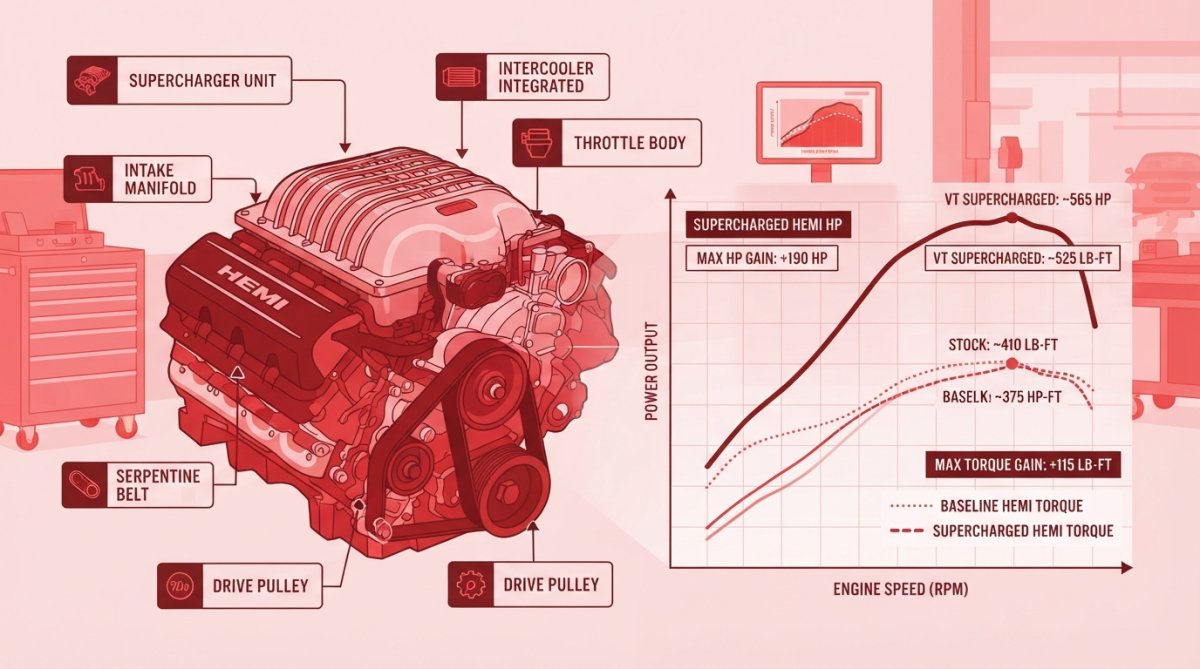
A stock 5.7L HEMI makes approximately 370 horsepower and 400 lb-ft of torque at the crankshaft. With a supercharger kit and stock internals, realistic power gains land between 100 and 150 horsepower at the wheels, translating to roughly 130-190 horsepower at the crank when accounting for drivetrain loss.
Magnuson kits typically deliver 110-130 wheel horsepower gains with conservative tuning. Vortech centrifugal systems achieve 120-150 wheel horsepower depending on boost level and tuning aggression. Kenne Bell twin-screw kits can exceed 150 wheel horsepower with pulley optimization and dyno tuning.
Torque gains are equally impressive. A 5.7L HEMI with a supercharger will produce 500-550 lb-ft of torque at the wheels, compared to 300-320 lb-ft stock. This is the real-world difference between a truck that hunts gears on the highway and one that pulls effortlessly in any gear.
Emissions Compliance and Legal Considerations
Supercharger kits exist in a gray area regarding emissions legality. Federal law allows modifications to engines, but individual states, particularly California, impose strict rules on what's legal.
Most complete supercharger kits are not CARB-certified, which means they're technically illegal for street use in California and a handful of other states that follow California emissions standards. Vortech offers CARB-compliant options, but they're more expensive. In non-CARB states, supercharger kits are generally legal as long as your vehicle passes emissions testing.
Watch Out
A supercharger will void your factory powertrain warranty. Dodge will not cover engine or transmission failures on a supercharged vehicle, even if the failure is unrelated to the supercharger. Budget for potential repairs if your engine develops issues after modification.
Choosing the right supercharger kit for your HEMI requires balancing power goals, budget, and long-term plans. If you're building a daily driver, Magnuson's TVS technology delivers proven reliability and immediate torque. If you're chasing peak horsepower and plan future modifications, Vortech or Kenne Bell provide the foundation for extreme power. Whatever path you choose, prioritize professional installation and dyno tuning, these investments protect your engine and ensure your supercharger delivers the performance you paid for. VT Superchargers offers financing on complete kits, 24-month warranty coverage, and access to a network of approved installers who specialize in HEMI forced induction. Register today and join thousands of owners who've transformed their HEMI engines into tire-smoking monsters.
Frequently Asked Questions
What horsepower gains can I expect from a 5.7L HEMI supercharger kit?
Most supercharger kits for 5.7L HEMI engines deliver 80-150 horsepower gains depending on the type and boost level. Centrifugal superchargers like Vortech typically provide 100-130 hp, while Roots-style systems like Magnuson offer 90-120 hp with better low-end torque. Actual gains vary based on fuel octane, ECU tuning, and supporting modifications. Professional dyno testing after installation confirms your specific vehicle's output.
How much does a HEMI supercharger cost, including installation?
Complete supercharger kits range from $3,600 to $8,400, with most quality options between $6,800-$7,400. Professional installation typically adds $1,500-$2,500 depending on your location and shop rates. Budget-conscious buyers can choose TorqStorm kits starting at $3,600, while premium options like Vortech run $8,400+. Many manufacturers offer financing to spread payments over 12-36 months, making performance upgrades more accessible.
Is a supercharger kit DIY-installable, or do I need a professional?
Most bolt-on supercharger kits take 8-14 hours for an experienced mechanic, making professional installation the safest option for warranty coverage and proper tuning. DIY installation is possible if you have mechanical skills and the right tools, but ECU calibration and fuel system upgrades require either a tuner or custom software like HP Tuners. Many shops charge $1,500-$2,500 for complete installation and baseline tuning, which protects your investment and engine reliability.
What's the difference between a ProCharger and other centrifugal superchargers for HEMI?
ProCharger and Vortech both use centrifugal technology but differ in design and application. Vortech V-3 Si systems are widely available for HEMI engines with air-to-water intercoolers, while ProCharger options are less common for HEMI platforms. Centrifugal superchargers like these deliver smooth, linear power delivery and excellent cooling efficiency. Roots-style alternatives like Magnuson provide immediate boost response at lower RPMs. Choice depends on whether you prioritize peak horsepower (centrifugal) or low-end torque (Roots).
Will a supercharger void my factory warranty or damage my engine?
Aftermarket supercharger kits do not automatically void your factory powertrain warranty, but Dodge may deny claims directly related to the modification. Quality kits like those from Magnuson, Vortech, and Kenne Bell are engineered to maintain stock-like reliability when properly tuned and maintained. Using premium fuel, maintaining regular service intervals, and avoiding extreme tuning reduces long-term wear. Many manufacturers offer their own 3-year limited warranties on supercharger components, providing additional protection.
This article was written using GrandRanker
Related post


RECENT POSTS