Supercharger vs Turbocharger Fuel Economy: Truck Guide
Table of Contents
- How Superchargers and Turbochargers Actually Differ
- Parasitic Loss Supercharger vs Turbo: The Fuel Economy Math
- Fuel Economy Comparison by Driving Cycle
- Bolt-On Supercharger Kits for Trucks: What Fits and What It Costs
- How Forced Induction Affects Engine Longevity
- Real-World MPG Scenarios for Towing Trucks
- Frequently Asked Questions
Last Updated: September 24, 2026
How Superchargers and Turbochargers Actually Differ
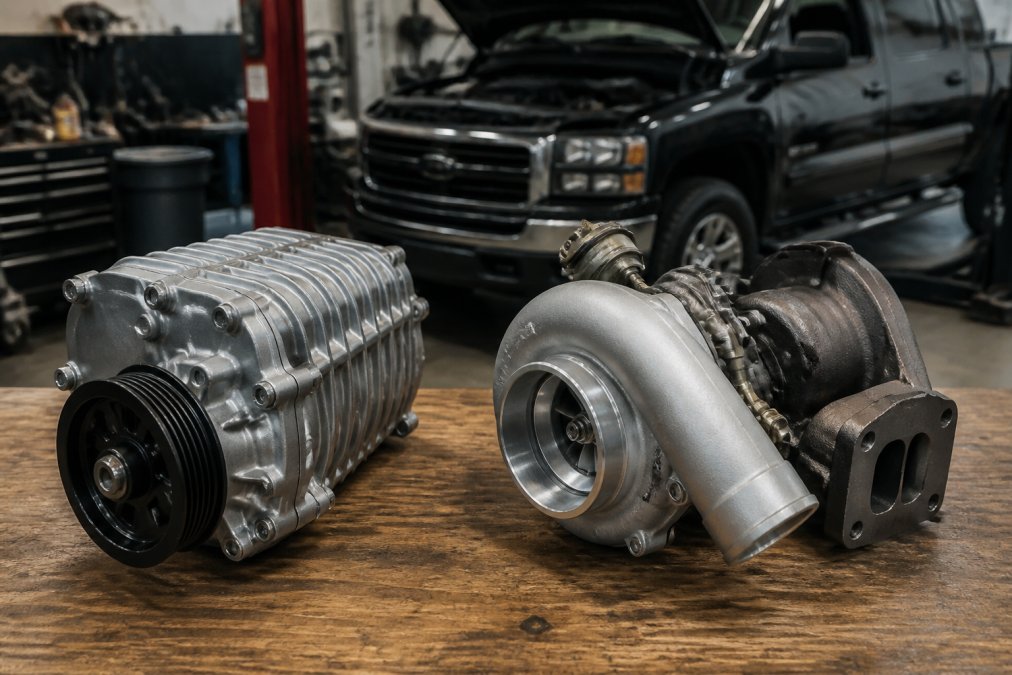
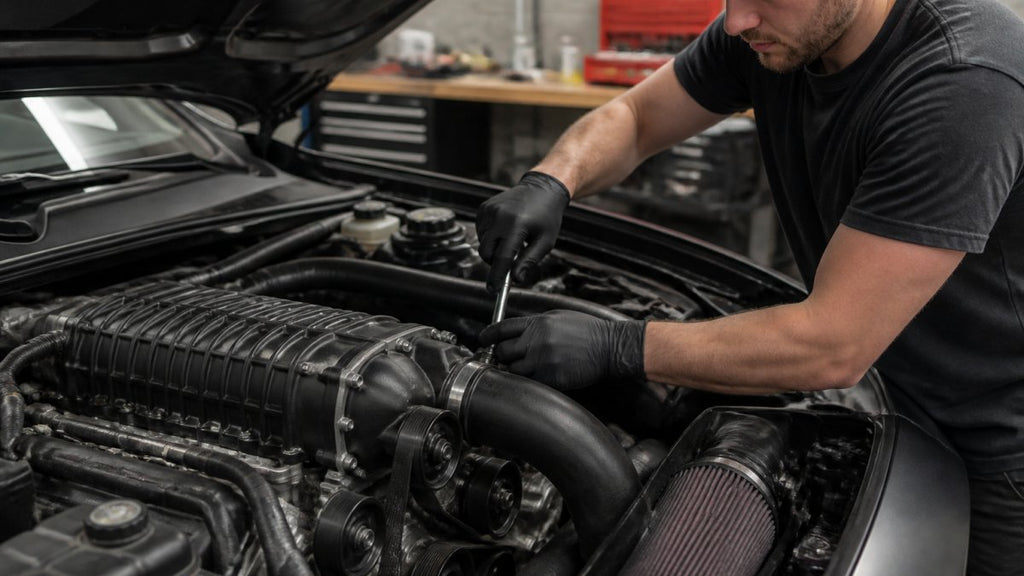
The short answer to supercharger vs turbocharger: a supercharger is driven mechanically by the engine's crankshaft via a belt, while a turbocharger is driven by exhaust gas energy that would otherwise be wasted out the tailpipe. Both force more air into the combustion cycle, but they pay for that air in different currencies. This guide from VT Superchargers breaks down what that means for truck fuel economy, especially when towing.
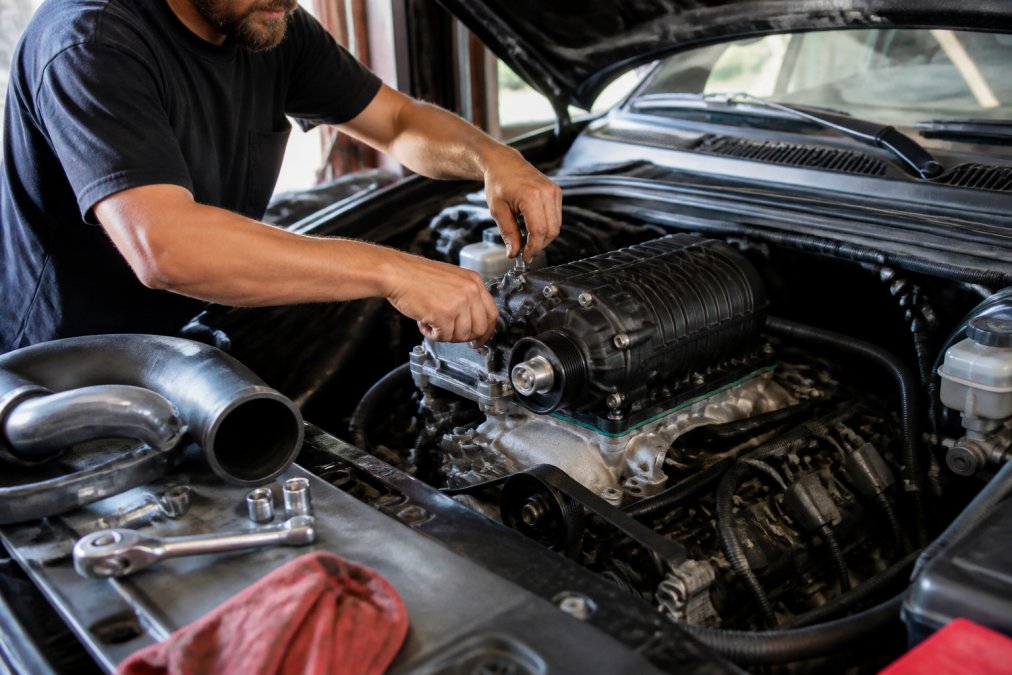
Supercharger Power Delivery
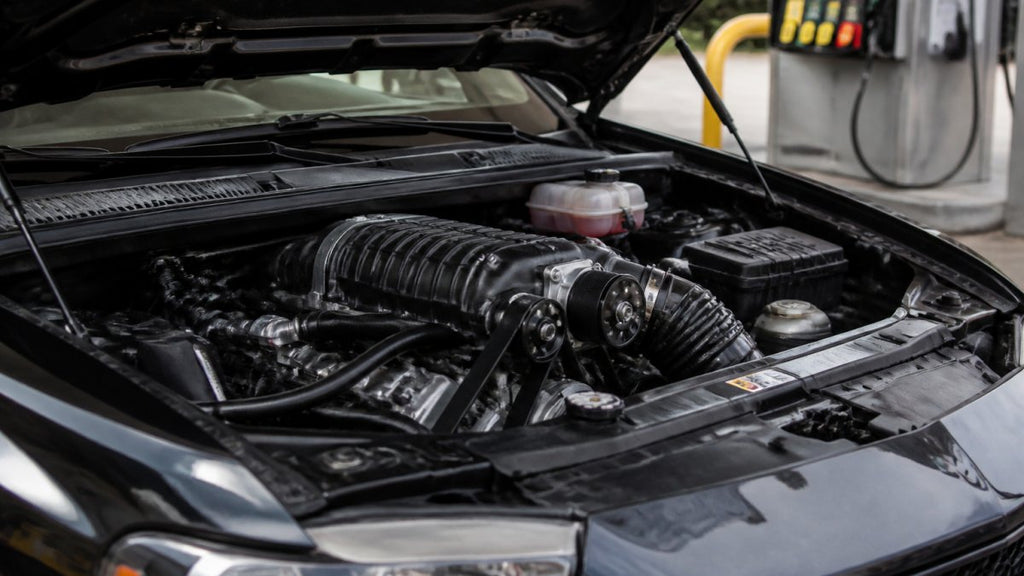
A supercharger delivers boost the instant you press the throttle. Because it's belt-driven off the crankshaft, boost rises with engine RPM with no waiting for exhaust pressure to build, instant torque and sharp throttle response, exactly what a heavy truck wants pulling a trailer up a grade. The trade-off is parasitic loss: the engine spends horsepower spinning the blower before you feel it at the wheels.
Turbocharger Power Delivery and Turbo Lag
A turbocharger runs off exhaust gas energy, recovering energy the engine already made instead of stealing it from the crank. The catch is turbo lag, the delay between pressing the throttle and the turbine spooling to useful boost. Modern variable geometry turbos and smaller turbine housings have shrunk that lag, but under a sudden heavy load it's still noticeable.
Key Takeaway
The core difference isn't power, it's when you get it and what it costs. Superchargers trade fuel for instant response; turbos trade response time for efficiency.
Parasitic Loss Supercharger vs Turbo: The Fuel Economy Math
The parasitic loss supercharger vs turbo comparison comes down to one question: does the compressor steal power from the crankshaft, or reclaim it from exhaust gas energy? A belt-driven supercharger draws a small but constant amount of engine power to spin its rotors. A turbocharger draws almost nothing mechanically, because exhaust gas that was leaving the engine anyway does the work.
Where the Supercharger's Power Actually Goes
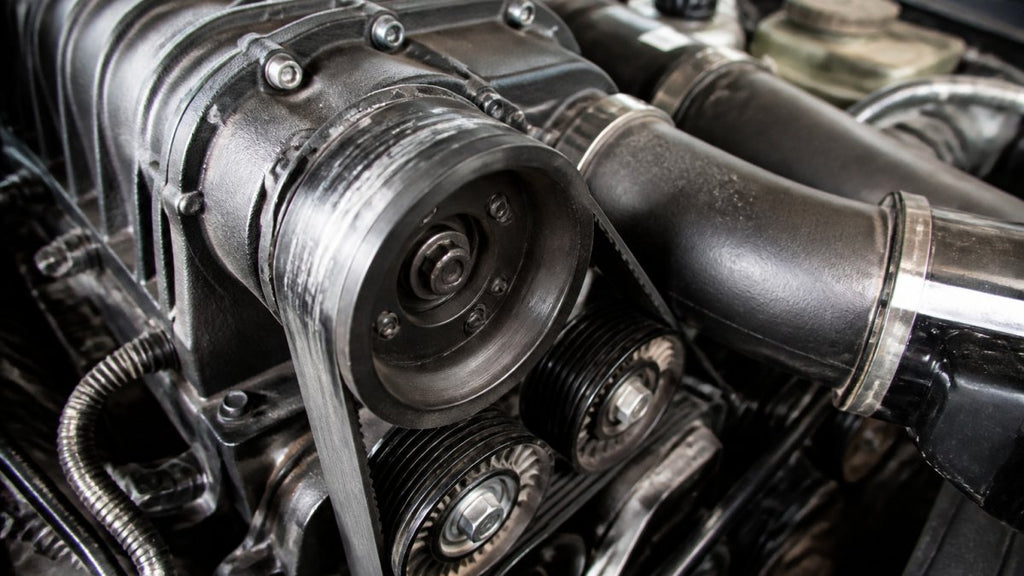
A positive-displacement (roots or twin-screw) blower is driven off the accessory belt, so the crank pays for boost before the wheels see it. Drive power scales with airflow and pressure ratio, which is why a blower adding 6 psi at 5,000 rpm can consume tens of horsepower just to turn. At cruise, with the bypass valve open and rotors freewheeling, that draw drops sharply but doesn't hit zero, the rotors, bearings, and belt still turn.
Why the Turbo's "Free" Energy Isn't Entirely Free
A turbocharger recovers enthalpy from the exhaust stream, but it isn't a perpetual-motion device. Spinning the turbine raises exhaust backpressure upstream, which pushes against the pistons during the exhaust stroke, a pumping loss the engine pays for. The penalty is small at low boost and grows with boost, which is why a turbo's efficiency advantage is largest at light load.
The Modern Equalizer: Direct Injection and Variable Geometry
Here's the part most comparisons skip: modern direct injection and variable geometry turbos have changed this equation. Direct injection allows leaner air-fuel ratios and higher compression under light load, and variable geometry keeps the turbo efficient across a wider RPM range. A 2026-era turbo truck is not the laggy, thirsty machine your uncle remembers.
Key Takeaway
The honest math: a supercharger pays a small, constant mechanical tax that hurts most at light load; a turbo pays a variable pumping-loss tax that grows with boost but stays near zero at cruise. Modern VGT and direct-injection hardware has shrunk, not erased, the gap.
Fuel Economy Comparison by Driving Cycle
Fuel economy doesn't have one number, the supercharger vs turbocharger question plays out differently in each driving cycle. The table below summarizes how each system behaves across the situations truck owners actually face.
| Driving Cycle | Supercharger | Turbocharger | Why |
|---|---|---|---|
| Highway cruising | Slight penalty | Minimal penalty | Belt drag vs. near-idle turbo |
| City stop-and-go | Higher penalty | Moderate penalty | Constant parasitic loss vs. lag |
| Towing uphill | Boost under load | Boost under load | Both burn more fuel under boost |
| Light-load commuting | Modest penalty | Best efficiency | Turbo reclaims exhaust energy |
Highway Cruising and Light Load
At a steady highway cruise, a turbocharged engine usually holds a small fuel economy edge. The turbo isn't making meaningful boost or demanding extra fuel, so the engine runs near its natural thermal efficiency, while a supercharger keeps spinning and carries a small, constant parasitic tax even when you don't need the power. Optimizing these forced induction systems through precise engine tuning for efficiency can help mitigate such losses by refining the air-fuel ratios during light-load operation.
Towing and Heavy Load
Under heavy load, the efficiency gap narrows fast. When towing, both systems make boost, and boost means burning more fuel no matter which compressor does the work. The key insight: forced induction doesn't wreck towing gas mileage because of parasitic loss, it changes it because you're making more power, and power comes from fuel.
Pro Tip
If your truck "hunts" gears on the highway with larger tires, the fix is often more low-end torque, not less. A supercharger's instant torque keeps the transmission in a higher gear instead of downshifting constantly, which can actually stabilize real-world fuel consumption on a tow rig.
Bolt-On Supercharger Kits for Trucks: What Fits and What It Costs
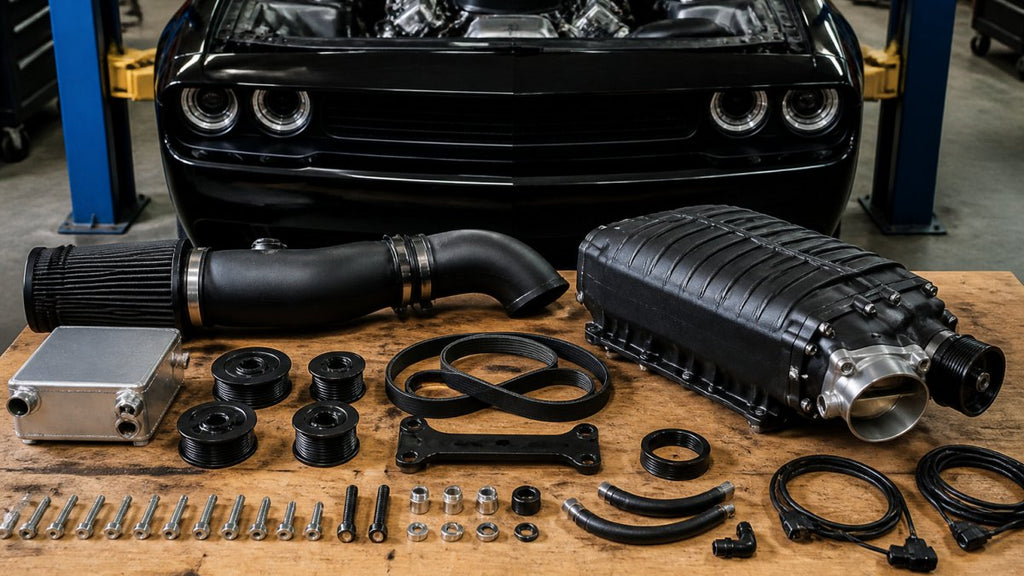
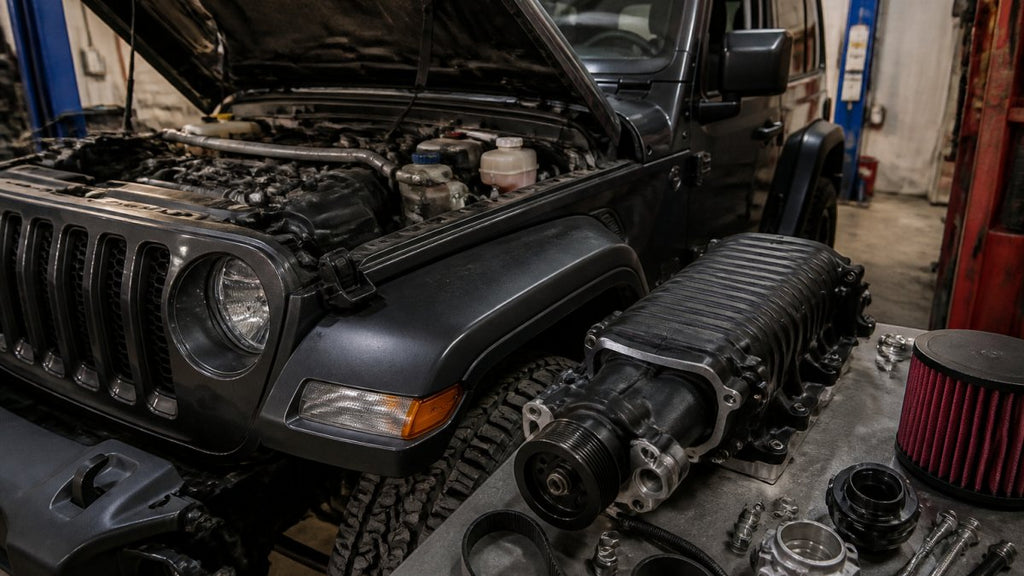
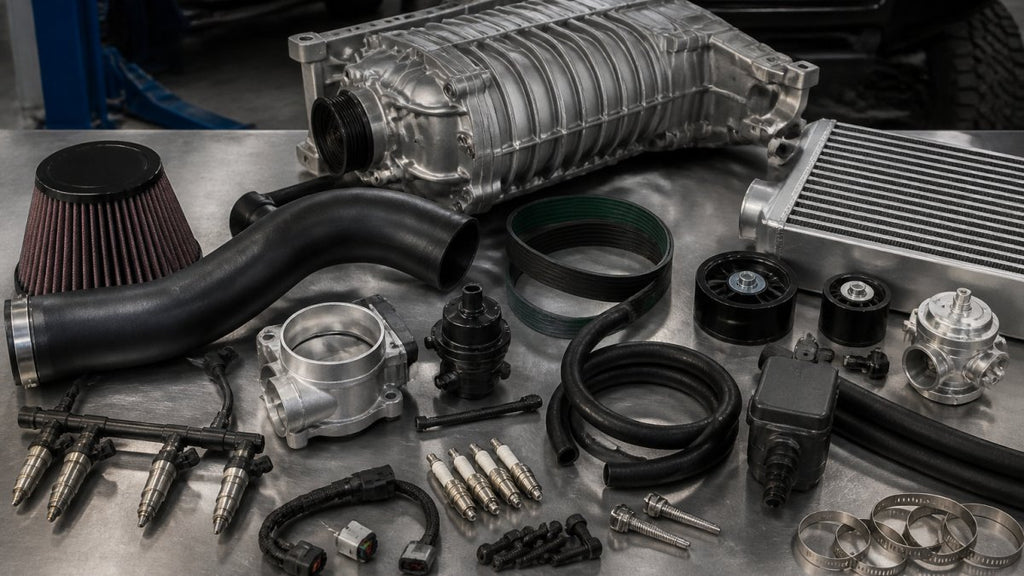
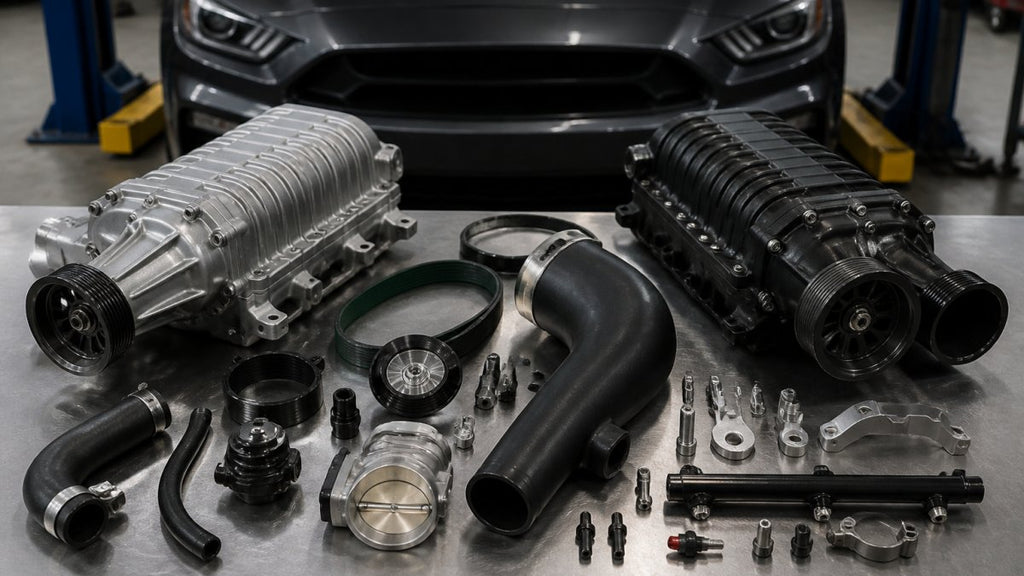
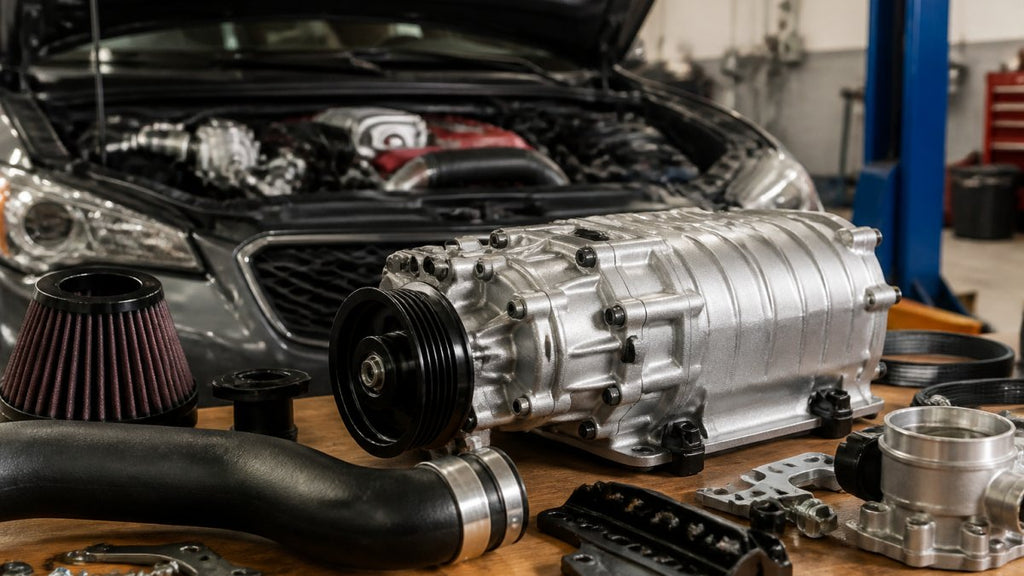
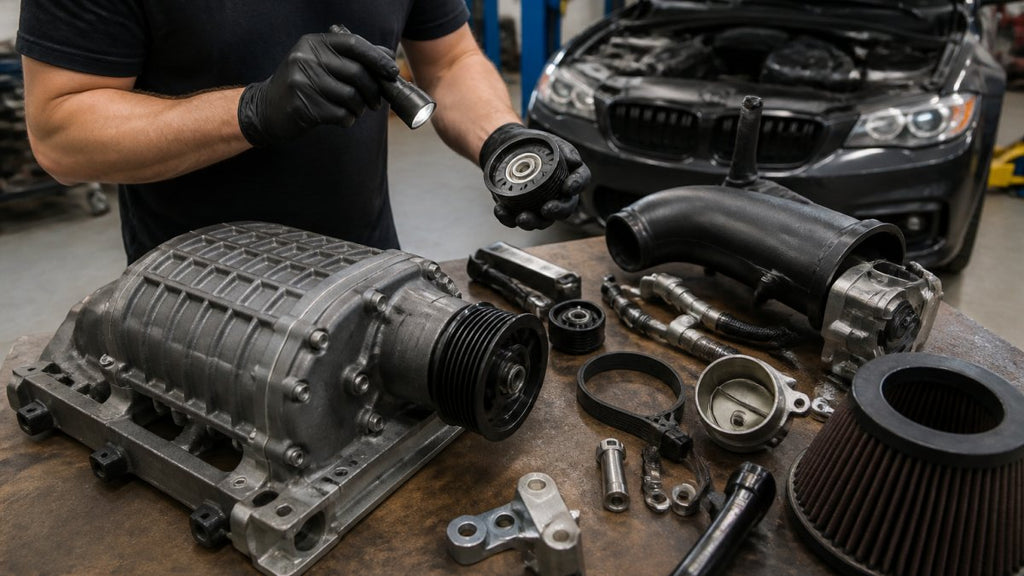
For truck owners who want a supercharger's instant torque without a custom build, bolt-on kits are the practical path. VT Superchargers builds kits with OEM-style fitment, so installation doesn't require cutting panels or splicing factory wiring. The table below covers what's available and what each kit costs.
| Kit | Price | Platform | Key Gains |
|---|---|---|---|
| Toyota Tacoma 2.7L Supercharger Kit with PnP ECU | $4,900.00 | 2TR-FE | +50% hp, +40% torque |
| Suzuki Jimny JB74 Turbocharger Kit | $5,450.00 | 1.5L NA | Up to 141 hp |
| Suzuki Jimny JB74 K15B Supercharger Kit | $5,700.00 | 1.5L K15B | +50% power, +40% torque |
| Toyota Tacoma 4.0L 1GR-FE Supercharger Kit | $6,000.00 | 1GR-FE V6 | +40-60% hp, +30-50% torque |
| Toyota Tacoma 3.5L V6 2GR-FKS Supercharger Kit | $6,000.00 | 2GR-FKS | +100 hp, +90 lb-ft |
Watch Out
A common mistake is ordering a kit without confirming your exact engine code and model year first. A 2.7L and a 3.5L Tacoma take completely different kits, and the wrong one won't bolt up. Confirm fitment with the manufacturer before you buy.
How Forced Induction Affects Engine Longevity
Forced induction affects engine longevity mainly through heat, cylinder pressure, and tuning quality, not the mere presence of boost. A well-engineered kit running correct air-fuel ratios and proper cooling can hold up for years; a poorly tuned one pushing too much boost on stock fuel and cooling will shorten engine life.
Suzuki Jimny JB74 1.5L Turbocharger Kit →


Three factors decide which outcome you get:
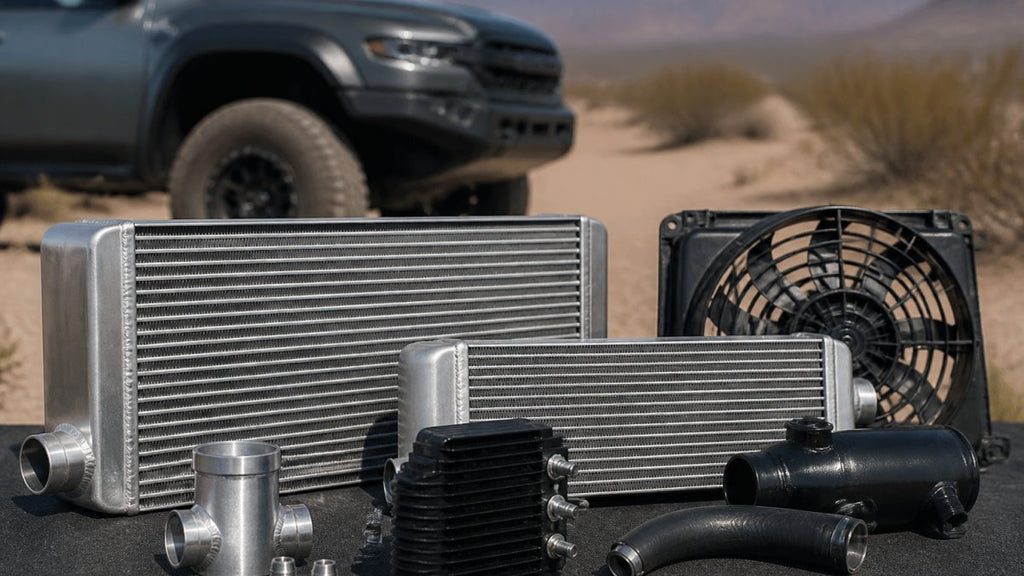
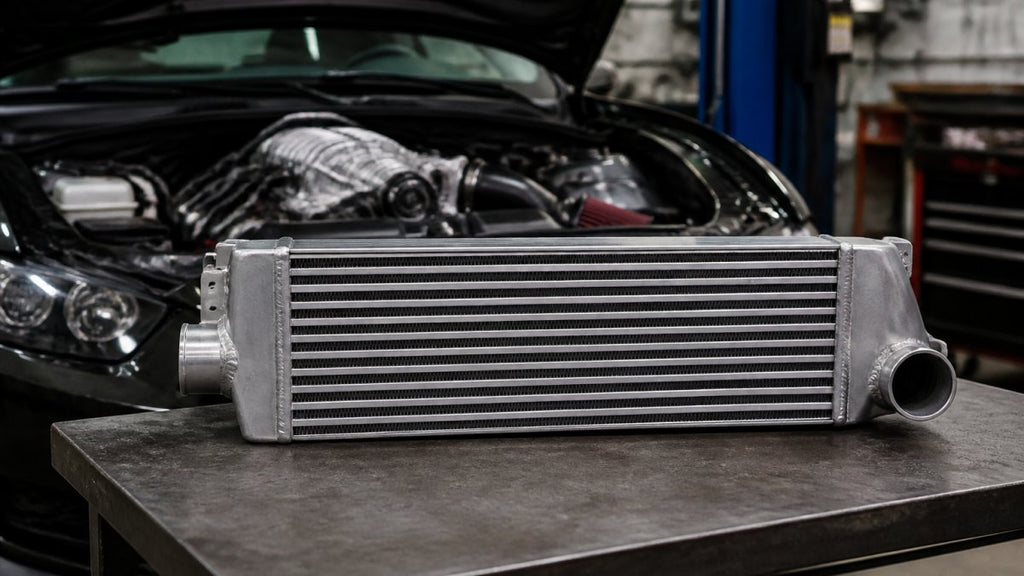
- Cooling capacity. Intercoolers and charge coolers keep intake temperatures down, which protects pistons and prevents heat soak under sustained load.
- Air-fuel ratio control. Running lean under boost is the fastest way to damage an engine. A properly calibrated ECU keeps the mixture safe.
- Boost level. More boost means more cylinder pressure. Staying within the kit's designed psi keeps stress predictable.
Real-World MPG Scenarios for Towing Trucks
Real-world MPG for a towing truck depends on load, terrain, and how often you're into the boost. You can estimate the impact yourself with a simple framework rather than trusting a single advertised number.
Scenario 1: Unloaded Highway Commute
This is the turbo's home turf. At a steady 65-70 mph with no trailer, a turbocharged truck runs near its naturally aspirated efficiency because the turbo is barely spooled and the engine is in its sweet spot. A supercharged truck carries its constant parasitic tax here, so expect a small but repeatable penalty, often low single-digit percentages versus the same truck unboosted.
Scenario 2: City Stop-and-Go
Frequent throttle transitions expose the two systems' weaknesses differently. A positive-displacement supercharger delivers boost the instant you tip in, so every launch from a stop can pull a slug of fuel, but it avoids the downshift-and-spool cycle a laggy turbo forces. A turbo truck may look more efficient on paper yet burn more fuel in practice if the driver constantly waits for boost and the transmission hunts.
Scenario 3: Towing on Flat Highway
This is the scenario truck owners actually care about, and the one most articles skip. With a 6,000-8,000 lb trailer at steady 60-65 mph, both systems make moderate boost continuously. The turbo's light-load edge largely evaporates because it's now working, and the supercharger's parasitic draw is a smaller fraction of total fuel burn because total fuel burn is high.
Scenario 4: Towing Uphill and Into Headwinds
This is where the supercharger's instant torque can actually help real-world economy. On a long grade, a turbo truck may downshift repeatedly as boost builds and fades, and each downshift spikes rpm and fuel consumption. A supercharger holds boost linearly with rpm, so the transmission can stay in a higher gear and pull the load at lower rpm, offsetting the blower's parasitic loss.
A Simple Way to Estimate Your Own Numbers
Use this quick calculator method:
- Note your baseline highway MPG at your typical cruise speed, unloaded.
- Note your baseline towing MPG with your normal trailer.
- Ask how often you'll actually be under boost. Flat highway cruising at light throttle sees a small penalty; constant grades and headwinds see more.
- Weight the result by your real driving mix, a truck that tows 10% of the time and commutes 90% will average very differently than a dedicated tow rig.
A common pattern: the turbo wins the commute, the supercharger holds its own or wins the heavy tow, and the two are close on flat highway. Match the system to your actual driving cycle, not a spec sheet.
Frequently Asked Questions
Is a turbo or supercharger better for fuel economy?
It depends on how you drive. A turbocharger recovers exhaust gas energy that would otherwise be wasted, so at light, steady load it costs less fuel than a supercharger, which draws power from the crankshaft at all times. A supercharger's parasitic loss is most noticeable during highway cruising. In heavy towing, both systems run rich under boost and fuel economy drops for either one.
Do you get better MPG with a supercharger?
Not usually, and not in the way most drivers hope. A supercharger adds instant torque and sharper throttle response, but it also adds mechanical drag on the crankshaft. In a truck running a bolt-on kit like the Toyota Tacoma 3.5L V6 2GR-FKS Supercharger Kit, expect fuel economy to drop under load, especially while towing. Light-throttle highway driving sees the smallest penalty.
Do superchargers cause more parasitic loss than turbochargers?
Yes. A supercharger is driven by a belt off the crankshaft, so it consumes engine power to spin the compressor, even when you are not asking for boost. A turbocharger is driven by exhaust gas energy that would otherwise leave through the tailpipe, so it does not steal crankshaft power. That difference is the main reason turbos tend to hold fuel economy better at cruise.
Will a supercharger shorten my truck engine's life?
Not automatically. Longevity depends on boost pressure, air-fuel ratio, intercooling, and tuning quality. Kits with water-to-air intercooling and a calibrated piggyback ECU, such as the Toyota Tacoma 2.7L Supercharger Kit with PnP ECU, manage intake temperatures and fuel delivery to keep combustion stable. Skipping tuning or running excessive boost is what shortens engine life.
Related post
09
Oct
RECENT POSTS