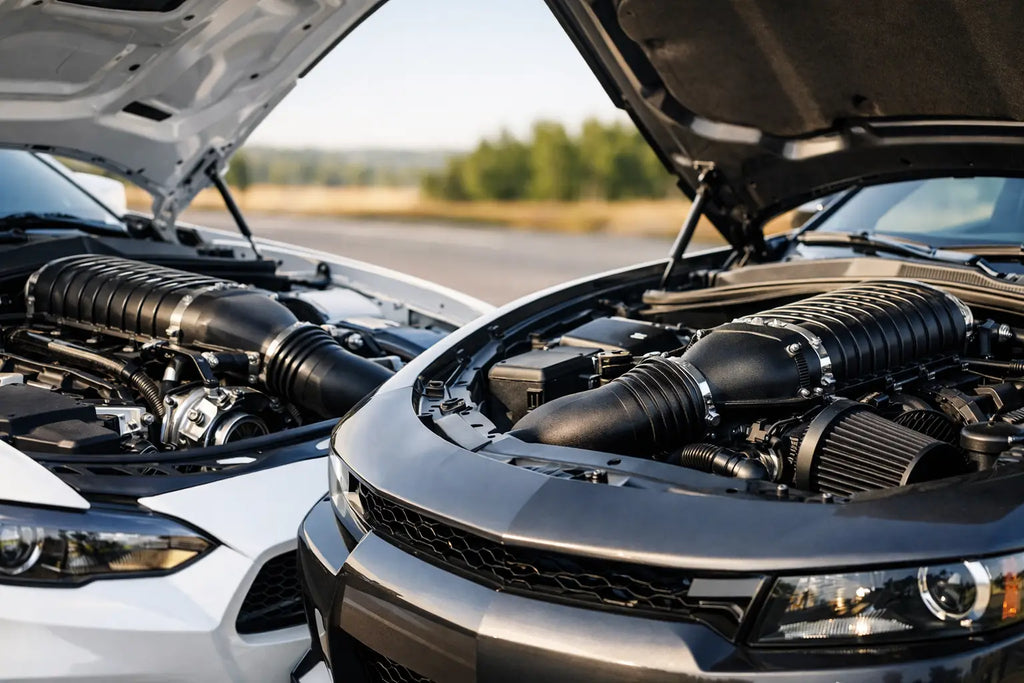
Best Daily Driver Supercharger Platforms
You bolt on 33s, load the bed with camping gear, add a steel bumper, and suddenly your truck feels like it lost a cylinder. Or maybe your Charger is fine around town but falls flat when you need to pass on a two-lane road. We see this all the time. The best daily driver supercharger platforms are not just the vehicles with the biggest dyno number. They are the ones that take added power without turning your normal commute, tow run, or trail weekend into a tuning project.
A good daily-driver setup should hit hard when you roll into the throttle, then settle down and behave in traffic. It should pull a grade without hunting between gears. It should not idle rough, surge in a parking lot, or make you nervous every time the temperature climbs. After installing hundreds of kits, that is what we care about most: power you can use every day.
What Makes a Supercharger Platform Good Every Day?
The right vehicle already has a solid engine, a transmission that can manage extra torque when driven responsibly, and enough room under the hood for a clean, vehicle-specific installation. But the real test happens from the driver's seat.
Does it pull hard from 2,000 rpm when the trailer is hooked up? Does it feel sharp when you merge onto the interstate? Can you run 87 or 91 octane as required by the calibration and expect the same clean behavior on a 95-degree afternoon? Those questions matter more than bragging rights.
One of the biggest complaints we hear is that a vehicle feels slower after the owner builds it. Bigger all-terrain tires, roof racks, recovery gear, skid plates, tools, and passengers all add up. A daily-driver supercharger makes sense when it restores the torque the vehicle lost and gives it more reserve without sacrificing OEM-like manners.
Best Daily Driver Supercharger Platforms for Real Use
Toyota Tacoma 3.5L V6
The third-generation Tacoma is one of the clearest answers to this question. Owners love the truck, but the factory 3.5L can feel sleepy off the line and flat in the middle of the rev range. Add 33-inch tires, a bed rack, rooftop tent, steel bumpers, and a full weekend of gear, and it starts working hard just to hold speed on a grade.
Most Tacoma owners do not need a race truck. They need the truck to stop downshifting every time the road points uphill. They want better response pulling into traffic, more confidence passing an RV, and enough torque to get moving with a small camper or utility trailer behind it.
A properly calibrated supercharger changes the character of the Tacoma without changing why people bought it. The truck feels more willing. You do not have to bury the pedal to get it to respond. That is a huge deal on a platform that often spends Monday commuting, Friday towing dirt bikes, and Saturday crawling forest roads.
Toyota 4Runner 4.0L V6
The 4Runner is built like it expects to outlive the owner, but nobody buys one because it is fast. Once it gets 33s, armor, a drawer system, and a fridge in the back, the 4.0L V6 can feel especially lazy at highway speed. Altitude makes it worse. Drive a loaded 4Runner through Colorado, Utah, or the mountain West and you know exactly what I mean.
We see this all the time with overland builds. The owner has spent money making the rig capable, comfortable, and self-sufficient. Then the added weight turns every mountain pass into a full-throttle event. A supercharger brings back the low- and midrange pull that makes the truck enjoyable again.
The 4Runner is one of the best daily driver supercharger platforms because it rewards usable torque. You are not constantly chasing top-end power. You are rolling into the throttle at 45 mph, climbing a grade with the family aboard, or getting past slow traffic before the passing lane disappears. Clean tuning and correct installation are everything here. The goal is a stronger 4Runner that still starts, idles, and drives like a 4Runner should.
Jeep Gladiator 3.6L Pentastar
The Gladiator looks great on 35s. It also gets noticeably heavier and slower on 35s. Throw in a winch bumper, bed rack, tent, and a couple of passengers, and the factory Pentastar has to work for every bit of speed. One of the biggest complaints we hear from Gladiator owners is weak midrange torque, especially when towing or climbing at elevation.
The good news is that this platform responds well to added, controlled boost because it needs help where real drivers live. A daily-driven Gladiator does not need to scream at redline. It needs to leave a stoplight without feeling loaded down, hold a gear on an incline, and tow a small trailer without making the driver constantly manage the throttle.
A proper kit also beats a pile of random parts. We have seen owners try to solve the problem with exhaust, intake, throttle boosters, and aggressive gearing plans, only to still want more pulling power. Those parts may change the feel a little. A supercharger adds the actual torque that the big tires and extra weight took away.
Dodge Charger and Challenger 5.7L HEMI
For the guy who wants a fast street car but still needs a back seat, trunk space, air conditioning, and decent road manners, the 5.7L HEMI Charger and Challenger are hard to ignore. These cars already have the right attitude, but a naturally aspirated 5.7 can feel like it wants more once you are used to it.
This is where people get carried away chasing peak horsepower. For a daily driver, the better move is a conservative, proven package with a calibration that behaves in stop-and-go traffic. You want instant shove when you squeeze into a gap on the freeway, not a temperamental car that hates hot starts or fouls plugs after a week of short trips.
After installing hundreds of kits, I can tell you that the best street cars are the ones that do not make their owners babysit them. The Charger and Challenger platform can deliver serious power while staying comfortable enough for a long drive. Keep the maintenance current, use the fuel the tune calls for, and do not treat every red light like a starting line.
Nissan Frontier 3.8L V6
The newer Frontier is a solid, straightforward truck with a strong personality, but owners who tow side-by-sides, run 32s or 33s, or live in hilly country still ask for more punch. The truck has the right size for daily duty, and that is why additional torque matters so much. It is not a full-size truck with a giant engine to lean on.
A well-matched supercharger setup gives the Frontier the response owners expect when the truck is loaded. It can make freeway merging less dramatic, improve passing confidence, and help the vehicle feel less strained with gear in the bed. For a midsize truck used as both transportation and weekend equipment, that is the kind of power increase that earns its keep.
Mazda3 and Other Lightweight Street Platforms
Not every good supercharger daily driver is a truck or SUV. A Mazda3 is a great example of a platform where modest added power can completely change the driving experience. These cars are light, practical, and fun, but owners often want stronger acceleration without giving up the refined feel that makes them easy to live with.
On a lighter car, throttle response matters even more than a huge peak number. You want the car to feel awake when you pull away from a light or accelerate onto a highway. The right setup should preserve smooth part-throttle driving, predictable fueling, and the kind of reliability that lets you hand the keys to your spouse without giving a speech first.
The Kit Is Only Half the Job
Here is the part nobody wants to hear after looking at horsepower charts: the platform is only as good as the installation and tune. A clean, vehicle-specific kit with proper belt alignment, correct fueling, sound charge-air cooling, and a calibration built for that application is what separates a daily driver from a headache.
Do not buy based on the biggest advertised number alone. Ask whether the kit is made for your exact engine and model year. Ask what fuel it requires. Be honest about your tires, towing load, elevation, and how you drive. If you have a 4Runner on 33s that sees Moab and mountain passes, your needs are different from a Charger that gets driven 20 miles to work every day.
VT Superchargers focuses on that real-world fitment because the goal is simple: bolt it on, floor it when you need it, and drive it home without drama. Use a qualified installer if the job is beyond your tools or comfort level, follow the tuning and maintenance requirements, and give the vehicle the same respect you did before it made more power.
The best platform for you is the one that fixes the complaint you feel every time you drive it. If your Tacoma hunts gears with a trailer, your 4Runner hates mountain passes, your Gladiator feels buried under 35s, or your Charger needs more shove in the middle, choose the setup that makes the vehicle feel right again - not just loud on the internet.
Related post
09
Oct
RECENT POSTS