How to Extend Supercharged Engine Life: 7 Proven Steps
Table of Contents
- Step 1: Start With a Healthy Base Engine
- Step 2: Build a Supercharger Maintenance Schedule
- Step 3: Pick the Best Oil for Supercharged Engines
- Step 4: Control Heat Soak and Cooling System Health
- Step 5: Manage Air-Fuel Ratio and Tuning
- Step 6: Maintain the Intake, PCV, and Belt Systems
- Step 7: Use Oil Analysis and Diagnostics to Catch Problems Early
- How Much Horsepower Do Superchargers Add (and What It Costs in Wear)
- Frequently Asked Questions
Last Updated: September 13, 2026
Step 1: Start With a Healthy Base Engine
Forced induction multiplies existing weaknesses. A compression test and leak-down test tell you whether the base engine can handle boost, skipping this is the fastest way to cut supercharged engine life short and turn a running engine into a paperweight.
Compression testing measures how well each cylinder seals; leak-down testing pressurizes each cylinder and measures where air escapes, past the rings, intake valves, or exhaust valves. Together they reveal worn rings, burned valves, and head gasket problems that boost worsens.
Compression and Leak-Down Testing Before Boost
Run both tests on a warm engine, and write down the numbers for every cylinder. Consistent readings across all cylinders matter more than the absolute number. A single cylinder reading noticeably lower than the rest points to a problem that needs fixing first. According to SAE International's engine testing standards, cylinder-to-cylinder variation is one of the most reliable indicators of internal wear.
Why High-Mileage Engines Need Extra Scrutiny
High-mileage engines deserve a harder look because bearing load and thermal stress rise the moment boost arrives. A strong-running 120,000-mile engine isn't automatically boost-ready: valve seals, timing chain tensioners, and ring lands all age, and boost accelerates every failure mode.
Watch Out
Never boost an engine that failed a leak-down test, even slightly. A leaking cylinder that runs fine naturally will often fail catastrophically under boost within a few thousand miles.
Step 2: Build a Supercharger Maintenance Schedule
A supercharger maintenance schedule is a written, mileage-based plan covering belts, pulleys, fluids, and inspection points. Most owners never build one, which is why so many supercharged engines die young. Tier it by boost level: a 6 psi daily driver and a 14 psi track car don't wear components at the same rate.
Why Boost Level Changes Every Interval
Boost pressure is the biggest variable in how fast a supercharged engine consumes consumables. Higher boost means higher intake air temperature, cylinder pressure, blow-by, and belt and bearing load. A stock-pulley schedule will destroy a high-boost setup; a track-car schedule wastes money on a commuter.
A practical way to tier it:
- Low boost (roughly 6-8 psi, stock pulley, daily driven): use the longer end of every interval below.
- Mid boost (roughly 9-12 psi, aftermarket pulley, mixed driving): use the shorter end, and shorten oil changes by about 25 percent.
- High boost (13 psi and up, track or towing use): halve the oil interval, inspect the belt at every oil change, and log boost and intake air temperature on every drive.
Belt, Pulley, and Fluid Intervals
Track these items on a simple spreadsheet or logbook:
| Component | Typical Interval | What to Check | Failure If Ignored |
|---|---|---|---|
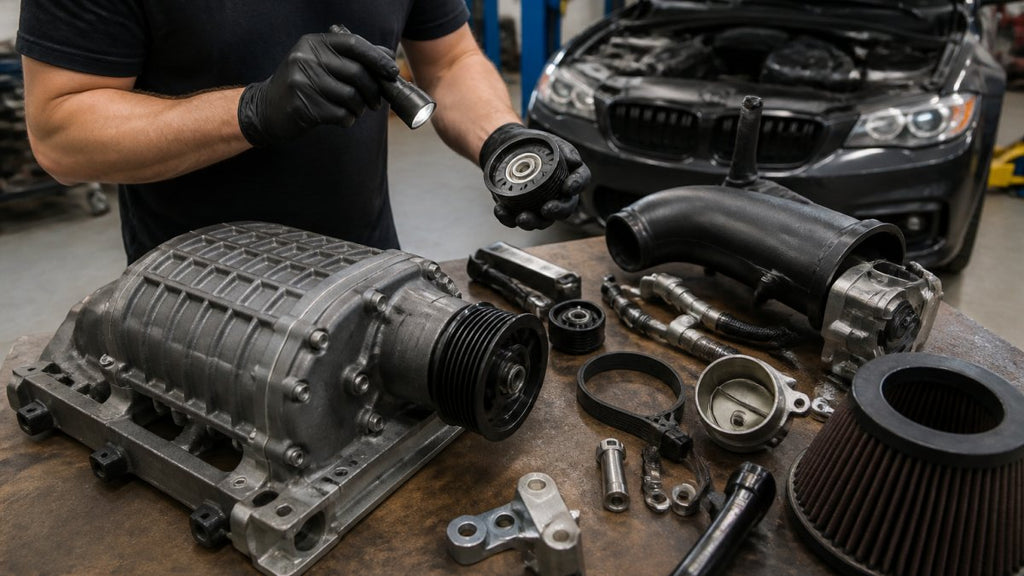
| Supercharger belt | Every 30,000-50,000 miles (low boost); 15,000-25,000 (high boost) | Cracking, glazing, tension, rib wear | Belt shreds at speed, takes out accessory drive |
| Supercharger oil (self-contained units) | Every 50,000-100,000 miles, or per kit maker | Level, color, metal particles, smell | Bearing and gear wear inside the blower |
| Pulley and tensioner | Every belt change | Bearing play, alignment, runout | Belt misalignment, chronic squeal, thrown belt |
| Intake filter | Every 15,000-30,000 miles | Dust loading, tears, oil soak from PCV | Restricted airflow, supercharger overspins to hit target boost |
| Coolant (air-to-liquid intercooler) | Per manufacturer interval, or every 2-3 years | Level, color, pH, contamination | Heat soak, timing pull, detonation risk |
| Spark plugs | Every 30,000-60,000 miles on boosted engines | Gap erosion, heat range, insulator color | Pre-ignition, misfire under load |
Exact intervals depend on boost level and driving style: a moderate-boost daily driver can stretch them, while a high-boost track car needs everything checked far more often. VT Superchargers builds bolt-on kits with OEM-style fitment, and pulley sizing directly affects how hard the belt and bearings work, log every change from day one.
Diagnostic Triggers That Override the Schedule
Mileage intervals are a floor, not a ceiling. Inspect early if any of these appear:
- Squealing or chirping at cold start: belt glazing or a failing tensioner bearing.
- Boost gauge reads lower than normal at the same RPM: belt slip, a boost leak, or a clogged filter.
- Intake air temperature climbing faster than usual: intercooler coolant degradation or a heat-soak problem.
- Oil consumption rising between changes: blow-by is increasing, and the PCV system needs attention.
- Any new knock or timing pull in the log: stop and diagnose before the next hard pull.
Pro Tip
Photograph your belt and pulleys at every oil change. Comparing photos over time reveals slow wear that's invisible in a single glance.
Watch Out
A belt that fails at wide-open throttle can wrap around the crank pulley and take out the accessory drive, the water pump, and sometimes the hood liner. Treat every squeal as a warning, not an annoyance.
Logging That Actually Helps
A maintenance log is only useful if it captures conditions, not just dates. Record boost level, ambient temperature, and driving type (commute, tow, track) with each entry. Patterns emerge fast, belts that fail after every track weekend, oil that darkens on short trips, letting you move from reactive repairs to a schedule tuned to your use.
Step 3: Pick the Best Oil for Supercharged Engines
The best oil for supercharged engines is a full synthetic with the correct viscosity for your bearing clearances and boost level, changed more often than the factory naturally aspirated interval. Boost raises cylinder pressure, pushing more blow-by past the rings into the oil (sae.org).
Viscosity, Synthetic Base Stocks, and Oil Coolers
Synthetic base stocks resist thermal breakdown better than conventional oil, which matters because superchargers raise oil temperatures. Follow your engine builder's or kit manufacturer's viscosity recommendation: too thin risks bearing wear under load, too thick slows cold-start flow.
An oil cooler is one of the most underrated upgrades for a supercharged build: lower, more stable oil temperatures extend oil life and reduce thermal stress on bearings. If you tow or off-road, it's essential.
Step 4: Control Heat Soak and Cooling System Health
Heat soak is the buildup of underhood and intake temperatures after the engine stops moving air through the engine bay, and it's one of the biggest silent killers of supercharged power. A heat-soaked intake delivers hotter, less dense air, so the ECU pulls timing.
Intercooler, Coolant Flush, and Heat Soak Management
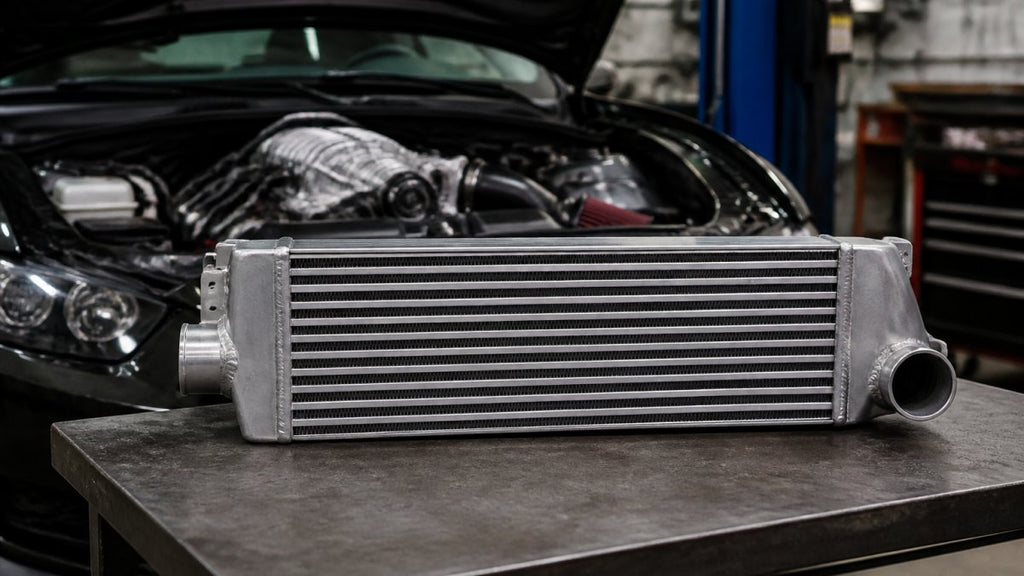
An intercooler lowers intake air temperature after compression, directly protecting against detonation. Air-to-air and air-to-liquid both work; the right choice depends on vehicle layout and use. A coolant flush at the manufacturer's interval keeps heat transfer efficient.
Practical heat soak management looks like this:
- Let the engine idle for a minute before shutdown after hard driving
- Park with the hood open after track sessions when practical
- Consider a vented hood or heat shield if underhood temps run high
- Avoid repeated full-throttle pulls in stop-and-go traffic
Step 5: Manage Air-Fuel Ratio and Tuning
Air-fuel ratio is the mass ratio of air to fuel entering the engine, and it's the single most important number to monitor on a supercharged build. Too lean under boost and detonation follows, cracking ring lands and melting pistons faster than almost any other failure mode.
Detonation, Spark Plug Heat Range, and ECU Tuning
ECU tuning adjusts fuel delivery and ignition timing to match your boost level: a proper tune richens the mixture under load and pulls timing where knock is likely. Spark plug heat range matters too, a colder plug dissipates heat faster and reduces pre-ignition risk. Running the stock heat range on high boost is a common, expensive mistake.
Key Takeaway
Air-fuel ratio monitoring isn't optional on a supercharged engine. A wideband gauge and a proper tune are the two cheapest insurance policies you can buy.
Step 6: Maintain the Intake, PCV, and Belt Systems
The intake system, PCV system, and supercharger belt form the mechanical chain that feeds and drives your boost, and each fails in its own way. Blow-by is combustion gas escaping past the rings into the crankcase; a healthy PCV system routes it back into the intake to be burned rather than letting pressure build.
Blow-By, Air Filters, and Supercharger Belt Replacement
Boost increases blow-by, so PCV maintenance matters more on a supercharged engine than a naturally aspirated one. A clogged PCV valve lets crankcase pressure build, pushing oil past seals and into the intake. Check it at every oil change and replace it at your manual's interval.
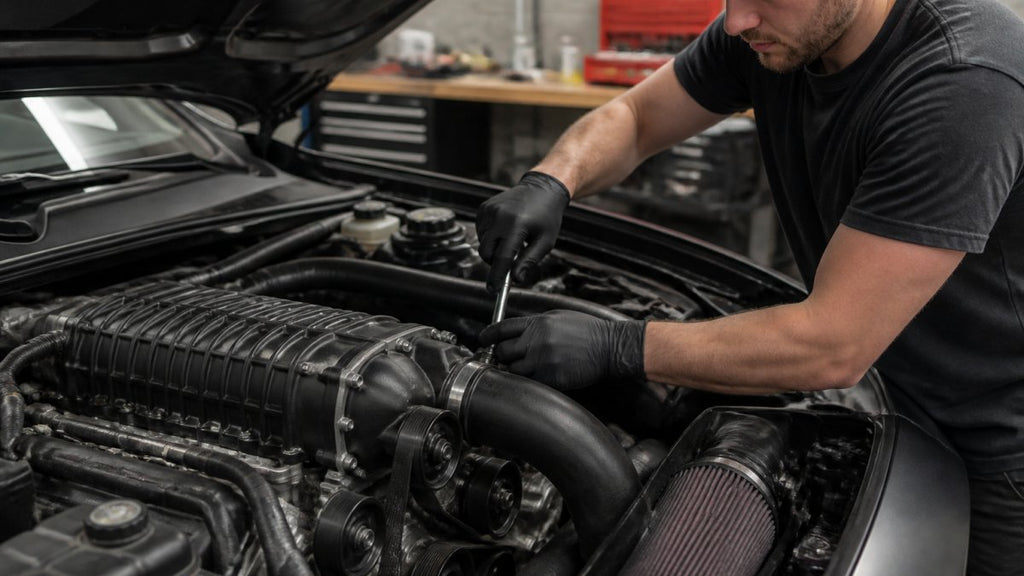
Air filter health is equally simple: a dirty filter restricts airflow and forces the supercharger to work harder for the same boost. Supercharger belt replacement should follow the Step 2 interval, but inspect sooner if you hear squealing or see glazing, a belt that fails at speed can take out the accessory drive.
Step 7: Use Oil Analysis and Diagnostics to Catch Problems Early
Oil analysis, or UOA (used oil analysis), is a lab test measuring wear metals, fuel dilution, coolant contamination, and additive depletion in your used oil. It's the closest thing to a blood test for your engine, catching problems long before they become failures.
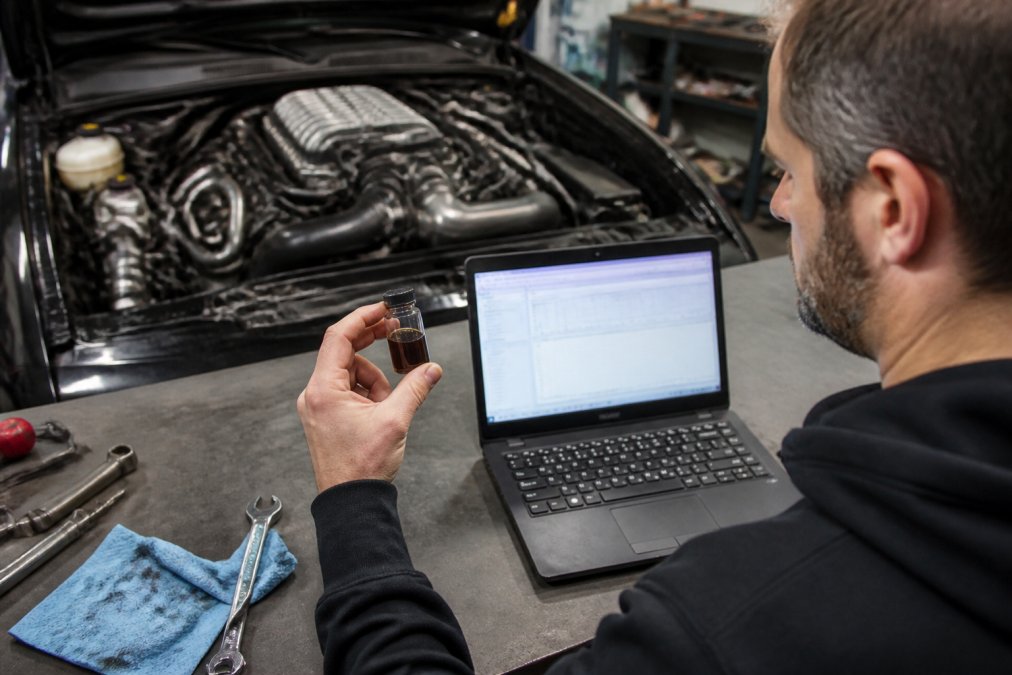
Send a sample at every oil change and track the trend, not the single result. Rising iron or copper points to bearing wear; fuel dilution to rich running or excessive blow-by; coolant traces to a head gasket issue. Combined with OBD-II diagnostics and a boost gauge, UOA gives a complete picture of engine health.
Pro Tip
Pull your oil sample mid-drain, not at the start. The first fluid out carries the most sediment and skews your wear-metal readings.
How Much Horsepower Do Superchargers Add (and What It Costs in Wear)
Superchargers add substantial horsepower and torque, with gains varying by kit, boost level, and engine. The trade-off is real: more power means more stress on bearings, pistons, and the drivetrain, and every component wears faster as boost rises. What most guides skip is the mechanism behind that wear, and that wear isn't linear with boost.
Where the Extra Power Comes From
A supercharger increases the mass of air entering the cylinders each intake stroke. More air means more fuel burned, and more fuel burned means more force on the piston during the power stroke. Volumetric efficiency, compression ratio, and boost pressure together determine how much extra power an engine makes and how much stress it absorbs.
A rough rule of thumb: every 1 psi of boost adds roughly 6-7 percent more power on a naturally aspirated engine of similar displacement, assuming the tune and fuel support it (sae.org). That's an approximation, not a guarantee, and it breaks down once the ECU must pull timing to stay safe.
The Wear Mechanisms Nobody Explains
Boost doesn't just add power. It changes the forces inside the engine:
- Cylinder pressure and ring lands: Higher cylinder pressure pushes the top ring harder against the ring land. Sustained detonation or pre-ignition cracks ring lands, and that is a rebuild, not a repair.
- Rod and main bearing load: The connecting rod sees a larger combustion force on every power stroke. Bearing fatigue is cumulative, which is why oil film strength and oil temperature matter more on a boosted engine than a naturally aspirated one.
- Heat rejection: More fuel burned means more heat into the pistons, valves, and oil. If the cooling system and oil cooler cannot keep up, oil temperature climbs, viscosity drops, and bearing protection falls.
- Blow-by and crankcase pressure: Higher cylinder pressure forces more combustion gas past the rings. That gas carries fuel, water, and acids into the oil, which is why PCV health and oil change frequency are not optional.
- Drivetrain and clutch: The engine is only half the story. A big boost jump can exceed what the stock clutch, transmission, and axles were designed for.
Why Wear Is Not Linear With Boost
Doubling boost doesn't double wear, it compounds it. Intake air temperature rises, the ECU pulls timing to avoid knock, combustion becomes less efficient, and the engine spends more time stressed. That's why a conservative boost level on a healthy engine can last years with diligent maintenance, while an aggressive setup on a tired engine rarely makes it past the first season.
The Tuning and Heat Angles That Actually Extend Life
Two things separate a supercharged engine that lasts from one that doesn't, and most guides miss both:
- Air-fuel ratio and ECU tuning. A proper tune richens the mixture under load and pulls timing where knock is likely. A wideband gauge and a data log are the cheapest insurance on a boosted build. Running lean under boost is the fastest path to a cracked piston.
- Heat soak management. After the engine stops moving air through the engine bay, intake and underhood temperatures climb. A heat-soaked intake delivers less dense air, the ECU compensates by pulling timing, and the engine runs hotter for the same power. Intercooler health, coolant condition, and airflow through the engine bay are what keep this in check.
Using Oil Analysis to Quantify Wear
Used oil analysis (UOA) turns the vague idea of "more wear" into a number you can track. Sample at every oil change and watch the trend:
- Rising iron: cylinder walls, rings, or valvetrain wear.
- Rising copper or lead: rod and main bearing wear, the classic boosted-engine failure mode.
- Fuel dilution: rich running, excessive blow-by, or short trips that never let the oil reach temperature.
- Coolant traces: a head gasket issue that boost will make worse.
A single UOA result is a snapshot; a trend across three or four changes tells you whether your boost level and maintenance schedule are sustainable.
Key Takeaway
Horsepower gains are easy to advertise and hard to live with. The number that matters long-term is not peak boost, it is whether your oil analysis trend stays flat. That is the real cost of wear, and it is measurable.
That's the throughline behind every step above: supercharged engine life is a maintenance discipline, not a single upgrade. VT Superchargers designs bolt-on kits with OEM-style fitment for makes including Dodge, Ford, Jeep, Mazda, Nissan, Suzuki, and Toyota, backed by a 24-month warranty and financing options. Pair a properly sized kit with the schedule in this guide, and you get the power you paid for without the rebuild bill.
Frequently Asked Questions
Does a supercharger reduce engine life?
A supercharger adds mechanical and thermal stress, so it can shorten engine life if you skip maintenance. Forced induction raises cylinder pressure, bearing load, and heat, which accelerates wear on rings, bearings, and head gaskets. With the right oil, cooling upgrades, tune, and a strict maintenance schedule, many supercharged engines run well past 150,000 miles. The deciding factor is usually maintenance discipline, not the blower itself.
Can you daily drive a vehicle with a supercharger?
Yes. Modern bolt-on kits from VT Superchargers are engineered for OEM-style fitment and daily driving, including towing and off-road use. The key is keeping boost pressure, air-fuel ratio, and oil temperatures in a safe range. Run a quality synthetic oil, watch coolant and intake air temps in traffic, and follow the supercharger maintenance schedule for belts, pulleys, and fluids. Daily-driven supercharged trucks routinely pass 200,000 miles when owners stay on top of these items.
What is the most important maintenance task for a supercharged engine?
Oil changes top the list. Forced induction raises oil temperature and shear stress, so the best oil for supercharged engines is a full synthetic with the right viscosity for your climate, changed every 3,000 to 5,000 miles. Next is the supercharger maintenance schedule: belt and pulley inspection, coolant flush intervals, and air filter service. Tuning and air-fuel ratio monitoring come third. Together, these three cover most failure modes.
Is it safe to supercharge a high-mileage engine?
It depends on the engine's condition, not just the odometer. A compression test and leak-down test reveal ring, valve, and head gasket health before you add boost. If those numbers are within spec, a bolt-on kit at modest boost can be safe on a 100,000-mile engine. If compression is uneven or leak-down is high, rebuild first. Oil analysis before and after install gives you a baseline to compare against.
Extending supercharged engine life comes down to discipline: test the base engine, build a maintenance schedule, and monitor the numbers that predict failure. VT Superchargers supports that approach with bolt-on kits built for precise, OEM-style fitment, a 24-month warranty, and worldwide shipping so you can keep your build running strong. Register with VT Superchargers today and get the fitment guidance and pulley options your specific vehicle needs.
Related post
RECENT POSTS