Supercharger vs Turbo Cost: 2026 Breakdown
Table of Contents
- Supercharger vs Turbo Cost: The Real Numbers
- How Mechanical Differences Affect Your Total Cost
- Supercharger Installation Labor Cost Breakdown
- Turbocharger Installation: Why Labor Costs More
- How Much Horsepower Do Superchargers Add vs Turbos
- Forced Induction Maintenance Costs Over 5 Years
- Total Cost of Ownership: Which System Pays Off
- Conclusion
- Frequently Asked Questions
Last Updated: September 1, 2026
Supercharger vs Turbo Cost: The Real Numbers
When deciding between forced induction options, the supercharger cost vs turbo cost analysis goes beyond sticker price. At VT Superchargers, we've helped thousands of enthusiasts understand what they're actually paying for, and what they'll pay later. The real difference emerges when you factor in installation labor, tuning, maintenance, and long-term reliability.

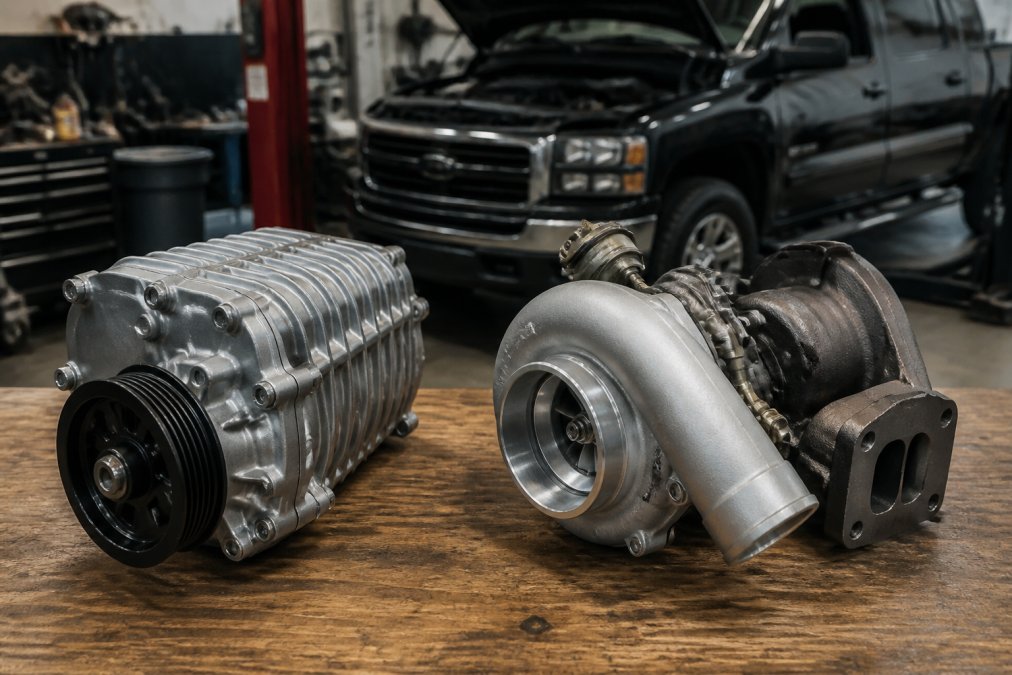
Superchargers are crankshaft-driven, bolted directly to your engine via belt. Turbochargers use exhaust gas energy to spin a turbine that compresses incoming air. That mechanical difference ripples through every line item on your invoice.
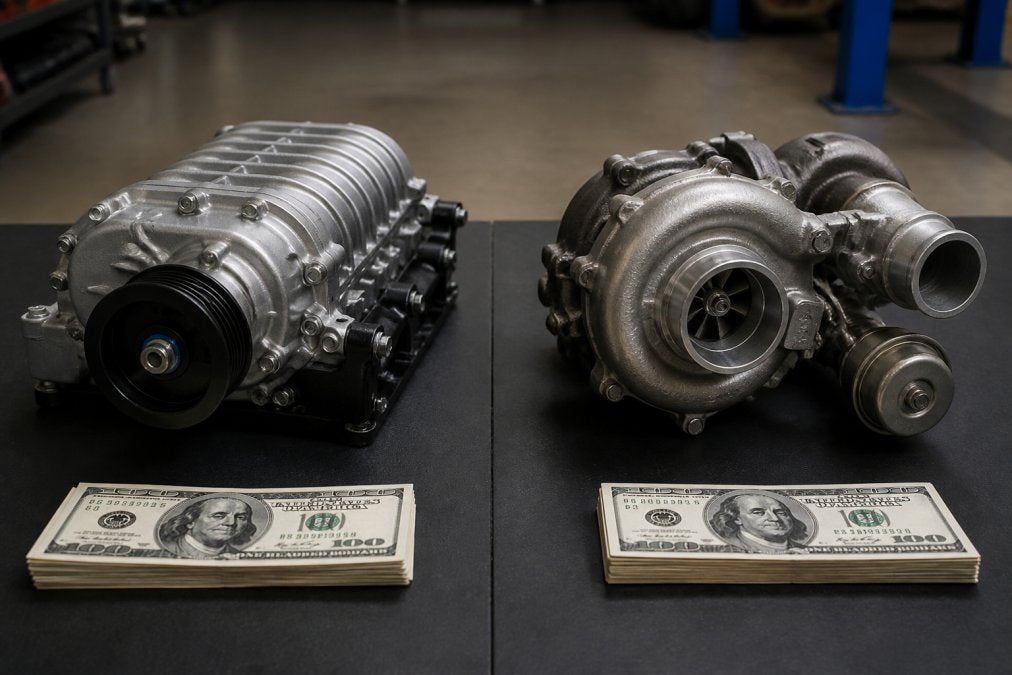
According to VT Superchargers' 2026 performance analysis, supercharger kits range from $4,600 to $7,500, while turbocharger systems cost similar amounts for the kit alone. But installation labor is where divergence happens: professional supercharger installation runs $2,000-$3,500 in 4-6 hours, while turbocharger installation costs $4,000-$6,000 or more, requiring 20-30 hours because the work involves exhaust manifold modifications, custom piping, intercooler plumbing, and extensive engine bay rework.
This guide breaks down every cost category so you can make a decision based on actual numbers.
How Mechanical Differences Affect Your Total Cost
The mechanical design of each system determines how much labor, fabrication, and supporting modifications you'll need.
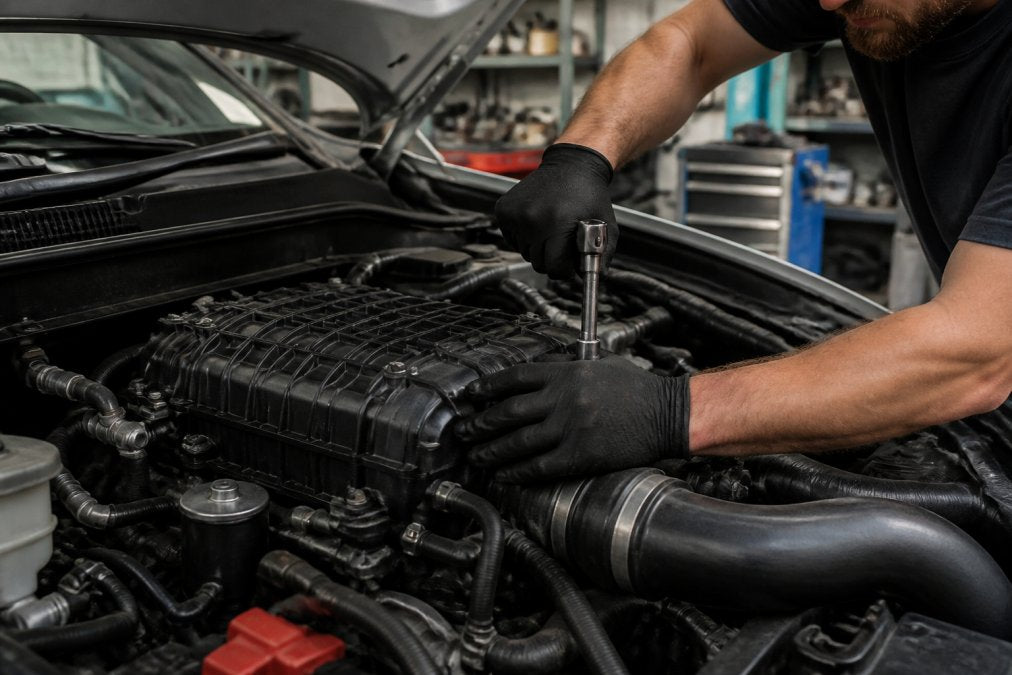
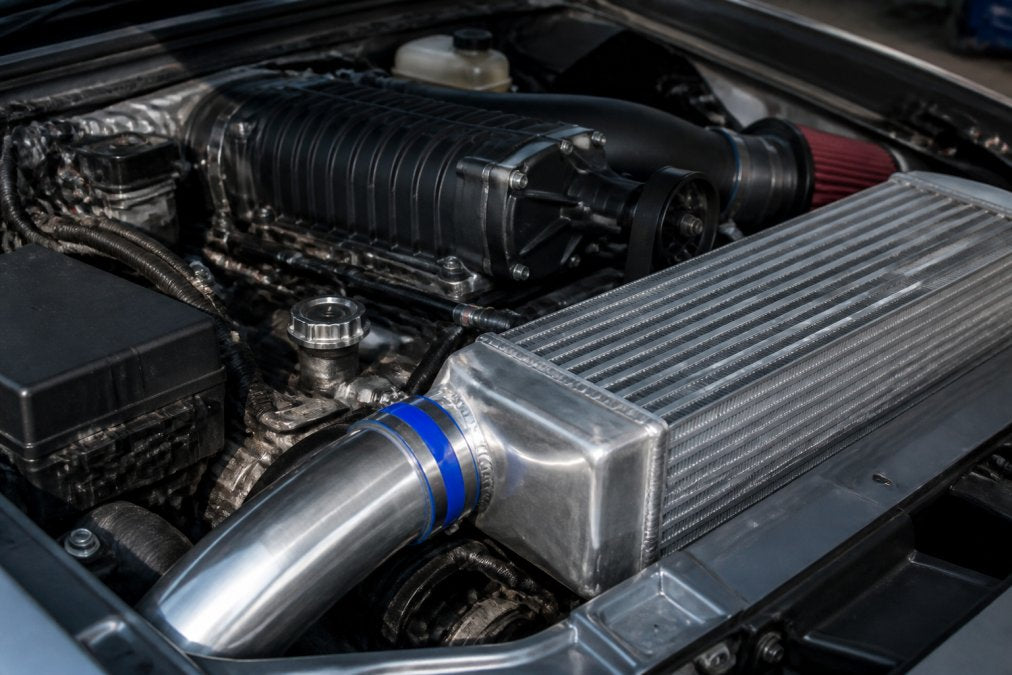
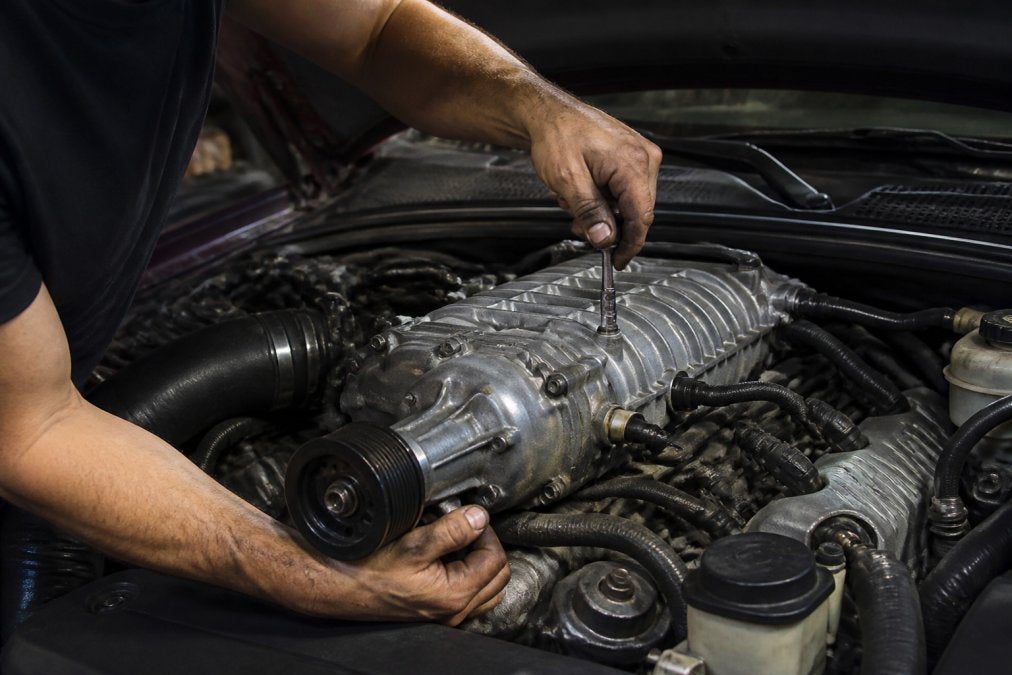
Superchargers mount directly to the engine block and connect to the crankshaft via belt and pulley. This direct coupling means no exhaust modifications, no complex piping, and no external turbine housings. The unit bolts on, you route the belt, connect the air inlet, and wire the boost control. Complexity stays low.
Turbochargers live in your exhaust manifold and require custom fabrication to integrate properly. Installation demands custom exhaust piping, a new manifold (often hand-fabricated), intercooler integration with custom hoses and fittings, wastegate plumbing, and blow-off valve installation. Your engine bay becomes a puzzle where every piece must fit around existing components.
For a bolt-on mentality where you want the upgrade installed cleanly without major engine bay surgery, superchargers align with that goal. For those chasing maximum efficiency and exhaust-heat recovery, turbos offer advantages that justify the complexity.
Supercharger Installation Labor Cost Breakdown
Professional supercharger installation typically costs $2,000-$3,500 and completes in 4-6 hours. Understanding the labor breakdown reveals where your money goes.
Professional Shop Installation
The installation sequence is straightforward: engine bay prep, supercharger unit installation, boost control wiring, intake ducting routing, fuel pressure regulator connection if needed, and final leak-down testing. Most shops charge $50-$100 per hour for forced induction work, so a 5-hour job lands in the $2,000-$3,500 range.
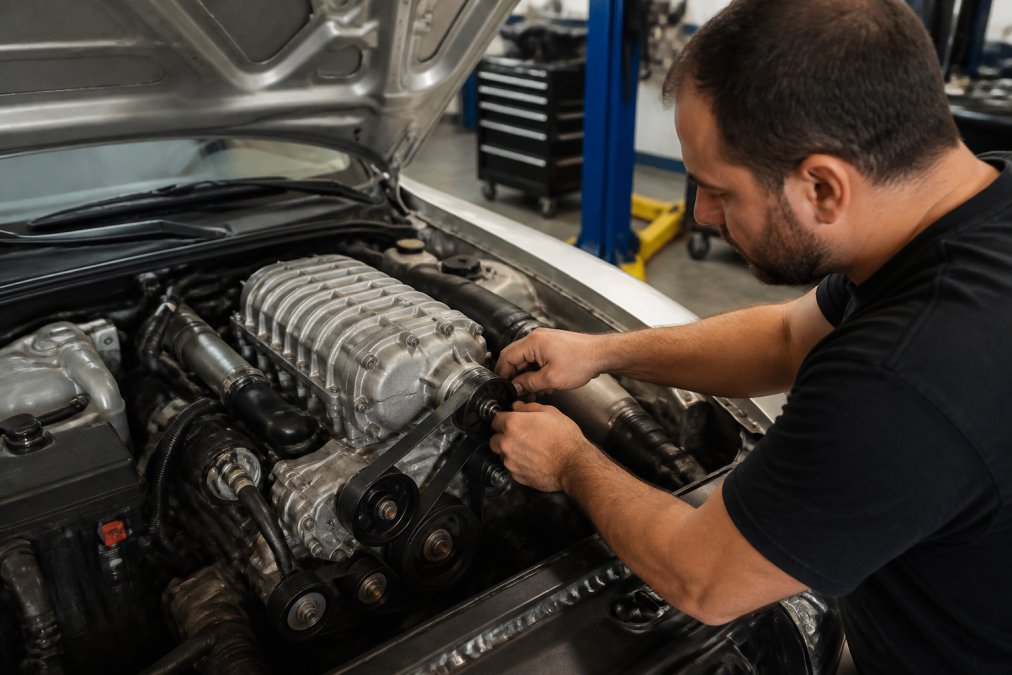
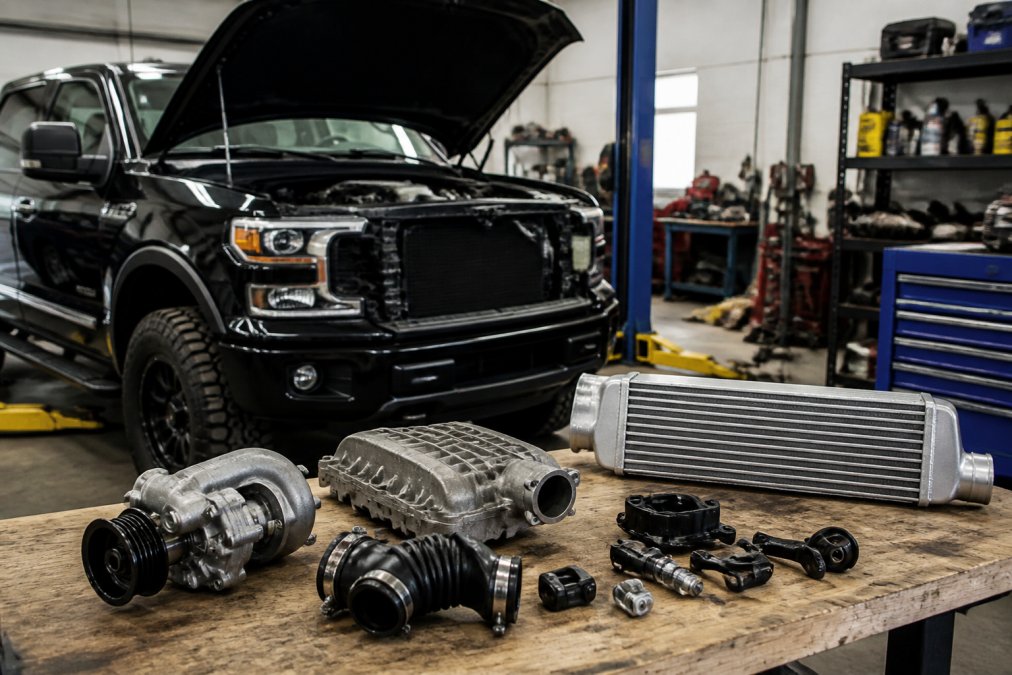
VT Superchargers kits are engineered for OEM-style fitment, meaning your installer doesn't need to fabricate custom brackets or modify engine bay components.
DIY Installation: Parts-Only vs. Professional Labor Savings
If you have mechanical experience and proper tools, DIY supercharger installation is feasible. The parts-only cost runs $4,600-$6,950 without labor. A DIY builder saves the entire $2,000-$3,500 labor bill, but this assumes you own basic hand tools, a torque wrench, a jack and jack stands, and diagnostic equipment. Even experienced mechanics typically spend 8-12 hours on a first installation.
The hidden cost of DIY is warranty risk. Professional installation from a certified shop typically includes a labor warranty (usually 12-24 months on workmanship), which protects you if a connection fails or boost control malfunctions. For a $5,000+ system, that protection is often worth the labor cost.
Supporting Modifications and Hidden Labor
Additional costs frequently emerge after the supercharger is bolted on. ECU tuning runs $400-$800 and requires 2-4 hours of dyno time. Upgraded fuel injectors or an intercooler add $500-$1,500 in parts and another 1-2 hours of labor. If your fuel system cannot support increased fuel demand under boost, a fuel pump upgrade ($300-$600) and 1-2 hours of labor become necessary.
These supporting modifications push your total installed cost into the $6,700-$11,250 range for a complete, professional installation on a daily driver.
Labor Cost Comparison: Supercharger vs. Turbocharger
Supercharger labor shines in predictability and speed. A 4-6 hour job at $50-$100 per hour is straightforward math. Turbocharger labor stretches to 20-30 hours because custom fabrication, exhaust manifold work, and intercooler plumbing cannot be rushed. This labor-hour gap is the single largest cost differentiator between the two systems.
Turbocharger Installation: Why Labor Costs More
Turbocharger installation runs $4,000-$6,000 or more, typically requiring 20-30 hours of labor. The complexity compounds at every stage.
Your technician must remove or fabricate a custom exhaust manifold, install the turbo housing, connect exhaust piping to the turbine inlet, and route the outlet to your exhaust system. Intercooler plumbing comes next: custom intake pipes, coolant lines, and hose routing to prevent heat soak. The wastegate and blow-off valve require vacuum lines, mechanical linkages, and precise calibration.
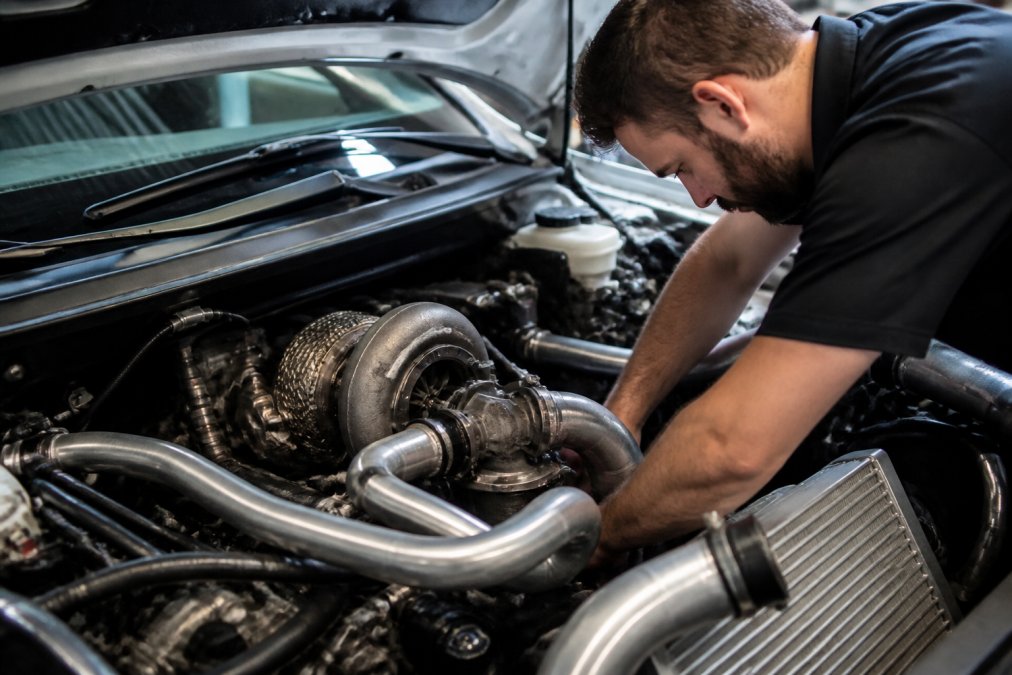
Oil and coolant lines must be run from the engine to the turbo and back. Your mechanic will install boost sensors, connect them to the ECU, and calibrate the wastegate for proper boost control. Every connection point is a potential leak, so pressure testing is mandatory.
Custom exhaust fabrication alone can consume 8-12 hours. Intercooler integration adds another 4-6 hours. Tuning and calibration require 3-5 hours of dyno time. There is no "bolt-on" path for turbos.
How Much Horsepower Do Superchargers Add vs Turbos
Both systems deliver real power gains, but the delivery characteristics differ.
Superchargers provide instant throttle response because the crankshaft drives the compressor directly. There's no lag; as soon as you press the accelerator, boost pressure rises. Power delivery is linear and continuous across the RPM range, which is why superchargers are favored for towing and off-road use where steady, available torque matters.
Turbochargers generate power more efficiently but introduce turbo lag, a slight delay between throttle input and boost pressure arriving. Modern turbos have minimized this lag significantly. Once the turbine spins up, boost pressure can exceed supercharger levels, delivering higher peak horsepower. Turbo power delivery is more aggressive and concentrated higher in the RPM band, which appeals to track enthusiasts.
A supercharger typically adds 40-60% more horsepower and torque to naturally aspirated engines (peer-reviewed research). A turbo can match or exceed those numbers, but the installation cost and complexity required is higher. The question isn't which adds more power, it's which power delivery profile and cost structure fits your use case.
Forced Induction Maintenance Costs Over 5 Years
Long-term ownership costs reveal where superchargers and turbos diverge most dramatically.
Routine Maintenance: Supercharger vs. Turbocharger
Superchargers have fewer moving parts and lower operating temperatures. The belt and pulley system requires periodic inspection and occasional replacement, typically every 60,000-80,000 miles (sae.org). Coolant systems stay standard. Oil changes remain at normal intervals. Over five years of typical driving (12,000-15,000 miles annually), maintenance costs stay predictable: belt replacement ($200-$400), standard service intervals, and occasional sensor diagnostics. Total five-year maintenance: $1,500-$3,000.
Turbochargers demand more attention. The turbine spins at extreme speeds (up to 150,000 RPM) and generates significant heat. Oil changes become more frequent, every 3,000-5,000 miles instead of 5,000-7,500, because turbo bearings depend on clean oil for lubrication and heat dissipation. Intercooler cleaning (every 20,000-30,000 miles), wastegate inspection, and boost sensor diagnostics add recurring costs. If a turbo bearing fails, a common failure mode under aggressive driving or poor maintenance, replacement costs $1,500-$3,000 and requires 8-12 hours of labor. Over five years, a turbo system typically costs $3,000-$6,000 in maintenance.
Resale Value Impact: A Hidden Cost Most Buyers Ignore
When you sell or trade in your vehicle, forced induction modifications affect its market value. A supercharger installation, especially a professional OEM-style kit with full documentation and warranty transfer, typically reduces resale value by 20-35% of the installed cost. If you spent $8,000 on a supercharger system, expect to recover $5,200-$6,400 of that investment when you sell. motorcycle performance parts.
Turbocharger installations typically recover only 10-25% of their installed cost at resale, a steeper loss. A buyer seeing a $15,000 turbo installation may worry about bearing longevity, oil change intervals, and future repair costs, and will discount the vehicle accordingly. You might recover only $1,500-$3,750 of that $15,000 investment.
This resale penalty is a real cost of ownership that most TCO calculations overlook. For a $8,000 supercharger system, that's a $2,400-$3,200 resale hit. For a $15,000 turbo system, that's a $3,750-$13,500 resale hit.
Emissions Compliance and Legal Compliance Costs
Many aftermarket supercharger and turbocharger kits are not California Air Resources Board (CARB) certified, meaning they cannot be legally installed in states with emissions testing requirements (California, New York, Massachusetts, and others) (arb.ca.gov). If you install a non-CARB-legal kit in a regulated state and fail an emissions test, you face costly options: remove the system entirely, purchase a CARB-certified alternative kit (often $1,000-$2,000 more expensive), or pay fines up to $2,500 per violation plus vehicle registration suspension.
CARB-certified supercharger and turbocharger kits cost 15-25% more than off-road-only alternatives. Additionally, some insurance companies charge higher premiums for vehicles with forced induction modifications, typically 5-15% more per year. Over five years, that's an extra $500-$1,500 in insurance costs.
Five-Year Total Cost of Ownership: Maintenance, Resale, and Compliance Combined
Supercharger (CARB-legal kit, professional installation):
- Kit (CARB-certified): $5,500-$8,500
- Installation labor: $2,000-$3,500
- Tuning and supporting mods: $900-$2,300
- Five-year maintenance: $1,500-$3,000
- Insurance premium increase (5 years): $500-$1,500
- Resale value loss (20-35% of installed cost): $2,400-$4,200
- Total five-year cost: $13,300-$23,000
- Effective cost per year: $2,660-$4,600
Turbocharger (CARB-legal kit, professional installation):
- Kit (CARB-certified): $5,500-$9,000
- Installation labor: $4,000-$6,000
- Tuning and supporting mods: $1,600-$3,700
- Five-year maintenance: $3,000-$6,000
- Insurance premium increase (5 years): $750-$2,000
- Resale value loss (10-25% of installed cost): $3,750-$11,250
- Total five-year cost: $18,600-$37,950
- Effective cost per year: $3,720-$7,590
For most daily drivers, the supercharger's lower maintenance burden and better resale value retention make it the more economical choice over five years. Turbochargers justify their expense only if you keep the vehicle longer than five years, drive it aggressively enough to recoup the power investment, or plan to rebuild the turbo system rather than sell the vehicle.
Total Cost of Ownership: Which System Pays Off
The real question isn't which system is cheaper upfront, it's which one costs less to own for the duration you'll keep the vehicle.
For a typical daily driver kept for five years, supercharger total cost of ownership breaks down as: kit ($4,600-$6,950), installation labor ($2,000-$3,500), tuning ($400-$800), supporting modifications ($500-$1,500), and five-year maintenance ($1,500-$3,000). Total: roughly $9,000-$16,000 all-in.
A turbocharger system follows this path: kit ($4,600-$7,500), installation labor ($4,000-$6,000), tuning ($600-$1,200), supporting modifications ($1,000-$2,500), and five-year maintenance ($3,000-$6,000). Total: roughly $13,200-$23,200 all-in.
For off-road use, towing, and daily driving where reliability and predictable power matter more than peak horsepower, superchargers deliver better TCO. For track-focused builds where maximum power justifies the complexity, turbos can make sense despite higher ownership costs.
VT Superchargers kits are engineered with TCO in mind. Our bolt-on design minimizes labor hours, our 24-month warranty covers defects, and our OEM-style fitment means supporting modifications stay minimal.
Conclusion
The supercharger cost vs turbo cost analysis reveals that superchargers win on installation labor, maintenance simplicity, and total cost of ownership for most drivers. Turbos offer peak power efficiency and exhaust-heat recovery, but at the expense of complexity, labor intensity, and long-term maintenance costs. If you're ready to add real power to your daily driver or off-road vehicle without the fabrication headaches, VT Superchargers delivers bolt-on kits with OEM-style fitment, a 24-month warranty, and financing options to fit your budget. Explore our supercharger kits engineered for your specific vehicle and see why thousands of enthusiasts trust us for reliable, affordable forced induction.
=== FAQ ANSWERS (audit these too, same rules) ===
[1] Q: Is it cheaper to get a turbo or supercharger installed? A: Superchargers are typically cheaper upfront. A complete supercharger system costs $6,700-$11,250 installed, including kit ($4,600-$6,950), labor ($2,000-$3,500), and supporting mods. Turbos often exceed this due to higher labor costs ($4,000-$6,000+) and more complex fabrication. However, long-term maintenance costs favor superchargers.
[2] Q: What is the downside of a supercharger? A: Superchargers consume engine power to operate (mechanical parasitic loss), reducing overall efficiency compared to turbos. They also generate heat, requiring intercooler upgrades on some builds. Upfront costs are higher than turbo kits alone, and they deliver boost instantly but lack the dramatic top-end power scaling turbos provide. Fuel economy typically drops 1-3 MPG depending on driving habits.
[3] Q: How much horsepower do superchargers add vs turbos? A: Horsepower gains depend on engine displacement and boost pressure. Most bolt-on supercharger kits deliver 40-100 additional horsepower on naturally aspirated engines. Turbos can produce similar or greater gains (50-150+ HP) but require more supporting mods and tuning. VT Superchargers kits deliver approximately 50% more power for the Suzuki Jimny and comparable gains across other vehicle platforms, with exact figures varying by engine size and configuration.
[4] Q: What are the hidden labor costs associated with forced induction upgrades? A: Beyond installation labor, budget for ECU tuning ($400-$800), intercooler or cooling upgrades ($500-$1,500), fuel system modifications, and exhaust work. Turbo installations require custom exhaust manifold fabrication and piping, often adding $1,000-$2,000 in labor. Superchargers are simpler bolt-on systems, typically requiring only tuning and minor supporting mods. Always confirm total labor hours and parts costs before committing.
Frequently Asked Questions
Is it cheaper to get a turbo or supercharger installed?
Superchargers are typically cheaper upfront. A complete supercharger system costs $6,700-$11,250 installed, including kit ($4,600-$6,950), labor ($2,000-$3,500), and supporting mods. Turbos often exceed this due to higher labor costs ($4,000-$6,000+) and more complex fabrication. However, long-term maintenance costs favor superchargers.
What is the downside of a supercharger?
Superchargers consume engine power to operate (mechanical parasitic loss), reducing overall efficiency compared to turbos. They also generate heat, requiring intercooler upgrades on some builds. Upfront costs are higher than turbo kits alone, and they deliver boost instantly but lack the dramatic top-end power scaling turbos provide. Fuel economy typically drops 1-3 MPG depending on driving habits.
How much horsepower do superchargers add vs turbos?
Horsepower gains depend on engine displacement and boost pressure. Most bolt-on supercharger kits deliver 40-100 additional horsepower on naturally aspirated engines. Turbos can produce similar or greater gains (50-150+ HP) but require more supporting mods and tuning. VT Superchargers kits deliver approximately 50% more power for the Suzuki Jimny and comparable gains across other vehicle platforms, with exact figures varying by engine size and configuration.
What are the hidden labor costs associated with forced induction upgrades?
Beyond installation labor, budget for ECU tuning ($400-$800), intercooler or cooling upgrades ($500-$1,500), fuel system modifications, and exhaust work. Turbo installations require custom exhaust manifold fabrication and piping, often adding $1,000-$2,000 in labor. Superchargers are simpler bolt-on systems, typically requiring only tuning and minor supporting mods. Always confirm total labor hours and parts costs before committing.
This article was written using GrandRanker
Related post
RECENT POSTS